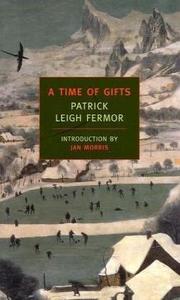
Start with A Time of Gifts. In December 1933, aged eighteen, Leigh Fermor set out to walk from the Hook of Holland to Constantinople with a rucksack, a copy of Horace and about a pound a week. He wrote the first volume of the account in 1977, more than forty years later, and that gap is the whole point: this is not a young man's travel diary but an old man reconstructing a vanished Europe from memory, notebooks and enormous reading.
Read it first because the trilogy is continuous — volume two begins mid-journey on a bridge over the Danube, literally in the middle of the crossing where volume one stops. There is no other sensible entry, and no reason to want one.
The walking trilogy
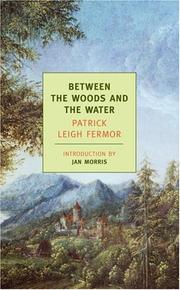
A Time of Gifts takes him through the Netherlands, Germany and Austria to the Slovak-Hungarian frontier. Between the Woods and the Water covers Hungary and Transylvania, and it is the warmest of the three — a summer of borrowed horses, country houses and aristocratic families who would lose everything within a decade. Many readers name it their favourite.
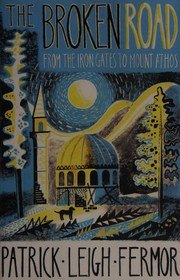
The Broken Road is the posthumous third volume, and it requires an honest caveat. Leigh Fermor worked on it for decades and never finished it; it was assembled after his death in 2011 by Artemis Cooper and Colin Thubron from an early draft and a later diary. It is unmistakably his prose, it contains superb passages on Bulgaria and the Black Sea coast, and it does not arrive properly at Constantinople. Read it knowing that it stops rather than concludes.
The honest warning about the prose
This is where readers divide, and the split is real. Leigh Fermor is a maximalist. A single sentence may run half a page. A castle glimpsed on a hillside can trigger four pages on Habsburg heraldry, or a digression into the etymology of a river name, or a reconstruction of a battle fought there in 1526. Some readers find this the greatest travel writing in English. Others find it exhausting and self-admiring, and that reaction is not unreasonable.
The test is the first thirty pages. If the density delights you, the whole shelf is waiting. If you are already skimming, stop — it does not get plainer.
The Greek books
Mani and Roumeli came earlier, in 1958 and 1966, and are the books he wrote at the height of his powers about the country he settled in. Mani is the better of the two: the Deep Mani peninsula in the southern Peloponnese, then almost roadless, its tower villages, blood feuds and funeral laments recorded by someone who spoke the language and stayed. Roumeli covers northern Greece and is looser and more anecdotal.
Read Mani after the first two walking volumes. It is a more disciplined book than either, and if the trilogy has convinced you, it will confirm the judgement.
The war book
Abducting a General is the account of the operation he is famous for outside literature: the kidnapping of a German divisional commander on occupied Crete in 1944 and the march across the mountains that followed. The volume includes his own postwar report and the wartime dispatches.
It is a different kind of writing — clipped, operational, much plainer. Read it for the events rather than the prose, and read it late, once you already care about him.
Where to stop, and the biography
The natural stopping point is the end of Between the Woods and the Water. Two complete volumes, a self-contained journey through the best of the writing, and no unfinished ending. Plenty of admirers never go further.
Patrick Leigh Fermor An Adventure by Artemis Cooper is the authorised biography, and it is genuinely useful because it establishes where the books compress, rearrange or improve on what actually happened. Read it last. Read it before the trilogy and you will spend the journey fact-checking rather than travelling.
More travel writing reading paths are on Discover.
Follow the full ordered path here: Patrick Leigh Fermor Reading Order: Where to Start.