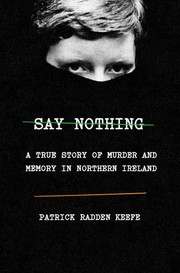
Start with Say Nothing. It is the shorter of the two big books at 536 pages, it is the more structurally elegant, and it teaches you how Patrick Radden Keefe works: take one unresolved thread — here, the 1972 abduction and disappearance of a Belfast widow — and use it to carry thirty years of a conflict without ever writing a conventional history of it.
The obvious alternative is Empire of Pain, on the Sackler family and OxyContin, which is the bigger and more consequential book. Read it second. At 720 pages it is denser with names, dates and corporate structures, and it goes down much more easily once you already trust the method.
This is a short path, and the reason is simple: there are only five books, published across roughly twenty years. Two of them are major, one is a collection, and two are early. There is no vast back catalogue to work through, which makes this one of the few author paths on this site you can genuinely finish in a couple of months.
Stage one: the two big ones
Say Nothing and Empire of Pain, four to five weeks for the pair. Both are dense with institutions and personnel, and about 40 pages a day is sustainable. Do not read either in short scattered sittings — the payoff in both depends on holding a large cast in mind across hundreds of pages, and picking one up for ten minutes a night defeats it.
Neither requires prior knowledge. Say Nothing assumes nothing about Northern Ireland; Empire of Pain assumes nothing about pharmaceuticals. Both have been the subject of legal pushback from people described in them, which is worth knowing as context rather than as a verdict on the reporting.
Stage two: the magazine work
Rogues, one to two weeks. Twelve New Yorker pieces, each self-contained at roughly magazine length: an arms dealer, a wine forger, a television chef, a Mexican cartel figure. One or two a sitting is ideal. Read it straight through and the pieces start to blur into a single tone, which is the one real weakness of the collection — the voice is consistent enough that twelve subjects can begin to sound like one.
This is also the best sampler if you are not sure you want to commit 1,250 pages to the two big books. Read three pieces and you will know.
Stage three: the early books
The snakehead and Chatter, about three weeks. Read The snakehead first. It is a 432-page account of a Chinatown smuggling network and the 1993 grounding of a ship carrying nearly three hundred migrants off New York, and it is both the better book and the closer ancestor of Say Nothing — the same technique, applied with less confidence.
Chatter, his first book, is about global electronic surveillance and was published in 2005. It is now partly dated by events, most obviously by what became public in 2013, and it should be read as a period document rather than as current reporting. It is the one book here that a reader can reasonably skip.
Where to stop
After Rogues. Say Nothing, Empire of Pain and Rogues are the working writer at full strength, and that is around 1,600 pages — plenty. The early books are for people who liked those three enough to want the origin story.
If this is the kind of reporting you want more of, David Grann and Erik Larson are the closest neighbours on this site.
Follow the full ordered path here: Patrick Radden Keefe Reading Order: Where to Start.