Mathematical physics is not a single subject but the collection of mathematical structures that theoretical physics depends on, from linear algebra and complex analysis to differential geometry and functional analysis. The challenge in learning it is that physics courses use these tools long before physicists study them rigorously. A good reading order fixes that, building the mathematics properly so the physics rests on solid ground.
The arc runs from the concrete and computational to the abstract and structural. Get comfortable with the workhorse methods first, then acquire the rigor and the geometry that modern theory demands.
Secure the algebra and calculus foundations
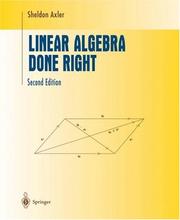
Linear Algebra Done Right by Sheldon Axler teaches the subject the way physicists eventually need it, structurally and without determinant-first crutches. Calculus on manifolds by Michael Spivak is the compact classic that generalizes calculus to the setting physics actually uses. Together they set the algebraic and analytic base.
Learn the working methods
Mathematics for physics by Michael Stone and Paul Goldbart is an excellent bridge, mathematically honest yet aimed at physicists. Mathematical methods for physicists by George Arfken and Hans Weber is the comprehensive method reference for special functions, transforms, and the rest. Complex Analysis by Lars Ahlfors provides the rigorous treatment of complex variables that underlies much of the toolkit.
Acquire geometry and analysis
Modern theoretical physics lives on geometry and analysis. Geometry, topology, and physics by Mikio Nakahara is the physicist's gateway to the geometric structures behind gauge theory and relativity, and A comprehensive introduction of differential geometry by Michael Spivak is the deeper source. For rigor, Functional Analysis by Walter Rudin and Methods of modern mathematical physics by Michael Reed and Barry Simon supply the operator theory that quantum mechanics truly requires.
Reach the structural summits
Mathematical methods of classical mechanics by V. I. Arnold reveals the geometric heart of mechanics itself, and Mirror symmetry by Kentaro Hori and coauthors opens the frontier where physics and geometry now meet. Both reward a reader who arrives with the earlier tools in hand.
Read in this order and the mathematics stops trailing the physics. Follow the full path to keep them aligned.
Follow the full reading path →
Ready to learn something deeply?
Build a reading path — free