Learn Arabic: script, dialects & a real plan
This curriculum takes a complete beginner from zero knowledge of Arabic all the way to confident reading and conversational ability, moving through four carefully sequenced stages. Each stage builds on the last: first mastering the script and sounds, then choosing a dialect path, then developing real grammar and vocabulary depth, and finally pursuing fluency through authentic materials and long-term strategy.
The Script & Sound System
BeginnerRead and write every Arabic letter in all its forms, understand short and long vowels, and produce Arabic sounds accurately — including sounds that don't exist in English.
▸ Study plan for this stage
Pace: 8–10 weeks total. Weeks 1–7: Work through Alif Baa at ~2 units/week (the book has 16 units), completing all audio drills, writing practice, and vocabulary in each unit before moving on. Weeks 8–10: Read The Arabic Alphabet by Awde cover-to-cover (~20–25 pages/day) as a consolidating reference, cross
- The Arabic abjad: 28 letters, right-to-left directionality, and the absence of capital letters
- The four positional forms of every letter (isolated, initial, medial, final) and which letters are 'sun' vs. 'moon' letters
- Short vowels (fatha, kasra, damma) and their diacritical marks (harakat), as introduced and drilled in Alif Baa
- Long vowels formed by the letters alif, waw, and ya, and how they contrast with their short counterparts in both sound and spelling
- The hamza and its various seats (alif, waw, ya, on the line), plus the special letter alif maqsura
- Emphatic (pharyngealized) consonants — ص ض ط ظ — and how they color surrounding vowels, as modeled in Alif Baa's audio
- Sounds with no English equivalent: the pharyngeals ع (ʿayn) and ح (ḥa), the uvular غ and خ, and the glottal hamza — all trained via Alif Baa's companion audio
- Shadda (gemination/consonant doubling) and sukun (vowel absence marker), and how they affect pronunciation and meaning
- Can you write any dictated Arabic word using the correct positional form of each letter, moving right to left without reversing letter order?
- Given a fully voweled (vowel-marked) Arabic word from Alif Baa, can you pronounce it accurately — including emphatic consonants and pharyngeal sounds — by applying the rules of harakat, shadda, and sukun?
- How does The Arabic Alphabet by Awde classify the connective behavior of letters, and which six letters connect only to the right (non-connectors)?
- What is the functional difference between a long vowel written with alif/waw/ya and a short vowel written with a diacritic, and how does each appear in a written word?
- How does the sun-letter rule (as described in Awde) affect the pronunciation of the definite article ال when it precedes different letters?
- What distinguishes the emphatic consonants from their plain counterparts in terms of articulation, and how does Alif Baa's audio help you hear and reproduce that distinction?
- Letter flashcard drill (Alif Baa–based): Make a physical or digital flashcard for each of the 28 letters showing all four positional forms. Quiz yourself daily — given the isolated form, write the other three from memory, and vice versa.
- Shadowing with Alif Baa audio: For every listening/pronunciation drill in Alif Baa, play the audio, pause, repeat aloud, then record yourself. Compare your recording to the native speaker and note discrepancies in emphatic or pharyngeal sounds.
- Positional-form tracing (Awde cross-reference): After finishing each Alif Baa unit, open The Arabic Alphabet by Awde to the corresponding letters and trace their forms in Awde's calligraphic examples, paying attention to stroke order and proportions.
- Dictation practice: Have a study partner (or use Alif Baa's audio tracks) dictate 10–15 fully voweled words per session. Write them out, then check spelling and diacritic placement letter by letter.
- Minimal-pair sound discrimination: Using vocabulary from Alif Baa, create lists of minimal pairs that differ only by an emphatic vs. plain consonant (e.g., سَيْف / صَيْف) or a short vs. long vowel. Drill them aloud until the distinction is automatic.
- Full-alphabet writing sprint: Once per week, write out the entire Arabic alphabet from memory in all four positional forms, then use Awde's reference charts to self-correct. Track your error rate each week to measure progress.
Next up: Mastering every letter's forms and the full sound system in this stage gives you the decoding and encoding foundation you need to begin absorbing Arabic vocabulary, basic grammar patterns, and sentence structure in the next stage — without being slowed down by uncertainty about how a word is read or written.

The single most widely used entry point for Arabic script in university programs worldwide. Its audio-integrated approach trains both reading and listening from day one, making it the ideal first book before anything else.
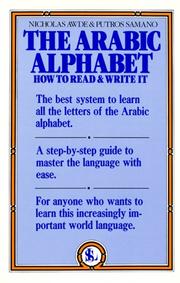
A slim, highly accessible companion that reinforces letter recognition and handwriting with clear visual breakdowns — perfect for consolidating what Alif Baa introduces before moving to grammar.
Understanding the Landscape — MSA vs. Dialects
BeginnerUnderstand the difference between Modern Standard Arabic and spoken dialects, make an informed personal choice about which path to pursue, and begin building foundational vocabulary and phrases in both registers.
▸ Study plan for this stage
Pace: 3–4 weeks, ~20–25 pages/day; Arabic for Dummies is approachable and conversational, so lighter daily reading paired with active practice keeps momentum without overwhelm. Aim to finish the book in ~3 weeks, leaving the final week for review and exercises.
- The diglossia situation in Arabic: the coexistence of Modern Standard Arabic (MSA/Fusha) and regional spoken dialects (Ammiyya) and why both exist
- The practical difference between MSA (used in media, literature, formal writing, and education) and dialects (used in everyday conversation, family, and street life)
- How to make an informed personal choice about which register to prioritize based on your goals (travel, business, religion, literature, media, etc.)
- The Arabic alphabet: the 28 letters, their four positional forms (isolated, initial, medial, final), and the direction of writing (right to left)
- Short and long vowels, the role of diacritics (harakat) in MSA, and why most adult Arabic text omits them
- Foundational survival vocabulary and phrases introduced in Arabic for Dummies: greetings, numbers, days, colors, and basic questions
- Pronunciation fundamentals unique to Arabic: emphatic consonants, the guttural sounds (ʿayn, ghayn, kha, ha), and the glottal stop (hamza)
- The concept of the Arabic root system (trilateral roots) as a preview of how Arabic vocabulary is built — a pattern to watch for going forward
- What is diglossia, and how does it specifically manifest in the Arabic-speaking world? Give two concrete examples of when a speaker would use MSA versus a dialect.
- Based on your personal goals for learning Arabic, which register (MSA or a specific dialect) makes the most sense to prioritize first, and why?
- Write out the Arabic alphabet from memory, identifying which letters cannot connect to the letter that follows them.
- What are the three short vowels in Arabic, what diacritical marks represent them, and how does their absence in most written text affect a reader?
- Demonstrate a basic greeting exchange in Arabic (as presented in Arabic for Dummies), using both the MSA and at least one dialectal variant if the book provides one.
- What is a trilateral root, and why is understanding this concept important for building Arabic vocabulary efficiently?
- Alphabet drilling: Using the letter tables in Arabic for Dummies, write each of the 28 letters in all four positional forms by hand every day for the first two weeks. Handwriting activates memory far more effectively than typing.
- Register comparison journal: Each day, pick one vocabulary word or phrase from Arabic for Dummies and research its MSA form versus one dialectal variant (e.g., Egyptian or Levantine). Keep a two-column notebook log to make the MSA/dialect contrast tangible and personal.
- Goal-setting essay: Write a one-page personal statement answering 'Why am I learning Arabic and which communities or contexts do I want to engage with?' Use this to make a concrete, written decision about your primary register — revisit it at the end of the stage.
- Pronunciation recording exercise: Use the phonetic guides in Arabic for Dummies to record yourself saying the greetings, numbers 1–10, and days of the week. Play back and compare to a native audio source (YouTube, Forvo). Note which sounds (ʿayn, kha, emphatics) need the most work.
- Flashcard deck build: Create a physical or digital (Anki) flashcard deck of the 50–75 core vocabulary words introduced in Arabic for Dummies. Each card should show: Arabic script (front), transliteration + English meaning + an example sentence (back). Review daily using spaced repetition.
- Root-spotting challenge: In the final week, flip through the vocabulary sections of Arabic for Dummies and try to identify at least 5 groups of words that share the same three-letter root (e.g., k-t-b: kataba/kitaab/maktab). Write them out and note the shared meaning thread — this previews the morphological logic of the entire language.
Next up: Completing this stage gives you a working mental map of the Arabic language landscape, a committed register choice, a solid alphabet foundation, and a starter vocabulary — the exact toolkit needed to begin structured grammar study and more systematic vocabulary acquisition in the next stage.

An unusually honest overview of the MSA-vs-dialect question written for self-learners. Reading this early helps the learner make a strategic decision about their goals before investing heavily in one path.
Core Grammar & Vocabulary — Building the Engine
IntermediateInternalize the core grammar of Modern Standard Arabic — the root-and-pattern system, verb conjugation, noun cases, and sentence structure — and build a working vocabulary of 1,000+ words.
▸ Study plan for this stage
Pace: 10–14 weeks total. Weeks 1–6: Work through "Arabic Verbs and Essentials of Grammar" chapter by chapter, ~8–12 pages/day, revisiting each chapter's paradigm tables until they feel automatic. Weeks 7–14: Shift to daily Hans Wehr sessions — learn 15–20 new root entries per day (~2–3 dictionary pages),
- The Arabic root-and-pattern (trilateral root) system: how three-consonant roots combine with vowel patterns (awzān) to generate entire word families (verb, noun, adjective, doer, place, instrument)
- Verb conjugation across all persons, genders, and numbers in the Perfect (māḍī) and Imperfect (muḍāriʿ) tenses, as presented in Wightwick's verb tables
- The ten derived verb forms (Forms I–X): their characteristic patterns, typical meanings, and how Wightwick distinguishes their uses (causative, reflexive, reciprocal, etc.)
- Noun and adjective inflection: the three grammatical cases (nominative, accusative, genitive) and how case endings signal grammatical role — a cornerstone of Wightwick's grammar chapters
- Definiteness and the iḍāfa (construct state / genitive chain): how two or more nouns link without a preposition to express possession or attribution
- Sentence structure: the verbal sentence (fiʿliyya) vs. the nominal sentence (ismiyya), and how word order and agreement rules differ between them per Wightwick
- Navigating Hans Wehr: reading a full root entry — understanding the ordering of derived forms, abbreviations, and how to extract meaning, part of speech, and plurals efficiently
- Vocabulary acquisition strategy: learning words in root families (not in isolation) so that one root entry in Wehr yields 5–10 related words simultaneously
- Given any Arabic verb in the perfect tense (3rd person masculine singular), can you produce its full conjugation table — perfect, imperfect, and imperative — for all persons, genders, and numbers, following Wightwick's paradigms?
- What does the verb form (e.g., Form II or Form V) tell you about a verb's probable meaning before you even look it up, and how does Wightwick's explanation of the derived forms help you make that prediction?
- How do case endings (ḍamma, fatḥa, kasra) change the grammatical role of a noun in a sentence, and how does the iḍāfa construction affect the case and definiteness of the nouns within it?
- When you encounter an unfamiliar Arabic word in a text, what is your step-by-step process for identifying its root and locating it in Hans Wehr — including how you handle weak roots or roots with ʾ/ʿ?
- What is the difference between a verbal sentence and a nominal sentence in Modern Standard Arabic, and what agreement rules govern the verb or predicate in each type?
- After 8+ weeks of daily Wehr study, can you recognize the root family of at least 1,000 words and use the dictionary to rapidly confirm meaning, plural form, and part of speech within 30 seconds per entry?
- Conjugation drilling with Wightwick's tables: Every day for the first six weeks, pick one verb from a chapter and write out its complete perfect and imperfect conjugation from memory, then check against the book's paradigm table. Rotate through sound verbs, then hollow, defective, and doubled verbs.
- Root-family mapping: After each Hans Wehr study session, take 5 roots and draw a 'word web' on paper — place the root in the center, then branch out to every derived word in that Wehr entry (verb forms, verbal nouns, active/passive participles, place nouns, adjectives). Write a short Arabic phrase using at least two words from the same root.
- Case-ending sentence rewriting: Write 10 simple Arabic sentences from Wightwick's examples, then deliberately change the grammatical role of one noun (e.g., make the subject the object) and rewrite the sentence with correct case endings. Say each sentence aloud to internalize the sound of the endings.
- Iḍāfa construction practice: Generate 20 iḍāfa phrases by combining nouns from your Wehr vocabulary lists. Check that the first noun (muḍāf) is indefinite and the second (muḍāf ilayhi) is in the genitive. Translate them back to English and then re-construct them from English the next day.
- Derived-form (Form I–X) identification drill: Take a page of any Modern Standard Arabic text (a news headline, a Quranic verse, a textbook sentence) and identify every verb. Write its root, its form number, and predict its meaning using Wightwick's form-meaning guidelines before checking Wehr.
- Weekly vocabulary self-test: At the end of each week of Wehr study, cover the English side of your root-family notes and attempt to give the meaning, plural, and one derived form for each root studied that week. Aim for 80%+ recall before moving on; re-study any root below that threshold.
Next up: Mastering Wightwick's grammar framework and building a 1,000-word root-based vocabulary from Wehr gives the reader the structural confidence and lexical density needed to begin engaging with authentic, unvoweled Modern Standard Arabic texts — the natural focus of an advanced reading and comprehension stage.

A concise, clearly organized reference that demystifies the Arabic verb system — the hardest part of the grammar for most learners. Reading this alongside Al-Kitaab dramatically accelerates pattern recognition.

The canonical Arabic-English dictionary, organized by root — using it actively at this stage trains the learner to think in the root-and-pattern system that is central to Arabic literacy.
Deepening Fluency — Reading, Speaking & Long-Term Strategy
ExpertEngage with authentic Arabic texts and media, develop a sustainable independent study practice, and build toward real conversational and reading fluency over the long term.
▸ Study plan for this stage
Pace: 4–5 weeks, ~20–25 pages/day — read actively with a notebook nearby; revisit key chapters on SRS and pronunciation as you build your personal Arabic learning system
- Spaced Repetition Systems (SRS): using tools like Anki to encode Arabic vocabulary, phrases, and grammar into long-term memory through optimally timed review
- Pronunciation-first learning: mastering Arabic phonemes (emphatic consonants, guttural sounds, long vs. short vowels) before drilling vocabulary so that every word is stored with accurate sound
- Minimal pairs training: using near-identical sounds in Arabic (e.g., ح vs. ه, ق vs. ك) to sharpen listening discrimination and speaking precision
- Image and sentence-based flashcards: avoiding translation-based cards in favor of cards that link Arabic words directly to images, emotions, or authentic example sentences
- Comprehensible input at the advanced level: seeking out authentic Arabic texts, podcasts, films, and news (MSA and a chosen dialect) that sit just above your current level (i+1)
- Building a personal frequency-based vocabulary list: prioritizing the most common Arabic words and collocations drawn from real corpora rather than textbook word lists
- Sustainable independent study habits: designing a daily routine that integrates reading, listening, speaking practice, and SRS review without burnout
- Long-term fluency strategy: setting measurable milestones (e.g., reading an Arabic newspaper article unaided, holding a 10-minute conversation) and iterating on your system over months and years
- How does Wyner's SRS methodology differ from traditional vocabulary memorization, and how can you apply it specifically to Arabic's root-and-pattern morphology?
- Why does Wyner insist on establishing correct pronunciation before building a vocabulary deck, and which Arabic sounds require the most targeted minimal-pairs work for your native language background?
- What makes a 'good' Anki card for an Arabic word or grammatical construction, according to Wyner's principles — and what makes a bad one?
- How would you construct a sustainable daily Arabic study schedule using Wyner's framework, balancing new input (reading/listening) with SRS review and active speaking practice?
- Which sources of authentic Arabic content (news, film, literature, podcasts) best serve the 'comprehensible input' principle at an advanced level, and how do you select material at the right difficulty?
- How do you measure progress toward conversational and reading fluency, and how does Wyner's system help you course-correct when motivation or retention dips?
- Build your Arabic Anki deck from scratch using Wyner's guidelines: create at least 50 cards that use images or authentic Arabic example sentences (sourced from Arabic websites or literature) instead of English translations — include audio recorded by a native speaker or sourced from Forvo.
- Conduct a personal Arabic phoneme audit: list every Arabic sound that does not exist in your native language, find minimal-pair audio examples for each, and create dedicated Anki cards that train your ear to distinguish them before you drill vocabulary.
- Select one authentic Arabic text per week (a news article from Al Jazeera, a short story excerpt, or a Wikipedia article in Arabic) and read it without a dictionary first — note unknown words, then add the top 10 most useful ones to your Anki deck using Wyner's image/sentence method.
- Design your personal 'Arabic fluency roadmap': write a one-page document that sets 3-month, 6-month, and 1-year milestones (e.g., reading a novel chapter, passing a CEFR benchmark, holding a conversation on a specific topic), and map out a realistic daily study schedule in 30–60 minute blocks.
- Watch one episode of an Arabic TV series or a YouTube channel in your target dialect per week — first without subtitles, then with Arabic subtitles — and mine it for 5–10 high-frequency phrases to add to your SRS deck with audio and a scene-based image.
- Find a language exchange partner or italki tutor for weekly 30-minute Arabic conversation sessions; before each session, prepare 10 target sentences using vocabulary from your Anki deck, and after each session log errors and add corrected forms back into your deck.
Next up: By internalizing Wyner's system for autonomous, data-driven language acquisition, you will have the tools and habits needed to sustain indefinite self-directed Arabic study — making you fully equipped to pursue any specialized domain (Classical Arabic texts, professional MSA, or a specific dialect) entirely on your own terms.

Not Arabic-specific, but the most practical guide to building a long-term language learning system using spaced repetition and immersion — essential reading for sustaining progress independently after formal study ends.
Discussion
Keep reading
Paths that share books, cover the same subject, or open a related topic.