Lead Poisoning: The Best Books on Flint, Lead and Public Health, in Order
Flint was not an accident of chemistry; it was the visible end of a century in which a known neurotoxin was defended, marketed and left in paint, petrol and pipes. This path starts with the crisis itself, told by the paediatrician who forced it into the open and by the reporter who traced the governance failure, then widens to the hundred-year industry history, then to the manufactured-doubt playbook that made the delay possible, and finally to the wider pattern of environmental harm falling on particular places. It is public-health history and policy, not household testing advice.
Flint, from the inside
BeginnerRead the two books that established the record, one from the whistleblower and one from the reporter.
▸ Study plan for this stage
Pace: Three weeks for the two books, 384 and 305 pages. Read Hanna-Attisha first and Clark second. What the Eyes Don't See is written by the paediatrician who ran the blood-lead analysis and went public — it is a participant's account and an advocacy book, not a neutral history, and it should be read as s
- The 2014 water-source switch and the absence of corrosion-control treatment as the specific technical failure
- Why blood-lead screening data, not water sampling, is what finally forced official acknowledgement
- Michigan's emergency-manager law and what it did to who could make decisions for the city
- The difference between Hanna-Attisha's insider account of being disbelieved and Clark's reconstruction of the governance chain
- Sampling protocol as a site of manipulation — pre-flushing, bottle size, which homes are tested
- That lead exposure has no established safe threshold in children, which is why the argument was never about a limit being crossed
- What did removing corrosion control actually do to Flint's pipes, and why did that not show up in the official water testing?
- What evidence did Hanna-Attisha present, and on what grounds was it initially rejected?
- Which decisions in Clark's account were made by elected officials and which by appointed emergency managers?
- Where do Hanna-Attisha's and Clark's accounts of the same events differ in emphasis, and what does each author's position explain about that?
- What would a reader lose by taking either book as the whole record?
- Write out the timeline from the source switch to the state of emergency using Clark's chronology, then mark where Hanna-Attisha enters it — the gap between the two dates is the argument of both books.
- Take the before-and-after blood-lead percentages Hanna-Attisha reports and state precisely what they do and do not prove about individual children.
- List every institution that had the information needed to act earlier, in Clark's telling, and note what each one did with it.
Next up: Having the crisis itself straight, you can look at the political structure that produced it and at how ordinary Flint's water turns out to be nationally.

The paediatrician who ran the blood-lead numbers on Flint's children and went public against official denial. First-person, and the clearest account of what it takes to be believed.
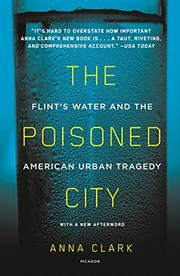
A journalist's reconstruction of how the emergency-manager law, the water-source switch and the missing corrosion control fit together. Read second: Hanna-Attisha gives you the alarm, Clark gives you the machinery.
How Flint kept happening
BeginnerUnderstand the politics and infrastructure underneath, and the national picture of drinking water.
▸ Study plan for this stage
Pace: Three to four weeks for 432 and 341 pages. Pauli's Flint Fights Back is an academic study built on years of embedded fieldwork with the water movement, and the author is openly sympathetic to it — read it as engaged scholarship. Siegel's Troubled Water is journalism with a policy argument and a set
- The Flint water movement as an organised political actor rather than a chorus of complaint
- The democracy argument: emergency management as suspension of local self-government, and what residents did in response
- Where activists, academics and Virginia Tech's water testing intersected, and how outside expertise entered the fight
- The national picture of drinking-water contamination beyond lead — disinfection byproducts, PFAS, nitrates
- The Safe Drinking Water Act and the Lead and Copper Rule as the regulatory frame everything else operates inside
- The gap between a legal compliance standard and a health-based standard
- In Pauli's account, what did Flint residents want that was not the same as clean water, and how do you weigh that against the public-health framing of stage one?
- How did the movement's relationship with outside experts help and constrain it?
- Which contaminants does Siegel treat as the more serious national problem, and on what evidence?
- What is the Lead and Copper Rule actually meant to do, and what did Flint demonstrate about it?
- After both books, is Flint best described as an outlier or a typical case?
- Using Pauli, list the demands the water movement made and mark which were ever met — that list is the clearest test of the democracy argument.
- Look up your own water utility's most recent Consumer Confidence Report and read it with Siegel's chapter on what these reports omit open beside it.
- Compare Pauli's account of the Virginia Tech testing with Hanna-Attisha's account of her own data release, and note what each says about who gets believed.
Next up: The national frame makes the obvious question unavoidable: lead was known to be a neurotoxin for a century, so the next stage goes back to who knew and when.

Flint's water movement told as a story about democracy — who was allowed to make decisions for the city, and who organised when they could not. The book that treats residents as actors rather than victims.

A survey of American drinking-water contamination beyond lead, and of the regulatory structure that lets it persist. It generalises Flint into a national condition.
The century of lead
IntermediateGo back to the industry that knew.
▸ Study plan for this stage
Pace: Four weeks for 326 and 443 pages, and these are the two scholarly works on the path — footnoted history built substantially on archival and litigation documents, slower going than the journalism above. Markowitz and Rosner have testified as expert witnesses in lead and vinyl chloride litigation, and
- That lead's toxicity was documented and industry-acknowledged decades before regulation
- Tetraethyl lead in petrol and lead in paint as two distinct exposure stories with a shared corporate defence
- The Lead Industries Association's marketing of lead paint for children's rooms as the documentary centre of the case
- The shift from acute poisoning to subclinical effects, and how a moving threshold was used to argue no harm was proven
- The Baltimore research controversy: what the Kennedy Krieger study did and why it split public-health ethics
- Litigation discovery as a historical source, and what that means for how these books are constructed
- What did the lead industry know about childhood lead poisoning, on the documentary record these books present, and by when?
- Why did the acceptable blood-lead level keep falling, and what was the industry argument at each step?
- What exactly was at issue in the Kennedy Krieger case, and how do Markowitz and Rosner frame it?
- How does building a history from litigation documents shape what the history can say?
- What is industry's stated objection to this scholarship, and where in the books can you see it addressed?
- Take three of the internal industry documents Markowitz and Rosner quote in Deceit and Denial and write out what each shows on its own, without the authors' framing around it.
- Chart the falling official blood-lead threshold decade by decade using Lead Wars, and mark alongside it what the industry said at each revision.
- Set Lead Wars' account of the Baltimore study beside Hanna-Attisha's account of screening Flint's children and write a paragraph on where research on children stops being observation.
Next up: The delay tactics documented here are not specific to lead, and the next stage reads the general playbook of which lead is the earliest clear case.

Markowitz and Rosner on lead poisoning as a public-health failure, including the Baltimore research controversy over studying children in partially abated housing. The core scholarly work on this path.
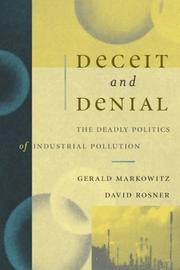
The same authors on lead and vinyl chloride, built largely on industry documents unearthed in litigation. Read it after Lead Wars for the documentary evidence of what was known and when.
Manufactured doubt
IntermediateLearn the general playbook, because lead is one of its earliest and clearest applications.
▸ Study plan for this stage
Pace: Four weeks for the three, with Merchants of Doubt at 355 pages and The Poisoner's Handbook at 328; our catalogue has no page count for Doubt Is Their Product, which is a comparable trade-length book. Michaels ran OSHA and is arguing for regulation from inside the regulatory world — read him as an ad
- Product defence as an industry: manufacturing uncertainty rather than disproving a finding
- The specific techniques — funding contrary studies, attacking methodology, demanding certainty, reframing as sound science
- That the same consultants and the same arguments recur across tobacco, lead, acid rain, ozone and climate
- The 1924 tetraethyl lead episode: workers dying at the refinery, and approval of the additive nonetheless
- The founding of forensic toxicology under Charles Norris and Alexander Gettler, and what a public laboratory made possible
- The asymmetry between how long a harm takes to prove and how long doubt takes to manufacture
- What does Michaels mean by product defence, and how does he distinguish it from legitimate scientific disagreement?
- Which of Oreskes and Conway's named figures appear in more than one controversy, and what does that recurrence establish?
- What happened at the tetraethyl lead refineries in 1924, and how was the additive approved afterwards?
- Where does Michaels' position as a former regulator strengthen his account, and where might it narrow it?
- Do these three books make the same argument, or do they differ about who is responsible?
- Take the tetraethyl lead chapter of The Poisoner's Handbook and the lead sections of Deceit and Denial and write the same episode as one timeline from both books.
- Pick one technique Michaels names and find it operating in the lead documents Markowitz and Rosner reproduce — name the document and the move.
- Read a current industry-funded response to a chemical regulation and check it against Michaels' list of techniques, marking which apply and which do not.
Next up: With the mechanism of delay understood, the last stage asks the harder empirical question of how environmental causation gets proved at all, and where the harm lands.
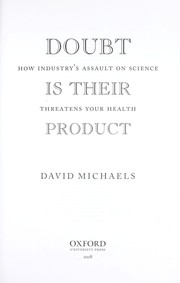
By a former OSHA head, on the product-defence industry that manufactures scientific uncertainty to delay regulation. The most directly applicable of the three.
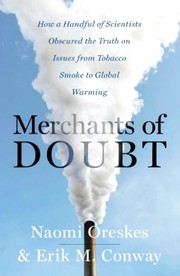
Oreskes and Conway on the small group of scientists who ran the same delay strategy across tobacco, acid rain, ozone and climate. Read it for the pattern, not for lead specifically.
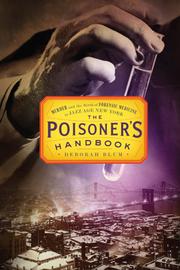
The birth of forensic toxicology in Jazz Age New York, including the tetraethyl lead episode in which workers died at the refinery and the additive was approved anyway. The origin scene for the whole story.
The wider pattern
IntermediatePlace lead inside environmental health and environmental justice.
▸ Study plan for this stage
Pace: Five weeks for 568, 368 and 336 pages, with Toms River the longest and the most technically demanding — Fagin walks through the epidemiology in detail and it repays slow reading. Toms River concerns a childhood cancer cluster and the deaths of children. Washington's A Terrible Thing to Waste argues
- Cluster investigation: why an apparent excess of cases is so hard to attribute, and what statistical power a small town does not have
- Exposure assessment as the weak link — knowing a chemical was present is not knowing who received a dose
- Environmental justice as the claim that exposure is distributed by race and class rather than by accident
- Washington's specific argument that lead and other neurotoxins function as a mechanism of measured cognitive inequality
- Silent Spring as the origin of the modern framework for arguing about chemical harm, and what it got its authority from
- The distinction between what an epidemiological study can conclude and what a community reasonably believes
- In Toms River, what did the study finally conclude, and why did it take as long as it did?
- Why is proving environmental causation in a single community so much harder than proving a general toxicity?
- What is Washington's causal chain, and which links in it are best supported by the evidence she presents?
- How does Flint's demographic profile look when read against Washington's argument?
- What did Silent Spring actually establish, and which of its methods are visible in every book on this path?
- Reconstruct the Toms River cluster study from Fagin's account as a one-page method summary: population, exposure measure, comparison group, finding, limitation.
- Apply that same five-line template to Hanna-Attisha's Flint blood-lead analysis and note which parts were easier for her and why.
- Read the chapter of Silent Spring on a single chemical alongside any one chapter of Deceit and Denial, and list the rhetorical moves Carson invented that the later book still uses.
Next up: You now have the crisis, the century behind it, the delay playbook and the limits of proof — enough to read the next drinking-water or chemical-exposure story without waiting to be told what it means.

A Pulitzer-winning account of a childhood cancer cluster and the epidemiology used to investigate it. The best available case study of how hard it is to prove environmental causation.

The argument that environmental toxins, lead prominently among them, are a mechanism of racial inequality in cognitive outcomes. Read it against Flint's demographics.
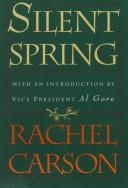
The 1962 book that created the modern framework for arguing about chemical harm. Read last, as the ancestor of every book above.
Discussion
Keep reading
Paths that share books, cover the same subject, or open a related topic.