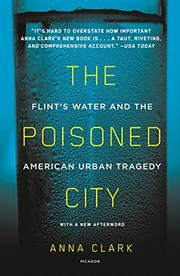
Read Mona Hanna-Attisha's What the eyes don't see first. She is the paediatrician who ran the blood-lead numbers on Flint's children and went public against official denial, and her first-person account is the clearest available record of what it took to be believed. Follow it with Anna Clark's The poisoned city, a journalist's reconstruction of how the emergency-manager law, the water-source switch and the missing corrosion control fit together. Hanna-Attisha gives you the alarm; Clark gives you the machinery.
Order matters because Flint is not self-explanatory. The causal claims in this literature are specific and contested in their details — which decisions mattered, which officials knew what and when, how many deaths the Legionnaires outbreak involved — and the honest way to read it is to attribute each finding to the book making it rather than treating the field as a single settled account. The books below disagree about emphasis and sometimes about culpability. Where they do, this guide says who is arguing what.
One practical note before the list: this is public-health history and policy. It is not household guidance. If you are worried about lead in your own water, paint or soil, that is a matter for your local health department and a certified testing laboratory, not a reading list.
The politics and the pipes
Flint Fights Back is Benjamin J. Pauli's account of the city's water movement told as a story about democracy — who was permitted to make decisions for Flint, and who organised when they were not. It treats residents as political actors rather than as victims, which is the main thing it adds to the two books above. Troubled Water by Seth M. Siegel surveys American drinking-water contamination beyond lead and the regulatory structure that lets it persist; Siegel's argument is that Flint generalises into a national condition, and it is his argument rather than a consensus finding.
The century of lead
Lead Wars is Gerald Markowitz and David Rosner on lead poisoning as a sustained public-health failure, including the Baltimore research controversy over studying children housed in partially abated properties. It is the core scholarly work on this path. Deceit and Denial is the same two historians on lead and vinyl chloride, built largely on industry documents unearthed through litigation. Read it after Lead Wars for the documentary evidence of what was known and when. Both authors have served as expert witnesses in lead litigation, which their critics raise and which is worth knowing as you read.
Manufactured doubt
Doubt is their product is David Michaels, a former head of OSHA, on the product-defence industry that manufactures scientific uncertainty in order to delay regulation. It is the most directly applicable of the three books in this stage. Merchants of Doubt by Naomi Oreskes and Erik Conway traces the same delay strategy across tobacco, acid rain, ozone and climate; read it for the pattern rather than for lead specifically. The poisoner's handbook is Deborah Blum on the birth of forensic toxicology in Jazz Age New York, and it contains the tetraethyl lead episode in which workers at the refinery died and the additive was approved anyway. That is the origin scene for the whole story.
The wider pattern
Toms River is Dan Fagin's Pulitzer-winning account of a childhood cancer cluster and the epidemiology used to investigate it — the best case study available of how genuinely hard it is to establish environmental causation, which is a useful corrective to the confidence of some advocacy writing. A Terrible Thing to Waste is Harriet A. Washington's argument that environmental toxins, lead prominently among them, function as a mechanism of racial inequality in cognitive outcomes; it is an argument, and a strongly stated one. Note that our catalogue record for it is an audio edition.
Finish with Silent Spring, the 1962 book that created the modern framework for arguing about chemical harm and is the ancestor of everything above. One buying warning: the edition our catalogue links is a German-language translation, so check before you order.
Follow the full ordered path here: Lead Poisoning and the Flint Water Crisis: Books to Read, in Order.
Ready to learn something deeply?
Build a reading path — free