Best Books on Immigration Law and Policy, in Reading Order
Immigration law is a field where the doctrine only makes sense once you know the people it operates on, so this path deliberately starts with the human reality before touching a statute. From there it turns to the history that produced the categories — legal, illegal, quota, refugee — then to the modern enforcement machinery and its convergence with criminal law, and finally to the philosophical arguments about who a country may admit or exclude. It presents the major positions rather than settling them, and it is about understanding a system, not advice about any individual's immigration situation, which requires a licensed attorney.
The Human Reality
BeginnerUnderstand what migration and enforcement actually involve for the people subject to them, so that later doctrinal categories attach to something concrete.
▸ Study plan for this stage
Pace: Eight to nine weeks for about 1,400 pages, but three of the four read quickly. Vargas's Dear America is 188 pages and can be read in two evenings. Zamora's Solito is 408 pages written in a child's present-tense voice and is emotionally demanding rather than technically hard — two weeks. Urrea's The
- The ordinary mechanics of undocumented life that Vargas documents: the driver's licence, the Social Security number, the job application, the airport, the constant management of documents — the texture that the phrase 'unauthorised presence' abstracts away
- That legal status is not a single binary. Vargas's account shows a person moving between categories, and the later doctrinal stages will name what those categories are
- The crossing as a process rather than a line: recruitment, the guide, the debt, the desert stretch, the pickup — Zamora shows the sequence from inside and Urrea shows the same sequence as an industry
- Prevention through deterrence as the policy that shaped the crossings all three books describe: hardening urban crossing points pushed traffic into the deserts, which is why the Arizona route in Urrea exists at all. Note this concept now; it recurs in stage three
- The smuggling economy Urrea reconstructs — the coyote, the recruiter, the debt structure, the disposability of the client — and the Border Patrol's own position within the same landscape
- Blitzer's causal chain: Cold War-era US involvement in El Salvador, Guatemala and Nicaragua; the wars' refugees; asylum denial rates in the 1980s; deportation of gang-affiliated young men back to countries that could not absorb them; and the later flows those conditions produced
- The 1980s asylum disparity Blitzer documents, where applicants fleeing US-allied governments were approved at dramatically lower rates than those fleeing adversary governments, which is the clearest historical illustration that asylum adjudication is not insulated from foreign policy
- Why this stage comes first: every doctrinal category in the rest of the path — admissible, removable, asylee, unauthorised — is a legal label applied to the people in these four books
- What specific documents and daily practices does Vargas describe managing, and what does that catalogue tell you about how status is actually enforced in ordinary life?
- Zamora and Urrea describe the same desert. What does the child's first-person account convey that the reconstructed group narrative cannot, and what does Urrea supply that Zamora cannot?
- What is the smuggling economy's structure in Urrea's account — who profits, who bears the risk, and where does the debt sit?
- Trace Blitzer's causal chain from a specific US foreign policy decision to a specific later migration flow. How strong is the evidence at each link?
- What did asylum approval rates in the 1980s correlate with, on Blitzer's account, and what does that suggest about the relationship between adjudication and diplomacy?
- Draw a map of Zamora's route and Urrea's route on the same page. Seeing the geography — the distances, the water sources, the road pickups — makes the rest of this path concrete in a way statistics do not.
- Make a list of every legal category or document named across the four books: visa type, status, proceeding, form number. Keep the list; you will be defining each of them in the next two stages.
- Write 400 words on the causal chain Blitzer traces for one country, and mark where you are relying on his reporting and where on his interpretation.
- After Urrea, write a paragraph on prevention through deterrence: what it was intended to do and what it produced. You will return to this paragraph in stage three.
- Note the moments in Vargas's book where a change in law or policy would have changed his situation. That list is a preview of the doctrinal questions ahead.
Next up: Having seen who the system operates on, the next stage explains where its categories came from — and shows that terms like 'illegal alien' were manufactured by specific legislation at a specific date rather than being facts about the world.

A Pulitzer-winning journalist's account of two decades living and working in the United States without papers. Start here because it explains, from the inside, the ordinary mechanics of undocumented life that the policy literature abstracts away.

A nine-year-old's journey from El Salvador to Arizona, reconstructed by the poet he became. It is the crossing itself at close range, and it sets up the systemic account of the same route in the next book.

Fourteen men died crossing the Arizona desert in 2001, and Urrea reconstructs the event from every side including the smugglers and the Border Patrol. Read third: it turns one journey into an anatomy of the whole crossing economy.

Traces four decades of Central American migration back through American foreign policy, following particular families and officials across both. It is the bridge from personal narrative to policy, and it explains why the people in the previous three books were on the road at all.
How the Law Got Here
IntermediateUnderstand the historical construction of immigration categories — quotas, the border, illegality, the path to citizenship — and see that current doctrine is the product of specific legislative choices.
▸ Study plan for this stage
Pace: Seven to eight weeks. Ngai's Impossible Subjects is 401 pages of academic history and is the densest book in the first three stages — allow three to four weeks and read the notes. Motomura's Americans in Waiting is 255 pages of clear legal scholarship, two to three weeks. Chomsky's Undocumented is s
- The 1924 Johnson-Reed Act and the national origins quota system: numerical restriction based on ancestry, which is the moment Ngai identifies as manufacturing the illegal alien as a legal and social category
- That illegality is produced by law rather than discovered by it — the same act that creates a quota creates the people who exceed it. This is Ngai's central analytic move and it recurs throughout the field
- The racial architecture of early immigration law: Chinese exclusion, the Asiatic Barred Zone, the treatment of Mexican migration as a labour supply rather than as immigration, and the Bracero programme's relationship to unauthorised entry
- The 1965 Hart-Celler Act, which replaced national origins quotas with hemispheric and per-country caps and family preference categories, and the unintended consequence that capping Western Hemisphere migration for the first time converted a long-standing legal flow into an unauthorised one
- Motomura's three models of the lawful immigrant: immigration as contract, as affiliation, and as transition. Each yields different answers about deportability, benefits and the road to citizenship, and Motomura argues the third is the recoverable American tradition
- Americans in waiting as a historical fact rather than a metaphor — the era of declarant aliens who could vote and hold office before naturalising, which most readers do not know existed
- Plenary power doctrine: the long-standing judicial position that Congress and the executive have exceptionally broad authority over immigration, largely insulated from constitutional review. This is the doctrinal fact that makes immigration law unlike the rest of American public law
- Chomsky's argument that legal status functions as a mechanism for producing a differentiated and exploitable labour force, which is an interpretation with an explicit political position and should be read as such alongside Ngai's more archival account
- How did the 1924 Act create the category of the illegal alien? Be precise about the mechanism, not just the effect.
- What did the 1965 Act change, and what did it produce that its sponsors did not anticipate? The Western Hemisphere cap is the key detail.
- Explain Motomura's three models of the immigrant relationship. For each, what does it imply about whether a lawful permanent resident may be deported for conduct that occurred years earlier?
- What is the plenary power doctrine, and what would immigration law look like without it? Name one consequence in each of admission, detention and removal.
- Chomsky argues legal status structures the labour market. What evidence supports that, what would count against it, and how does her account differ from Ngai's in method as well as in conclusion?
- Build a legislative timeline from 1882 to 1996 with one line per major act — Chinese Exclusion, 1917, 1924, Bracero, 1952, 1965, IRCA 1986, IIRIRA 1996 — and one sentence on what each changed. This timeline is the backbone of the whole field.
- Take the list of categories you made in stage one and define each one from Ngai and Motomura. Any you cannot define yet are the ones stage three will supply.
- Read the text of a short section of the Immigration and Nationality Act — the definition of 'admission' or the grounds of inadmissibility are good starting points, and both are freely available online. Then write a paragraph on how the statutory language differs from how the concept is discussed in prose.
- Write 500 words applying each of Motomura's three models to a single concrete case: a lawful permanent resident of twenty years facing removal for an old conviction. The three models give three different answers, and writing them out is the clearest demonstration that theories of membership have consequences.
- Return to Vargas's book from stage one and identify which statutes in your timeline determined his situation. Connecting a life to a legislative date is the point of this stage.
Next up: With the categories and their history in place, the next stage examines the machinery that enforces them today — detention, removal proceedings, and the merger of immigration with criminal law.
The foundational history of how the 1924 quota regime manufactured the category of the illegal alien, and how race shaped who could become American. Everything else in this stage is written downstream of it, so read it first.
A leading immigration scholar recovers an older American tradition of treating lawful immigrants as citizens-in-training rather than contract parties or affiliates. It is the clearest available account of what different theories of membership actually imply for doctrine.

A short, structural account of how legal status became the organising fact of American labour and race relations. Read it last in this stage as the argumentative complement to Ngai's history — it is an interpretation with a point of view, and it says so.
The Modern Enforcement System
IntermediateUnderstand detention, removal proceedings, the immigration courts, and the merging of immigration and criminal enforcement — plus what the work looks like to the people carrying it out.
▸ Study plan for this stage
Pace: Six to seven weeks for about 870 pages. Motomura's Immigration Outside the Law is 360 pages of careful legal argument — three weeks, and worth annotating. García Hernández's Migrating to Prison is 224 pages and reads in a week and a half. Cantú's The Line Becomes a River is 288 pages of memoir and r
- That removal is a civil proceeding, not a criminal one, and the consequences that follow: no right to appointed counsel, a lower standard of proof for the government, and detention that is legally characterised as non-punitive
- The immigration courts as part of the executive branch rather than the judiciary — immigration judges are Department of Justice employees, subject to case quotas and to the Attorney General's certification power over their decisions
- Crimmigration: the convergence García Hernández traces, in which criminal convictions trigger immigration consequences and immigration violations are prosecuted criminally, with the 1996 IIRIRA and AEDPA statutes as the pivot
- The aggravated felony category, which is defined by statute rather than by ordinary usage, has been expanded repeatedly and applied retroactively, and includes offences that are neither aggravated nor felonies
- The detention system's growth and its financing: mandatory detention provisions, the detention bed quota, and the private contracting arrangements that give the system an institutional constituency
- Motomura's central question — what the law should do about people already present without authorisation — and his framework of enforcement discretion, federalism, and the argument that unauthorised presence has long been tolerated in practice as a matter of policy design
- Prosecutorial discretion as the actual operating principle: the removable population vastly exceeds enforcement capacity, so who is removed is a matter of executive priority-setting rather than of law alone
- The enforcer's perspective in Cantú, and the reasons his book is contested — critics have objected to a former Border Patrol agent's authorship and to the book's reception. Read it aware of the objection, and aware that leaving the enforcer's account out entirely would leave a real gap in understand
- Removal is civil rather than criminal. List every procedural protection that classification removes, and explain the reasoning courts have given for it.
- What is an aggravated felony under the statute, and why does the term mislead? Give two examples of offences that qualify.
- Describe the institutional position of an immigration judge. What structural features would you point to if you were arguing the courts lack independence, and what would the counterargument be?
- Motomura argues that unauthorised presence has been tolerated as a matter of policy design rather than merely of enforcement failure. What is his evidence, and how does it change the framing of the debate?
- What drove the growth of immigration detention? Separate the statutory causes from the financial and institutional ones.
- Cantú describes carrying out policies the other books analyse. What does his account add, and what should a reader be cautious about in a memoir by a participant in a contested system?
- Diagram a removal proceeding from initial encounter to final order and appeal, marking at each step who decides, what the standard is, and whether counsel is available. Everything in this stage hangs off that diagram.
- Find the statutory definition of 'aggravated felony' in the INA online and read it in full. It is long, it is a list, and reading it directly is more persuasive than any description of it.
- Look up your jurisdiction's publicly available immigration court statistics — case backlogs, representation rates, outcome rates by court — and write a paragraph on what the representation figures alone imply about outcomes.
- Write 500 words applying Motomura's framework to one enforcement policy currently in effect where you live, setting out the strongest argument on each side before stating your own view.
- Take the prevention-through-deterrence paragraph you wrote in stage one and expand it with what you now know from García Hernández and Cantú about how the policy is operated.
- Attend or read a transcript of a public immigration court hearing if one is accessible to you. Hearings are generally open, and one hour in a real courtroom does more than a chapter.
Next up: The last stage steps back from how the system works to the prior question it presupposes — whether, and on what grounds, a state may exclude anyone at all.

Motomura's follow-up asks what the law should do about people already present without authorisation, and lays out the enforcement, federalism and integration arguments carefully. It is the most rigorous single treatment of the central practical question in the field.

A law professor's account of how civil immigration detention grew into a carceral system, with the statutory and financial history behind it. Read it after Motomura for the specific machinery his argument is about.

A former Border Patrol agent writes about enforcing the policies the previous books analyse, and about what it cost him. It is contested — some critics object to a former agent profiting from the account — and it belongs here precisely because the enforcer's perspective is otherwise missing from the path.
Who May a Country Admit or Exclude?
IntermediateEngage the political philosophy of borders directly, with the strongest open-borders and restrictionist arguments read against one another.
▸ Study plan for this stage
Pace: Six to seven weeks. Carens's The Ethics of Immigration is a substantial work of political philosophy and should take four weeks; its structure matters, because Part One argues from premises most liberal democracies already accept while Part Two makes the more radical open-borders case, and readers w
- Carens's two-part method: first, what follows for immigration from commitments democratic states already profess; second, the deeper argument that free movement is a basic liberty and open borders the eventual implication
- The social membership principle: that residence over time generates a moral claim to legal status regardless of how it began, which Carens uses to argue for a right to regularisation after a period of settlement
- The birthright citizenship argument — that assigning life chances by place of birth is morally arbitrary in the way feudal birthright was, which is Carens's most quoted analogy and the one Miller most directly contests
- The distinction between what justice requires of admissions policy and what it requires toward people already present. Carens argues the second is far more demanding than most states accept, and this is where he and Miller agree most
- Miller's self-determination argument: that a political community has a legitimate collective interest in deciding its own composition, and that this interest is not reducible to prejudice
- Miller's public culture and social trust arguments, and the empirical questions they rest on — whether rapid demographic change affects trust and redistributive solidarity is genuinely contested in the social science, and Miller's case depends in part on how that evidence falls
- Where the two agree: both accept refugee obligations, both reject exclusion on racial grounds, both think states owe far more to long-settled residents than current practice provides. The disagreement is narrower and sharper than public debate suggests
- That this is an unresolved disagreement between two of the field's most serious philosophers. Both arguments are well constructed, both have substantial support among specialists, and a reader's job here is to understand the structure of the disagreement rather than to be handed a verdict
- Reconstruct Carens's social membership argument as a chain of premises. At what point does a state's right to remove someone expire on his account, and what is the reasoning?
- State Miller's self-determination argument in its strongest form. What exactly is the collective interest he claims, and what limits does he place on it?
- The birthright-as-feudal-privilege analogy is Carens's most powerful rhetorical move. What is Miller's response, and does the analogy survive it?
- Miller's social trust argument depends on empirical claims. What are they, how strong is the evidence, and how much of his position survives if the evidence is weak?
- Identify three propositions both authors accept. What does the size of that shared ground tell you about how public immigration debate is usually framed?
- Where do you now stand, and what is the strongest objection from the other side that you cannot answer? Name it explicitly — on a question this contested, an argument you cannot state is one you have not engaged.
- Build a two-column argument sheet for Carens and Miller with rows for admission, exclusion, regularisation, refugees, and the moral status of borders themselves. Fill both columns before forming a view.
- Write 800 words defending the position you find less persuasive, using only that author's own premises and evidence. Then write a paragraph on what survived of your original view.
- Take one concrete policy currently in force in your country and analyse it under Carens's framework and then under Miller's, in a page each. Where they converge is worth as much attention as where they diverge.
- Return to Vargas, Zamora and the families in Blitzer from stage one and write a page on what Carens and what Miller would each say about their situations specifically. Testing philosophy against the individual cases the path opened with is the closing exercise.
- Write a final 1,000-word statement of your own position on immigration policy, citing at least one book from each stage, distinguishing clearly between claims about what the law is, what the evidence shows, and what you believe is right. Keeping those three registers separate is the single most useful discipline this path can leave you with.
Next up: This is the end of the path — the people, the categories, the machinery and the underlying moral question laid out from both sides rather than resolved — and the natural next step is comparative: the European asylum system and the international refugee regime, where the same arguments are conducted under a different legal architecture.

The most influential philosophical treatment, arguing first from within existing democratic commitments and then for open borders as the long-term implication. Read it first because it lays out the terms the opposing argument responds to.
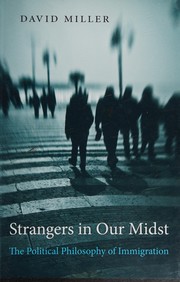
Miller's direct reply: that states may legitimately limit immigration on grounds of self-determination, public culture and social trust. Reading it immediately after Carens is the point of this stage — the two arguments are serious, they are unresolved, and this path does not pick between them.
Discussion
Keep reading
Paths that share books, cover the same subject, or open a related topic.