Antitrust is a small field organised around one large disagreement, and almost every book in it is a move in that argument. One camp holds that competition law exists to protect consumers, measured mainly by price and output, and that most concentration is either efficient or self-correcting. The other holds that it exists to limit private power, that the consumer-welfare standard narrowed the law past what Congress intended, and that the results are visible in every concentrated industry. Read only one side and you will not understand why courts and agencies behave as they do.
The order below is deliberate: the accessible case for enforcement first, then the doctrine that constrained it, then the empirical work, then the legal treatments. Reading the doctrine first is possible but discouraging — it is written for lawyers and it presumes the history.
Nothing here is legal advice. Antitrust liability is fact-specific and jurisdictional, and these books explain a debate rather than a compliance obligation.
The accessible case for enforcement
Antitrust by Amy Klobuchar is a history of American competition policy from the trusts to the platforms, and it is the easiest entry point on this list. Klobuchar is a sitting United States senator who has sponsored antitrust legislation, so the book is partly advocacy for a position she is trying to enact; that is stated openly and does not make the history unreliable, but it is context worth carrying. The Curse of Bigness by Tim Wu is the short manifesto version — a hundred-odd pages arguing that the Brandeisian tradition treated concentrated economic power as a political problem, and that abandoning that view was a mistake.
The doctrine that shaped the last fifty years
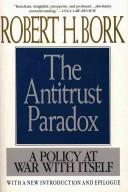
The antitrust paradox by Robert Bork is the most important book in modern antitrust and the one the previous two are arguing against. Bork's claim that the law's only legitimate goal is consumer welfare, and that most enforcement of the preceding decades had been incoherent, was adopted by American courts to a remarkable degree. Whether he read the legislative history correctly is disputed; that his framework won is not. Read it directly rather than through its critics.
Antitrust law by Richard Posner is the companion statement from the law-and-economics side — more measured than Bork, more analytically careful, and the clearest account of how economic reasoning is supposed to operate inside doctrine.
The empirical middle
Goliath by Matt Stoller is a political history of the fight over monopoly in the twentieth century, arguing that the shift was ideological and traceable to specific people and moments. Cornered by Barry Lynn documents concentration industry by industry and was early to the argument. The Great Reversal by Thomas Philippon is the most useful book on this list for anyone unsure who is right: an economist's data-driven comparison of American and European markets, arguing that Europe now has more competitive markets than the United States, with prices to match. It is the least rhetorical entry here. The myth of capitalism by Jonathan Tepper makes a similar case in more polemical form.
The legal end
Federal antitrust policy by Herbert Hovenkamp is the standard treatise and the closest thing the field has to a neutral authority; it is dense, expensive, and the place to go when you want to know what the law actually holds rather than what it should hold. The Master Switch, Tim Wu's second book on this path, closes the sequence by widening it: a history of information industries from the telephone to the internet, and the recurring cycle by which open systems consolidate into closed ones. It is the best framing available for the current platform arguments.
Follow the full path in order, or browse public policy for adjacent subjects.
Follow the full ordered path here: Best Books on Antitrust and Competition Policy, in Reading Order.
Ready to learn something deeply?
Build a reading path — free