Best Books on Geotechnical Engineering and Soil Mechanics, in Reading Order
Geotechnical engineering is the discipline where the material is not specified but discovered, and every book on this path is shaped by that fact. The opening stage explains how the field came to exist and what it feels like to practise, the second is the standard soil mechanics course — classification, effective stress, seepage, consolidation, shear strength — and the third moves to foundations and to the book that taught the profession judgment. The last stage is for people who will do analysis rather than apply correlations: plasticity theory, critical state soil mechanics, and rock, which behaves nothing like soil and is routinely underestimated by engineers trained only in it.
How the field thinks
IntermediateUnderstand why soil is unlike any other engineering material, and how geotechnical engineers reason under uncertainty about ground they cannot fully see.
▸ Study plan for this stage
Pace: 8-10 weeks. Goodman's biography of Terzaghi is 346 pages and reads like history rather than engineering; three weeks, and it is the only book on this path you can read on a train. Coduto's Geotechnical Engineering is 794 pages but is a survey rather than a problem-driven text — five to seven weeks a
- Why soil is unlike steel or concrete: it is not specified but discovered, it is spatially variable at every scale, and it is a three-phase medium whose behaviour depends on the water in it as much as on the grains
- Terzaghi's principle of effective stress, and Goodman's account of why it was a genuine conceptual break rather than an incremental result — total stress minus pore water pressure is what the soil skeleton actually feels
- The discovery of consolidation theory and what it explained that nobody could previously account for: settlement that continues for years after loading finishes
- Terzaghi's own working method, which Goodman documents — field observation first, theory second, and a lasting suspicion of analysis untethered from case records
- The observational method as a formal engineering approach: design for the most probable condition, identify the deviations, monitor, and have the remedial action planned in advance
- Site investigation as the discipline's foundational activity, and Coduto's insistence that the money spent on boreholes is the cheapest risk reduction available on any project
- The relationship between borehole spacing, spatial variability and residual uncertainty — the ground between your samples is always inferred
- Factor of safety in geotechnical work as compensation for material uncertainty rather than for load uncertainty, which is why the numbers are so much larger than in structural design
- State the principle of effective stress. Why was it a discovery rather than a definition, and what did engineers get wrong before it?
- Why does a factor of safety of three appear routinely in geotechnical design when structural design uses far smaller margins? Name the sources of uncertainty specifically.
- What is the observational method, and what does a project need to have in place before it can legitimately be used?
- Goodman describes Terzaghi arguing repeatedly with engineers who wanted more theory and with those who wanted none. What was his actual position?
- For a mid-size building on unfamiliar ground, what would a defensible site investigation consist of? Use Coduto's guidance and be specific about depth, spacing and tests.
- Draw the three-phase soil diagram and derive void ratio, porosity, water content, degree of saturation and unit weight relationships from it. You will use these constantly and should never need to look them up again.
- Write 300 words explaining effective stress to a structural engineer who has never heard of it, using a submerged soil element as the example.
- Take a real published case of foundation failure or excessive settlement and write a page on what the investigation missed. Goodman and Coduto both supply candidates.
- Sketch a site investigation plan for a building you can see from where you are sitting — borehole locations, depths, and which tests at which depths — and justify each choice.
- List the ten quantities Coduto treats as the outputs of a site investigation, and for each note which design decision it feeds.
Next up: With the reasoning and the vocabulary of the field established, you can start the actual mechanics course, where every one of these ideas becomes a calculation.

A readable biography of the man who turned foundation work from empirical trade into a science, by a distinguished geotechnical engineer. Start here: it is the only genuinely narrative book on this path, and it establishes why effective stress and consolidation were revolutionary rather than routine.
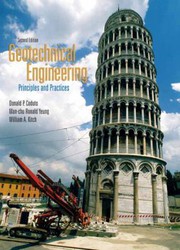
The most approachable survey of the whole discipline — site investigation, soil behaviour, settlement, stability and foundations in one volume, with a strong emphasis on practice. Read it before the mechanics texts to see where each piece of theory is eventually used.
The soil mechanics course
IntermediateWork confidently with classification, effective stress, seepage, consolidation and shear strength, and interpret standard laboratory and field tests.
▸ Study plan for this stage
Pace: 26-30 weeks, and this is a genuine course rather than a reading list — the time is dominated by problems, not pages. Das's Principles of Geotechnical Engineering is the spine: twelve to fourteen weeks working chapter by chapter and doing the end-of-chapter problems, not reading past them. Then Craig
- Index properties and classification: particle size distribution, Atterberg limits, the plasticity chart, and the Unified Soil Classification System — the shorthand every later chapter assumes
- Effective stress in practice: computing the vertical effective stress profile through a layered deposit with a water table, and the effect of capillary rise and of rapid drawdown
- Permeability and seepage: Darcy's law, flow nets, the calculation of seepage quantity and uplift pressure, and the critical hydraulic gradient at which piping begins
- One-dimensional consolidation and the compression curve together: Terzaghi's theory with its coefficient of consolidation and time factor, read alongside the oedometer curve that supplies compression index, recompression index and preconsolidation pressure — and the normally consolidated versus over
- Shear strength and the triaxial test: the Mohr-Coulomb criterion, friction angle and cohesion, the crucial drained versus undrained distinction, and the three standard triaxial forms — unconsolidated undrained, consolidated undrained with pore pressure measurement, consolidated drained — with what e
- Lateral earth pressure: at-rest, active and passive states, Rankine and Coulomb theories, and the wall movement required to mobilise each
- Holtz and Kovacs on clay mineralogy and the double layer, which is the physical explanation for behaviour that Das presents only as correlation
- Craig's critical state emphasis and Eurocode limit state framing, which will look unfamiliar after Das and is the reason for reading a second text
- Compute the effective stress profile through a three-layer deposit with a water table partway down. Then recompute it after the water table drops two metres. Which layer changes most and why?
- Draw a flow net under a sheet pile wall and calculate seepage quantity, uplift and the factor of safety against piping. What geometric change most improves the piping factor of safety?
- Explain the physical difference between drained and undrained loading, and say which applies to a rapidly constructed embankment on soft clay, both immediately and after ten years.
- Given an oedometer curve, identify the preconsolidation pressure by Casagrande's construction and compute the settlement of a layer under a given stress increase.
- Rankine and Coulomb give different active pressures for the same wall. What assumptions differ, and which would you use for a wall with a rough back face?
- Where do Das and Craig genuinely disagree, as opposed to using different notation? The critical state material is where to look.
- Work every end-of-chapter problem in Das for classification, effective stress, seepage, consolidation, shear strength and lateral earth pressure. This is the stage's real content; reading without doing them leaves nothing behind.
- Draw at least five flow nets by hand — under a dam, under a sheet pile, around a cofferdam — until the equipotential and flow line spacing becomes intuitive.
- Plot a real oedometer dataset if you can get one, and determine compression index, recompression index and preconsolidation pressure yourself. Then do the settlement calculation.
- Draw Mohr circles for the three triaxial test types on the same soil and label the strength envelope each produces. Being able to do this from memory is the shear strength chapter's exit test.
- Take one worked example from Das and redo it using Craig's method and notation. Where the answers differ, find out why.
- Write 400 words explaining why an overconsolidated clay settles so much less than a normally consolidated one, using the compression curve as the argument.
Next up: You now have the mechanics; the next stage applies them to the structures that carry loads into the ground, and introduces the book that teaches what the mechanics cannot.
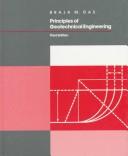
The standard North American undergraduate text and the core of this path: methodical, example-heavy, and covering the full sequence from index properties to lateral earth pressure. Work the problems — geotechnical intuition comes from repetition on real numbers.

The British counterpart, now maintained by Knappett and Craig, and stronger than Das on critical state concepts and on Eurocode-style limit state design. Reading a second text on the same material is not redundant here: the two traditions differ in emphasis and the comparison is instructive.

Holtz and Kovacs is the clearest of the three on the physical basis of soil behaviour — why clay does what it does, what the tests actually measure — and it is the one to read when Das gives you a procedure without a reason.
Foundations and engineering judgment
BeginnerDesign shallow and deep foundations, retaining structures and slopes, and understand why case history and judgment carry as much weight in this field as calculation.
▸ Study plan for this stage
Pace: 22-26 weeks for roughly 2,200 pages. Read Terzaghi and Peck's Soil Mechanics in Engineering Practice first over six to seven weeks, slowly and for the case records rather than the analysis — much of the analytical content you have already covered more systematically, and the case histories are the r
- Bearing capacity: Terzaghi's equation and its later refinements, the three bearing capacity factors, and the shape, depth and inclination corrections that turn a formula into a design
- The two governing criteria for a shallow foundation — bearing capacity and tolerable settlement — and the fact that settlement almost always controls for footings on sand
- Settlement calculation in practice: elastic settlement from correlations for granular soils, consolidation settlement from oedometer parameters for clays, and the very different confidence you should have in each
- Pile foundations: end bearing versus shaft friction, the alpha and beta methods, negative skin friction from consolidating fill, and group efficiency
- Drilled shafts and the construction-dependence of their capacity, which is the clearest case in the field of the method of construction changing the engineering
- Earth-retaining structures and slope stability as the two stability problems: gravity, cantilever, sheet pile and anchored walls with their full set of checks — sliding, overturning, bearing, global stability — and slopes by infinite-slope, method of slices and Bishop's simplified method, with short
- The load and resistance factor design framework in Coduto and how it differs from allowable stress design, including where the resistance factors actually come from
- Terzaghi and Peck's central lesson, which is the point of the whole stage: the analysis is only as good as the soil profile it rests on, and the case records show repeatedly that failures come from missed ground conditions rather than from arithmetic
- Design a spread footing for a given column load on a given soil, checking both bearing capacity and settlement. Which criterion controls, and what would change that?
- For a pile in soft clay overlain by fill that is still consolidating, what is the net capacity? Negative skin friction is the trap here — state its sign and magnitude.
- How does the construction method of a drilled shaft change its capacity? Name three specific mechanisms.
- Analyse the same slope with an undrained and a drained strength model. Which gives the lower factor of safety, and at what point in the structure's life does the governing case switch?
- Terzaghi and Peck present case records in which a competent analysis produced a failure. Pick two and identify what the analysis assumed about the ground that was untrue.
- In load and resistance factor design, where do the resistance factors come from, and what does that imply about applying them to soils outside the calibration database?
- Work the full design sequence for a shallow foundation at least five times with different soils and loads, until the bearing capacity and settlement checks are automatic.
- Design a cantilever retaining wall completely: earth pressures, sliding, overturning, bearing, global stability, drainage and reinforcement layout. One wall done properly teaches more than ten read about.
- Do a method of slices stability analysis by hand for one slope, then repeat it with Bishop's simplified method and compare. Doing it by hand once is what makes software output legible afterwards.
- Take three case records from Terzaghi and Peck and write half a page each: what was built, what was assumed, what happened, and what the investigation found.
- Compute the capacity of a driven pile by both a static formula and a correlation with standard penetration test data, and write a paragraph on the discrepancy.
- Write a one-page critique of your own stage-one site investigation plan now that you know what the design calculations need as input.
Next up: Everything so far has used closed-form solutions and correlations; the final stage takes on the constitutive theory behind numerical analysis and the material that soil mechanics does not describe at all.
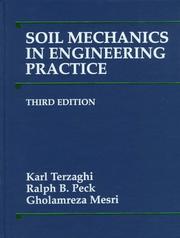
Terzaghi and Peck, later with Mesri, is the classic of the profession and still the best statement of how to think about ground: theory paired throughout with case records and with candid discussion of when the theory does not apply. Read it after a modern course, not instead of one.
The design sequel to Das's soil mechanics text, with the same notation: bearing capacity, settlement, mat foundations, piles, drilled shafts, retaining walls, sheet piles. The most directly useful book here for anyone who will size a footing.
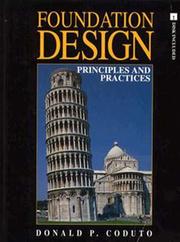
Coduto's foundation text is stronger than Das on the reasoning behind design decisions and on load and resistance factor design as it is actually applied. Read it alongside Das for the same reason you read Craig alongside him earlier.
Advanced soil behaviour and rock
BeginnerFollow the theoretical literature — plasticity solutions, critical state models used in numerical analysis — and handle rock masses, where soil mechanics does not transfer.
▸ Study plan for this stage
Pace: 20-24 weeks for about 1,560 demanding pages. Terzaghi's Theoretical Soil Mechanics is 510 pages of dated notation and closed-form plasticity; five to six weeks, read selectively for the derivations behind formulae you already use. Muir Wood's Soil Behaviour and Critical State Soil Mechanics is 488 p
- Terzaghi's plasticity solutions for bearing capacity and earth pressure, derived from limit equilibrium and slip surface geometry, and the assumptions each carries — rigid plastic material, no volume change, an assumed failure mechanism
- The critical state framework: a state at which continued shearing produces no further change in volume or stress, unifying drained and undrained behaviour, and the geometry that goes with it — the state boundary surface, the Roscoe and Hvorslev surfaces, and the critical state line in mean effective
- Cam clay and modified Cam clay as elasto-plastic constitutive models with a yield surface, a hardening rule and a flow rule, needing very few parameters — and why this matters practically, since these are the models inside modern geotechnical finite element software and running one without understan
- The limits of Cam clay — it was built for reconstituted clays and does not describe sands, structured natural clays or cyclic loading well, which is why more elaborate models exist
- Rock as a two-part problem: the intact rock material and the discontinuities cutting it, with the joints, bedding and faults usually governing behaviour rather than the rock strength
- Kinematic analysis of wedge and planar failure using stereographic projection, which has no analogue in soil mechanics and is the standard tool for rock slopes
- Underground openings: stress redistribution around a tunnel, the ground reaction curve and support interaction, and why timing of support installation is an engineering variable
- The path's closing warning, stated by Goodman throughout: engineers trained on soil consistently underestimate the role of jointing and treat rock as strong soil, which is how rock slope and tunnel failures happen
- Derive or reconstruct Terzaghi's bearing capacity solution and state every assumption it makes. Which assumption fails first in a layered deposit?
- What is the critical state, and why does it unify drained and undrained shear behaviour that the Mohr-Coulomb framework treats as separate cases?
- Where does Cam clay fail as a description of real soil? Name three specific soil types or loading conditions and the mechanism that defeats the model in each.
- For a jointed rock slope, why does the intact rock strength often not appear in the governing calculation at all?
- What does a ground reaction curve show, and what does it imply about installing tunnel support too early or too late?
- A geotechnical engineer with no rock training analyses a rock cut as a soil slope. Name three specific errors that follow.
- Reconstruct one Terzaghi closed-form solution completely, showing the assumed failure mechanism, and compare the result with the modern code equation for the same case.
- Plot a full set of triaxial stress paths in mean effective stress, deviator stress and specific volume space for normally consolidated and overconsolidated samples, and mark the critical state line.
- Implement modified Cam clay yourself in a spreadsheet or a few dozen lines of code for a single element under triaxial loading, and reproduce the drained and undrained responses. This is the only way to stop treating the model as a black box.
- Do a stereographic projection analysis of a rock slope with three joint sets and identify the kinematically possible failure modes. Work it by hand at least once.
- Sketch the stress distribution around a circular tunnel in an elastic medium, then in a yielding one, and write 300 words on what changes.
- Write a final two-page note to yourself on where each tool on this path stops working: the correlation, the closed-form solution, the constitutive model, and the classification system. This is the judgment Terzaghi and Peck were trying to transmit.
Next up: You end able to move between correlation, closed-form analysis and numerical modelling knowing what each assumes — and knowing that rock is a separate discipline rather than an extension of this one.
Terzaghi's own analytical volume: closed-form plasticity solutions for bearing capacity, earth pressure and stability. Dense and dated in presentation, but many of the formulae still embedded in codes and software originate here, and it is worth knowing what assumptions they carry.
The standard graduate treatment of the critical state framework — Cam clay and its relatives — which is the theoretical basis of the constitutive models in modern geotechnical finite element software. Essential if you will run numerical analyses rather than hand calculations.

Ends the path with the material soil mechanics does not cover: rock strength, discontinuities, wedge and slope stability, tunnels and underground openings. Jointing, not the intact rock, usually governs — and engineers trained only on soil consistently underestimate that.
Discussion
Keep reading
Paths that share books, cover the same subject, or open a related topic.