Play winning poker
This curriculum takes a complete beginner from the basic rules and feel of poker all the way through advanced game theory, exploitative adjustments, and the mental discipline required to perform under pressure. Each stage builds the vocabulary and conceptual framework needed for the next, so skipping ahead is strongly discouraged — the math and theory in later books will only click once the foundational intuitions are firmly in place.
Foundations: Rules, Reads, and Basic Strategy
BeginnerUnderstand how poker works, learn fundamental hand selection, position, and pot odds, and develop enough table intuition to play a solid, mistake-free beginner game.
▸ Study plan for this stage
Pace: 8–10 weeks total. Weeks 1–5: "Poker for Dummies" (~20–25 pages/day, reading all rule chapters first, then strategy chapters). Weeks 6–10: "The Theory of Poker Applied to No-Limit" (~15–20 pages/day, re-reading dense sections on the Fundamental Theorem and push/fold math as needed). Reserve the final
- Hand rankings and the complete rules of Texas Hold'em (blinds, betting rounds, showdown) as laid out in Poker for Dummies
- Starting hand selection: which hands to play from which positions, and why folding is a skill (Poker for Dummies hand charts)
- Positional advantage: the power of acting last and how it shapes every decision across all streets
- Pot odds and basic implied odds: calculating whether a call is mathematically justified given the size of the pot
- The Fundamental Theorem of Poker (Sklansky): every time an opponent plays differently than they would if they could see your cards, you gain; every time you play differently than optimal, you lose
- Deception and the value of occasionally playing strong hands weakly (and weak hands strongly) to balance your range — introduced in Sklansky
- Aggression as a default: why betting and raising generate more profit than passive calling in no-limit games
- Bankroll discipline and table selection: choosing stakes and games where your edge is positive, per the practical advice in Poker for Dummies
- After reading Poker for Dummies, can you explain the action on each of the four streets (pre-flop, flop, turn, river) and correctly identify who acts first and why?
- Using the starting hand guidance in Poker for Dummies, which category of hands should you almost always raise with from early position, and which should you fold regardless of position?
- How do you calculate pot odds, and given a pot of $100 with a $25 call required, are you getting the right price to draw to a flush (roughly 4:1 against on the turn)?
- In your own words, state Sklansky's Fundamental Theorem of Poker and give one concrete example of how it applies to a decision on the river
- Why does position matter more in no-limit than in limit poker, according to Sklansky's analysis?
- What is the danger of always playing strong hands the same way, and how does Sklansky suggest you introduce deception without becoming recklessly unpredictable?
- Deal out 50 practice hands alone (or with a friend) using only the starting hand ranges from Poker for Dummies — fold everything outside those ranges and track how often you would have won or lost at showdown to build discipline around hand selection
- Pot-odds drill: write out 20 scenarios with varying pot sizes and bet sizes, calculate the required equity to call profitably, then look up the actual equity of common draws (flush draw ~35%, open-ended straight draw ~32%) to check your math
- Position journal: play 2–3 free-play or low-stakes online sessions and after each session write one paragraph describing a hand where position helped you and one where being out of position hurt you — reference Sklansky's framework when explaining why
- Fundamental Theorem analysis: after each session, pick two hands where you made a decision and ask 'Was my opponent playing correctly given my actual hole cards?' and 'Was I playing correctly given their actual hole cards?' — write a one-sentence verdict for each
- Deception exercise: in a home game or play-money session, deliberately slow-play one strong hand and bluff one weak hand per session, then evaluate afterward whether the board texture and opponent tendencies justified each choice per Sklansky's criteria
- Reading recap quiz: after finishing each book, close it and write a one-page summary of the three most important concepts you learned — then re-open the book, find the relevant sections, and grade your own accuracy
Next up: ">Mastering the rules, hand selection, pot odds, and the Fundamental Theorem gives you the stable mechanical and conceptual foundation needed to absorb more advanced topics — such as range-based thinking, bet sizing theory, and exploitative adjustments — that intermediate-level study will demand.

Demystifies the rules, hand rankings, and basic betting structures across all major variants — essential vocabulary before anything else. Removes the intimidation factor so the reader can focus on learning.

Introduces the Fundamental Theorem of Poker and core concepts like pot odds, implied odds, and deception — the conceptual bedrock every subsequent book assumes you already know.
Building Blocks: No-Limit Hold'em Thinking
BeginnerApply foundational concepts specifically to No-Limit Hold'em: hand ranges, position-based decisions, continuation betting, and basic exploitative adjustments against common player types.
▸ Study plan for this stage
Pace: 4–5 weeks, ~20–25 pages/day; read each chapter twice — once for comprehension, once with a notepad to log key arguments and hand examples. Dedicate the final 3–4 days to review and exercises.
- Hand ranges vs. specific hands: Sklansky's central thesis that NLHE decisions must be made by thinking about the full range of hands an opponent can hold, not a single guessed hand
- The Gap Concept applied to NLHE: why you need a stronger hand to call a raise than to make one, and how this shapes preflop decision-making
- Position as a strategic multiplier: how acting last post-flop amplifies every other edge — hand strength, bluffing frequency, and pot control
- Pot odds and implied odds in a no-limit context: how the ability to bet any amount changes the math of drawing and calling decisions compared to limit poker
- Continuation betting logic: when a preflop aggressor should follow up on the flop, and how board texture, opponent tendencies, and range advantage determine c-bet frequency and sizing
- Balancing value bets and bluffs: Sklansky's framework for constructing bets that are neither purely exploitable nor purely mechanical
- Exploitative adjustments against player types: identifying loose-passive, tight-passive, loose-aggressive, and tight-aggressive opponents and the specific counter-strategies each demands
- The importance of non-standard plays: slow-playing, check-raising, and overbetting as tools whose value depends entirely on opponent tendencies and table dynamics
- According to Sklansky, why is it fundamentally flawed to put an opponent on a single hand rather than a range, and how does range-thinking change the way you evaluate a call on the river?
- How does the Gap Concept influence your preflop 3-betting and calling ranges from different positions, and what adjustments does Sklansky recommend when you are out of position?
- What board textures favor a continuation bet and which do not, based on the principles in the book? Give two concrete examples of each.
- How do pot odds and implied odds interact in no-limit specifically — when does a mathematically incorrect immediate call become correct because of implied odds, and what conditions must be true for those implied odds to be real?
- Describe the counter-strategy Sklansky recommends against a loose-passive player (calling station) versus a tight-aggressive player. Why does the same play that profits against one type lose against the other?
- What is Sklansky's reasoning for why balancing your betting range (mixing value bets and bluffs in a consistent ratio) matters more at higher stakes than at lower stakes against recreational players?
- Range-mapping drill: Deal yourself a hand and a board, then write out every plausible hand in a typical villain's preflop range. Eliminate hands that don't fit their actions on each street and practice narrowing the range by the river — do this for 10 hands per session.
- Position journaling: Play a free or low-stakes online session and log every hand where position was the decisive factor in your decision. After the session, annotate each hand with what you would have done if the positions were reversed, referencing Sklansky's position arguments.
- C-bet decision tree: Create a simple flowchart with three branches — board texture (wet/dry/middling), opponent type (calling station/nit/LAG), and your range advantage (strong/weak). For each combination, write the c-bet frequency and sizing you'd use based on the book's framework. Test it against 20 hand histories.
- Pot odds calculator practice: Take 15 river scenarios (from online hand history databases or self-dealt cards) and calculate both the immediate pot odds and the implied odds for a draw on an earlier street. Decide call or fold, then compare your answer to what Sklansky's principles would suggest.
- Player-type exploitation worksheet: Label four columns (LP, TP, LA, TA). For each player type, write three specific adjustments — one preflop, one on the flop, one on later streets — drawn directly from the book. Then review 20 hands from your own history and assign a player type to each opponent, applying the relevant adjustments.
- Bluff-to-value ratio audit: Review 30 of your own recorded hands where you bet or raised. Categorize each bet as a value bet, a bluff, or a semi-bluff. Calculate your ratio and compare it to the balanced ranges Sklansky advocates. Identify leaks where you are over-bluffing or under-bluffing in specific spots.
Next up: Mastering Sklansky's range-based thinking, positional discipline, and exploitative adjustments in NLHE provides the analytical vocabulary needed to tackle more advanced topics — such as GTO-influenced strategies, multi-street planning, and tournament-specific ICM pressure — that typically form the next stage of a serious poker curriculum.
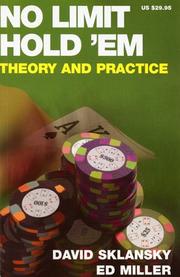
Bridges basic theory and serious NLHE play by introducing concepts like all-in leverage, stack-to-pot ratios, and semi-bluffing — vocabulary that is assumed in every advanced text.
Intermediate: Ranges, Solvers, and GTO Thinking
IntermediateThink in hand ranges rather than individual hands, understand the basics of Game Theory Optimal (GTO) play, and use equity and expected value calculations to make better decisions in real time.
▸ Study plan for this stage
Pace: 12–16 weeks total. Week 1–3: "The Mental Game of Poker" (~20–25 pages/day, ~220 pages). Week 4–7: "Poker's 1%" (~15–20 pages/day, ~150 pages) — read slowly and re-read key chapters. Week 8–16: "Applications of No-Limit Hold 'em" (~20–25 pages/day, ~350 pages) — the densest book; budget extra time to
- Tilt identification and the A-game/B-game/C-game framework (Tendler): recognizing how emotional leakage degrades decision quality and building mental routines to stay in your A-game during sessions
- The Learning Pit and Unconscious Competence model (Tendler): understanding that confusion and frustration during study are signs of growth, not failure, and using this to sustain deliberate practice through the harder material ahead
- The 1% rule and betting-frequency thinking (Miller): shifting focus from hand-reading to range construction by understanding that elite players think about how often they bet across their entire range, not just whether a single hand is strong enough to bet
- Balancing value bets and bluffs using the 1% framework (Miller): constructing ranges that are neither too bluff-heavy nor too value-heavy so opponents cannot exploit you by always calling or always folding
- Equity and Expected Value (EV) as the universal decision metric (Janda): calculating and comparing the EV of every action — bet, check, call, fold — rather than relying on feel or results
- Range vs. range equity and board texture interaction (Janda): understanding how the community cards interact differently with each player's entire range, creating range advantages and nut advantages that dictate who should be betting
- Polarized vs. condensed ranges and bet sizing (Janda): learning why polarized ranges prefer large bet sizes and condensed ranges prefer smaller ones, and how to construct each type intentionally
- Introduction to GTO principles and unexploitable strategies (Janda): grasping the concept of a Nash Equilibrium in poker, why a GTO baseline matters even in exploitative play, and the limits of pure GTO in live, recreational games
- After reading Tendler, can you identify your two most common tilt triggers and describe the specific in-session routine you will use to interrupt them before they move you from your A-game to your C-game?
- What does Miller mean by 'the 1%,' and how does thinking about betting frequency across your whole range change the way you construct a continuation-betting strategy on a given flop?
- Given a flop of A♠ 7♦ 2♣ in a single-raised pot where you 3-bet pre-flop, which player has the range advantage and the nut advantage, and what does Janda's framework say about who should be betting and at what frequency?
- How do you calculate the EV of a bluff on the river using Janda's formula, and what pot odds / break-even fold-equity percentage must your opponent reach for the bluff to be immediately profitable?
- What is the difference between a polarized range and a condensed (merged) range, and why does Janda argue that polarized ranges should use larger bet sizes while condensed ranges should use smaller ones?
- How do the mental-game concepts from Tendler directly support the kind of deep, frustrating study required to work through Janda's equity calculations — and what specific Tendler technique will you use when you feel lost mid-chapter?
- Tilt journal (Tendler): After every session for the first three weeks, write 3–5 sentences identifying any moment your emotions influenced a decision. Label it by tilt type (e.g., injustice tilt, fear of losing), rate its severity 1–5, and note what triggered it. Review weekly to spot patterns.
- Betting-frequency audit (Miller): Pull 20 hands from your database or hand history where you were the pre-flop aggressor. For each flop, note whether you bet or checked. Calculate your overall c-bet frequency. Then ask: is my checking range strong enough to protect, and is my betting range balanced between value and bluffs? Adjust your strategy for the next session.
- Range-vs-range equity drill (Janda): Choose 5 common pre-flop scenarios (e.g., BTN vs BB single raised pot, CO 3-bet pot). Using a free equity calculator (Equilab or Flopzilla), assign realistic ranges to both players, pick 3 board textures each, and calculate each player's equity. Write one sentence explaining who has the range advantage and why.
- EV calculation worksheet (Janda): Write out the full EV formula for a river bet in at least 10 different river spots from your own hand history. Include pot size, bet size, estimated fold equity, and equity when called. Identify the two spots where your actual decision deviated most from the EV-maximizing play.
- Polarized vs. condensed range construction (Janda): Pick one position (e.g., BTN open vs. BB call) and build two separate river ranges on a given runout — one polarized (nuts + air) and one condensed (medium-strength hands). Assign bet sizes to each and write a paragraph justifying your sizing choices using Janda's framework.
- Weekly study session debrief (all three books): End every week of study with a 10-minute written debrief. Answer: (1) What was the hardest concept this week? (2) Which Tendler mental-game tool helped me push through? (3) How does what I learned this week change one specific decision I make at the table? This ties all three books together continuously.
Next up: Mastering range construction, EV thinking, and GTO baselines here gives you the analytical vocabulary and emotional discipline needed to move into advanced solver work, exploitative adjustments, and population-level reads — the hallmarks of the expert stage — where these concepts are stress-tested against real solver outputs and complex multi-street planning.

Placed here intentionally — before the math gets harder, readers need a framework for managing tilt, fear, and variance so that the advanced concepts ahead are absorbed rather than emotionally rejected.

Teaches the single most important intermediate skill: thinking in betting frequencies and ranges rather than specific hands. This is the conceptual bridge from exploitative guesswork to GTO-informed play.

The first rigorous, range-vs-range GTO framework written for a general poker audience. Dense and demanding, but by this stage the reader has the vocabulary to absorb it fully.
Advanced: Exploitative Play and Modern GTO
ExpertSynthesize GTO baselines with deliberate exploitative deviations, understand modern solver-based thinking, and develop a complete strategic system for both cash games and tournaments.
▸ Study plan for this stage
Pace: 10–12 weeks total: Weeks 1–7 on "Modern Poker Theory" (~35–40 pages/day, including solver output study sessions every 3rd day); Weeks 8–12 on "Play Optimal Poker" (~25–30 pages/day, with one dedicated review/integration session per week tying Brokos's exploitative frameworks back to Acevedo's GTO ba
- GTO (Game Theory Optimal) as a baseline, not a destination — understanding Nash Equilibrium ranges and why solvers converge to them (Acevedo)
- Minimum Defense Frequency (MDF) and its role in constructing calling and raising ranges to prevent pure exploitation (Acevedo)
- Range construction and range visualization: thinking in balanced, polarized, and merged ranges across all streets (Acevedo)
- Bet sizing as a strategic lever: how different sizings interact with range advantage, nut advantage, and board texture (Acevedo)
- Node-locking and exploitative deviation: deliberately breaking GTO balance when a population or specific opponent has a detectable leak (Acevedo & Brokos)
- The concept of 'good enough' GTO — approximating solver solutions at the table using heuristics and mental models (Brokos)
- Exploitative adjustments in practice: identifying and quantifying opponent tendencies (over-folding, over-calling, capped ranges) and systematically deviating to punish them (Brokos)
- Integrating GTO and exploitative thinking into a unified decision-making process for both cash games and tournament contexts (Brokos)
- After studying Acevedo, can you explain why a GTO strategy is unexploitable and describe a situation where strictly playing GTO is suboptimal against a recreational player?
- How does Minimum Defense Frequency determine the composition of your calling range on a given street, and what happens to your EV if you defend below MDF against a competent opponent?
- Using Acevedo's range construction framework, how would you build a balanced 3-bet range from the BTN vs. a CO open, and what ratio of value hands to bluffs should it contain?
- According to Brokos, what is the process for identifying a specific opponent exploit, and how do you size your deviation from GTO to maximize EV without over-adjusting?
- How do bet sizing choices interact with range polarity — when should you use a large, polarized sizing versus a small, merged sizing on the flop, and how does this change by the river?
- How do the GTO principles from Modern Poker Theory and the exploitative frameworks from Play Optimal Poker combine into a single in-game decision process?
- Solver shadow work (Acevedo-focused): Pick one common spot (e.g., BTN vs BB single-raised pot on a K72r flop). Before opening a solver, write out your predicted GTO ranges and bet sizings for both players. Then run the solver and compare — log every surprise and write a one-paragraph explanation for each deviation from your prediction.
- MDF drilling: For 20 different bet sizes (from 25% pot to 150% pot), calculate the required MDF and construct a sample defending range from a realistic hand distribution. Practice until you can estimate MDF and range composition within seconds at the table.
- Range-vs-range equity mapping: Using Flopzilla or a similar tool, load two realistic ranges (e.g., EP open vs. BTN call) and analyze equity distribution across 10 different board textures. Identify who has range advantage, nut advantage, and how that should influence the first-action strategy.
- Exploit identification journal (Brokos-focused): Over 2–3 live or online sessions, tag every hand where an opponent shows a clear tendency (e.g., never check-raises the flop, always c-bets). After the session, write a specific counter-strategy for each tendency using Brokos's framework, then implement it in the next session and record results.
- Unified decision tree exercise: For 5 complex multi-street hands (from your own session history or training sites), write out the full decision tree — GTO baseline first (using Acevedo's heuristics), then overlay the exploitative adjustment (using Brokos's process). Justify every deviation with a specific read or population tendency.
- Tournament vs. cash game comparison drill: Take one hand scenario and solve it twice — once as a 100BB cash game hand (pure EV focus) and once as a tournament hand near the bubble (ICM-adjusted). Document how ICM pressure changes your GTO baseline and when exploitative deviations become more or less valuable.
Next up: Mastering the GTO-to-exploit synthesis in this stage gives the reader a complete strategic language — solver-grounded baselines plus principled deviation — which is the prerequisite mental framework for any further specialization, whether that means deep-diving into tournament ICM theory, live tells and psychology, or high-stakes cash game population reads.

The most comprehensive solver-backed GTO framework available in book form. Covers range construction, bet sizing theory, and node-locking for exploitative play — the current gold standard for serious students.

Makes GTO concepts practically actionable at the table without a solver, bridging the gap between theoretical perfection and real-game exploitative decisions. A perfect capstone for synthesizing everything learned.
Mastery: Bankroll, Pressure, and the Long Game
ExpertDevelop iron bankroll discipline, sustain peak performance under psychological pressure, and build the professional habits and mindset needed to beat poker consistently over the long run.
▸ Study plan for this stage
Pace: 6–8 weeks total: Weeks 1–4 cover "The Mental Game of Poker 2" (~25–30 pages/day, including journaling time); Weeks 5–8 cover "Thinking in Bets" (~20–25 pages/day, with slower, reflective reading to absorb decision-theory frameworks). Reserve 1–2 days between books to review notes and write a transit
- Advanced tilt recognition and root-cause analysis — identifying the deep emotional and cognitive triggers (e.g., injustice tilt, entitlement tilt, despair tilt) that Tendler maps in MGOP2 beyond surface-level frustration
- The Inchworm Concept — understanding that improvement happens by compressing the range between your worst and best play, not just raising your ceiling, and using this to set realistic performance benchmarks
- Unconscious competence and the learning model — recognizing which skills are truly 'in the bank' versus which still require conscious effort under pressure, and structuring study to accelerate that internalization
- Bankroll as a psychological tool — treating bankroll discipline not merely as math but as a buffer against emotionally-driven shot-taking, downswing panic, and identity threats tied to stakes
- Resulting vs. process thinking (Annie Duke) — decoupling the quality of a decision from its outcome, and building the mental infrastructure to evaluate poker decisions on the information available at the time, not on results
- Probabilistic thinking and decision-making under uncertainty — embracing the 'best guess' framework Duke advocates, quantifying confidence levels, and applying this to hand-reading, game selection, and life-bankroll decisions
- Seeking out 'wanna bet?' moments — using the accountability of imagined or real bets to stress-test your own beliefs about your game, your edge, and your opponents
- Building a long-run identity — synthesizing Tendler's emotional mastery with Duke's probabilistic worldview to construct a professional self-concept that is resilient to variance, immune to results-oriented thinking, and oriented toward continuous learning
- According to Tendler in MGOP2, what distinguishes the advanced forms of tilt (such as entitlement or injustice tilt) from basic frustration tilt, and how does identifying the root cause change the correction strategy?
- What is the Inchworm Concept, and how should a serious player use it to prioritize study — should you focus more on eliminating your worst performances or elevating your best, and why?
- How does Annie Duke define 'resulting,' and can you give a concrete poker example where a good decision led to a bad outcome and a bad decision led to a good outcome — and explain why conflating the two is dangerous for long-term improvement?
- Duke argues that all decisions are essentially bets made under uncertainty. How does reframing poker decisions through this lens change how you should review your sessions and respond to bad beats?
- How can Tendler's concept of 'unconscious competence' be used to honestly audit your current skill set — and what does that audit reveal about which areas of your game are truly reliable under high-pressure, high-stakes conditions?
- How do the frameworks from both books combine to form a coherent approach to bankroll management — one that addresses both the mathematical requirements and the psychological and identity-based pressures that cause players to deviate from sound bankroll rules?
- Tilt Autopsy Journal: After every session for the duration of this stage, write a structured entry identifying (1) the specific tilt type from Tendler's taxonomy if tilt occurred, (2) the triggering hand or event, (3) the underlying belief or expectation that was violated, and (4) one corrective mental cue to use next time. Review weekly for patterns.
- Inchworm Baseline Audit: Review your last 20–30 recorded sessions and tag each as 'A-game,' 'B-game,' or 'C-game' using honest criteria. Calculate what percentage of sessions fall into each category. Set a 6-week goal to reduce C-game sessions by 50% and define the specific mental triggers that cause the drop.
- Decision Quality Log (Duke Exercise): For 2 weeks, after each session select 5 key decisions and score them 1–10 on process quality independent of outcome. Then note the actual outcome. Track whether your process scores and outcome scores diverge — this is your 'resulting bias' measurement.
- 'Wanna Bet?' Belief Stress-Test: Write down 10 strong beliefs you hold about your game (e.g., 'I am a winning player at NL200,' 'I play well in 6-max'). For each, assign a confidence percentage and then ask: what evidence would change this belief? Share with a trusted poker peer and invite pushback.
- Bankroll Pressure Simulation: Deliberately drop down one stake level for two weeks while keeping detailed notes on how it feels emotionally. Then write a reflection connecting those feelings to Tendler's identity and ego concepts — how does your self-worth respond to the reduced stakes, and what does that reveal about your bankroll decision-making under real downswing pressure?
- Probabilistic Hand-Review Protocol: Choose 10 hands per week from your sessions and instead of labeling plays as 'right' or 'wrong,' assign probability ranges to your reads at each decision point (e.g., 'I estimated villain folds here 60–70% of the time'). Evaluate whether your ranges were reasonable given available information, not whether the outcome confirmed them.
Next up: By internalizing iron emotional discipline from Tendler and rigorous probabilistic decision-making from Duke, the reader has built the professional foundation — mental toughness, process orientation, and long-run thinking — needed to tackle advanced strategic and game-theory concepts with a clear, unbiased mind in any subsequent stage.

Goes beyond tilt management into peak performance, motivation, and building a process-oriented mindset — critical for anyone playing seriously and dealing with high-stakes variance.

Written by a former world-champion poker player, this book reframes decision quality vs. outcome quality and teaches probabilistic thinking under uncertainty — the philosophical capstone for a complete poker education.
Discussion
Keep reading
Paths that share books, cover the same subject, or open a related topic.