Corporate Restructuring and Bankruptcy: The Best Books, in Order
When a company runs out of money, three professions arrive at once — turnaround managers, distressed debt investors and bankruptcy lawyers — and each has its own literature that largely ignores the other two. This path reads all three, in that order, because the operational question comes first chronologically and the legal machinery comes last. It opens with narrative accounts so the technical books have concrete deals to attach to, and assumes you can already read a set of accounts.
The Narrative Way In
IntermediateWatch several real distressed situations run to conclusion, and pick up the vocabulary before meeting it in a textbook.
▸ Study plan for this stage
Pace: About six weeks for roughly 1,905 pages, read fast - these are narrative books and the point is vocabulary and pattern recognition, not study. Barbarians at the Gate (550 pp) first, two weeks: it is reported journalism by two Wall Street Journal reporters and remains the best account of a capital st
- How an over-leveraged capital structure gets built, and the fee incentives of every professional in the room when it is
- The vocabulary you will meet in the textbooks: covenant, tranche, seniority, subordination, workout, exchange offer, debtor-in-possession, cram-down
- The distressed debt trade as an activity: buying claims below par with a view on the recovery, and the difference between trading the paper and controlling the outcome
- Liquidity failure versus solvency failure - Lehman is the case that shows how quickly the first becomes indistinguishable from the second
- The rescue counterfactual: Sorkin's real subject is that the difference between a firm that files and a firm that is saved is often a few days and one phone call
- Creditor coordination as the central problem of every restructuring, visible in narrative form before it appears as law
- Why the vulture fund was a new category in the 1980s and what its arrival did to how restructurings are negotiated
- Reading a participant memoir critically: which of McDonald's claims are corroborated by the reported accounts and which are only his
- In the RJR Nabisco buyout, who was paid for what, and how did those fee structures shape the capital structure that resulted?
- What is a distressed debt investor actually buying, and what determines whether the trade works?
- Distinguish a liquidity crisis from a solvency crisis. At what point in the Lehman narrative does the distinction stop mattering?
- Sorkin describes several firms in similar positions with different outcomes. What actually differed?
- Which of McDonald's assertions about Lehman's risk management are supported by Sorkin's independently reported account, and which are not?
- Build the RJR Nabisco post-buyout capital structure from Burrough and Helyar's own figures - each layer, its size, its seniority - on one page. You will redraw this diagram for a live company in stage three, so get the format right now.
- Compile a running glossary as you read: every term you cannot define precisely goes in, with a definition drawn from the narrative context and corrected later from Moyer. Fifty to eighty entries by the end of the stage is normal.
- Take the last ten days of Lehman and write two parallel accounts - one from McDonald, one from Sorkin - and mark every factual disagreement. Where a participant and a reporter differ, note which has the documents.
- For three deals in The Vulture Investors, write down what the fund bought, at what price, and what it recovered. The pattern in those three trades is the strategy the finance stage will formalise.
- Pick one company currently in Chapter 11 and read its first-day motions on the public docket. The vocabulary you have collected should now make most of the document legible; anything that is not goes on the glossary.
Next up: The narratives show restructurings from the outside; the next stage takes the operational question that comes first chronologically - what a manager actually does when the cash runs out.

Burrough and Helyar on the RJR Nabisco leveraged buyout — still the best book about how a capital structure gets built badly, and about the incentives of everyone paid to build it. Read it first; the catalogue's year on this record is junk, the book is from 1989.

Lehman Brothers from inside the distressed debt desk, by a trader who watched the firm's risk management fail in real time. The most useful narrative here because the narrator's actual job is the subject of stage three.
The 2008 crisis as a sequence of rescue negotiations. Read it for the counterfactual it makes vivid: the difference between a firm that files and a firm that is rescued is often days and one phone call.

The founding book on distressed debt investing, following the first generation of practitioners through the 1980s and early 1990s. Older than the others, and the best introduction to what a vulture fund is trying to do.
Turnaround Management
BeginnerLearn the operational side — stabilising cash, diagnosing the causes of decline, and running a restructuring before the balance sheet decides for you.
▸ Study plan for this stage
Pace: About six weeks for roughly 1,080 pages. Slatter and Lovett's Corporate Turnaround (352 pp) first, two weeks - it is the standard text and a framework book rather than a manual, and the rest of the turnaround literature assumes it. Slatter's earlier Corporate Recovery (394 pp) follows in two weeks a
- The causes of decline in Slatter's taxonomy - poor management, inadequate financial control, competition, cost structure, big projects, acquisitions, financial policy, overtrading - and the fact that most failures show several at once
- The stabilisation-then-recovery sequence: crisis stabilisation, new leadership, stakeholder management, strategic focus, organisational change, critical process improvements, financial restructuring
- The thirteen-week cash flow as the central operating document of any turnaround, and why the horizon is thirteen weeks rather than a quarter or a year
- Cash stabilisation levers in order of speed: receivables, payables, inventory, capital expenditure, disposals
- Stakeholder management as a distinct workstream - lenders, trade creditors, employees, customers - each needing a different message on a different schedule
- The diagnosis problem: distinguishing a viable business with a bad balance sheet from a business that should be liquidated, which is the single decision the rest depends on
- Scale as a variable the academic texts understate - Sands's small-company procedures assume no treasury function, no covenant renegotiation team and a founder who is also the finance director
- Why the operational question precedes the financial one chronologically even though the finance is what forces the timetable
- List Slatter's causes of decline and, for a company you know, identify which apply. How would the recovery strategy differ by cause?
- What goes into a thirteen-week cash flow, and what decisions does it drive that a monthly forecast cannot?
- In what order would you pull the cash levers, and what does each cost the business later?
- How do you distinguish a viable business with a broken balance sheet from one that should be wound up, and what evidence would you demand?
- Where do Sands's small-company procedures diverge from Slatter's framework, and which of Slatter's steps simply do not exist at that scale?
- Slatter's earlier book is built on a sample of UK cases. What does that empirical base establish that the framework alone does not?
- Build a thirteen-week cash flow for a real company from its published accounts - weekly receipts, weekly disbursements, the covenant or liquidity floor - and identify the week it breaches. This is the single most useful thing in the stage and should be done in a spreadsheet, not read about.
- Take a company that filed for bankruptcy in the last five years, read the two annual reports preceding it, and classify the decline against Slatter's causes with evidence for each. Most cases will score three or four.
- Write a one-page stabilisation plan for that company as of eighteen months before filing: the cash levers in order, the stakeholder sequence, and what you would have needed to know that the accounts do not show.
- Work through Sands's vendor negotiation procedure and draft the actual letter it calls for. The practitioner books are only worth reading if you produce the documents they describe.
- Compare the recovery strategies Slatter derives from his sample against the outcomes in your chosen case. Where the company did something his evidence says fails, note it - that is the value of the empirical book over the framework.
Next up: Operational stabilisation buys time; the next stage takes the financial question that time is bought for - what the business is worth and who ends up owning it.

Slatter and Lovett, the standard text: causes of decline, the generic recovery strategies, and the stabilisation-then-recovery sequence. Read it first in this stage — it is the framework the rest of the turnaround literature assumes.
Slatter's earlier and more analytical book, built on a large sample of UK recovery and failure cases. Read it after the newer text if you want the empirical basis for the framework rather than the framework alone.

A practitioner's manual for small and mid-sized companies — thirteen-week cash flows, vendor negotiation, payroll triage. Included because the academic texts assume a scale of business most restructurings do not have.
The Finance
BeginnerValue a distressed company, analyse its debt, and understand what each class in the capital structure is actually fighting over.
▸ Study plan for this stage
Pace: About ten weeks for roughly 1,565 pages, and this is the working stage of the path - do the numbers or the reading is wasted. Gilson's Creating Value Through Corporate Restructuring (528 pp) first, three weeks: Harvard case studies on bankruptcies, workouts, spin-offs and highly leveraged transactio
- Valuing a distressed firm: enterprise value under going-concern and liquidation assumptions, and why the gap between them is the negotiation
- The capital structure map - each instrument, its face amount, its seniority, its collateral, its guarantors - and building it from public filings
- The fulcrum security: the class where value breaks, which converts to equity in a reorganisation, and which therefore determines who owns the company afterwards
- The absolute priority rule and the systematic ways it is deviated from in practice
- Recovery analysis and the waterfall: distributing enterprise value across the structure and computing recovery percentages by class
- Altman's Z-score and the prediction literature: what the models forecast, at what horizon, and their false positive rates
- Empirical recovery rates by seniority and by industry, and why an average recovery is a weak input to a specific case
- The advisor's role in Owsley and Kaufman - fiduciary duties, creditor committees, plan exclusivity, and the negotiation dynamics those rules create
- How do you value a distressed company, and which valuation method dominates in a negotiation and why?
- What is the fulcrum security, how do you locate it, and why does identifying it correctly determine the return on a distressed trade?
- Explain the absolute priority rule and give two mechanisms by which it is departed from in real cases.
- What does the Z-score predict, over what horizon, and what are its failure modes?
- Why is an average recovery rate by seniority a poor input for a specific case, and what would you use instead?
- What negotiating leverage does plan exclusivity create, and for whom?
- Take a company currently trading at distressed levels, pull its latest filings, and build its full capital structure map on one page - every instrument, amount, maturity, seniority, guarantor. Then locate the fulcrum security given a range of enterprise values.
- Run the recovery waterfall for that company at three enterprise values - a pessimistic, a base and an optimistic case - and compute recovery percentages by class. The class whose recovery is most sensitive to the assumption is the one that will fight hardest.
- Compute the Altman Z-score for three companies: one that filed, one that recovered, and one currently healthy, using accounts from two years before the outcome. The model will get at least one wrong, and identifying why is the exercise.
- Work one Gilson case in full, with its exhibits, before reading his analysis. Then compare your answer against his. Doing this for two cases is worth more than reading all of them.
- Take one restructuring Moyer analyses and check his approach against a real plan of reorganisation filed on a public docket - the disclosure statement will contain the valuation, the waterfall and the class recoveries in exactly the form he describes.
- Using Owsley and Kaufman, write out the negotiating position of the advisor, the official creditors' committee and the debtor at the moment exclusivity is about to expire. Three positions on one page is the fastest way to see why the timetable is itself a lever.
Next up: The finance determines who should own the company; the final stage covers the legal machine that decides whether they do, and the tactics now being used to bypass it.

Harvard case studies on bankruptcies, workouts, spin-offs and highly leveraged transactions, with the numbers included. The best bridge from narrative to technical work; read it first here.

The standard practitioner text: valuing a distressed firm, mapping the capital structure, understanding where the fulcrum security sits and why it determines who ends up owning the company. If you read one book in this stage, this is it.
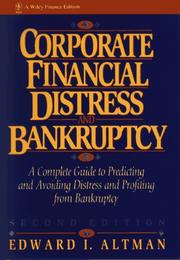
Altman created the Z-score and this is the academic reference — prediction models, recovery rates, the empirical literature on default. Read it for the evidence base underneath Moyer's practice.

Owsley and Kaufman on running a restructuring from the advisor's chair: fiduciary duties, creditor committees, exclusivity, and the negotiation dynamics of a Chapter 11 plan. The catalogue files it with its full subtitle.
The Law and the Institution
BeginnerUnderstand Chapter 11 as a legal machine and as a historically contingent institution, and see the modern creditor-on-creditor tactics that are reshaping it.
▸ Study plan for this stage
Pace: About seven weeks for roughly 1,300 pages. Skeel's Debt's Dominion (296 pp) first, ten days - it is an academic legal history of American bankruptcy and of the professional interests that shaped it, and it explains why the American system is unusually debtor-friendly rather than treating that as a n
- Chapter 11 as a machine: the automatic stay, debtor-in-possession status and financing, exclusivity, classification and voting, cram-down, and confirmation
- Skeel's argument that the shape of American bankruptcy law was determined by the professional groups that stood to gain from it - lawyers, bankers, and the railroads before them - rather than by economic logic
- Why the American system leaves management in place while most other systems appoint an administrator, and what that does to negotiating dynamics
- The English scheme of arrangement and the newer restructuring plan, and why forum choice has become a strategic decision
- Cross-border recognition and the coordination problem when a group operates in several jurisdictions
- Liability management exercises: uptiering, drop-down asset transfers, and non-pro-rata exchanges - the mechanics by which a majority creditor group subordinates a minority
- Guarantee stripping and the covenant drafting that permits it, which is why credit agreement language is now a trading input
- Caesars as the case where all three professions collide - the operational restructuring, the fulcrum fight, and the legal machinery - and where the tactics were tested against a court
- Walk through a Chapter 11 case from filing to confirmation and name the decision points at which each creditor class has leverage.
- Why is the American system debtor-friendly, and what does Skeel say produced that outcome?
- What does an English scheme of arrangement allow that Chapter 11 does not, and when would you choose it?
- Explain an uptiering transaction step by step. What credit agreement language makes it possible?
- What was contested in the Caesars case, and what did the examiner's findings establish?
- Having read the whole path, at what point in a company's decline does each of the three professions - turnaround manager, distressed investor, bankruptcy lawyer - actually gain control?
- Take a completed Chapter 11 case and read its docket at four points: the first-day motions, the debtor-in-possession financing order, the disclosure statement and the confirmation order. Write a page on what each document decided. The docket is the primary source this whole stage describes.
- Diagram an uptiering transaction from Caesars Palace Coup - which creditors moved, which assets moved, who was left behind - and then find the covenant provisions in a real credit agreement that would or would not permit it.
- Compare the same hypothetical restructuring under Chapter 11 and under an English scheme of arrangement using Olivares-Caminal: who votes, in what classes, at what thresholds, and who can be crammed down. The forum-shopping decision becomes obvious once the two are side by side.
- Trace Skeel's account of one moment when the law changed - the 1978 Code is the largest - and identify which professional group won. Then ask which group would win if the same statute were rewritten now.
- Return to the capital structure map you built in stage three and rerun it assuming an uptiering has occurred. The recovery to your original fulcrum security is the concrete cost of the tactics Caesars introduced, and computing it closes the path.
Next up: This closes the path: the reader can stabilise the operations, value the claims, locate the fulcrum, and follow the legal machinery and the tactics that now shape the outcome.

A history of American bankruptcy law and of the professional interests that shaped it. Read it first in this stage — it explains why the American system is unusually debtor-friendly, which is not a natural fact.

The comparative and cross-border reference: corporate and sovereign restructuring across jurisdictions, including schemes of arrangement and the English framework. Necessary the moment a restructuring involves more than one country.

Indap and Frumes on the Caesars Entertainment bankruptcy, and the best account of the aggressive creditor-versus-creditor tactics — asset transfers, uptiering, guarantee stripping — that now define large restructurings. Read it last; it is where all three of the earlier professions collide in one deal.
Discussion
Keep reading
Paths that share books, cover the same subject, or open a related topic.