The Best Books on Clean Code and Software Craftsmanship, In Order
This curriculum builds from clean code fundamentals through professional software craftsmanship to advanced design and architectural discipline. Because the learner starts at an intermediate level, it skips introductory programming basics and moves quickly into the canonical texts, layering vocabulary, principles, and real-world practice across four tightly sequenced stages.
The Canon: Core Principles
IntermediateInternalize the foundational vocabulary and rules of clean code — naming, functions, formatting, comments, and error handling — so every subsequent book builds on a shared language.
▸ Study plan for this stage
Pace: 8–10 weeks, ~40–50 pages/day (with code review time). Allocate 5–6 weeks to "Clean Code" (chapters 1–17), then 2–3 weeks to "The Art of Readable Code" (chapters 1–14). Build in 1 week for integration exercises and refactoring practice.
- Naming conventions: meaningful variable, function, and class names that reveal intent and avoid disinformation
- Function design: single responsibility principle, small functions, appropriate parameter counts, and handling side effects
- Code formatting and layout: whitespace, indentation, and visual structure as communication tools for readability
- Comments and documentation: when to write them, what they should convey, and how to avoid redundant or misleading comments
- Error handling: exceptions vs. return codes, try-catch-finally blocks, and using exceptions for control flow
- Surface-level improvements: variable names, function signatures, and loop structures that make code self-explanatory
- Information density and conciseness: removing unnecessary code, simplifying conditionals, and eliminating redundancy
- Consistency and predictability: establishing patterns so readers can anticipate behavior and reduce cognitive load
- Why is a meaningful name more valuable than a comment, and what are the consequences of poor naming in a codebase?
- What is the single responsibility principle, and how does it apply to function design? Give an example of a function that violates it.
- How should you decide whether to write a comment? What makes a comment valuable versus misleading or redundant?
- Compare exception-based error handling with return codes. When is each approach appropriate, and what are the trade-offs?
- How does code formatting (whitespace, indentation, line breaks) contribute to readability, and what visual patterns should you establish?
- What techniques from 'The Art of Readable Code' can you apply to simplify complex conditionals or reduce cognitive load in existing code?
- Refactor a legacy function (200+ lines) by breaking it into smaller, single-responsibility functions with meaningful names; document your naming choices.
- Audit a codebase (your own or open-source) for naming violations: find 5–10 variables/functions with poor names and propose better alternatives with rationale.
- Write a function with intentionally bad comments (redundant, misleading, or outdated), then rewrite it with either no comments or only valuable ones.
- Convert a set of functions using return codes for error handling into an exception-based approach; discuss the readability improvements.
- Reformat a poorly formatted code file (inconsistent indentation, long lines, unclear grouping) using the principles from both books; compare before/after.
- Take a complex conditional statement (nested if-else or boolean logic) and simplify it using techniques from 'The Art of Readable Code' (guard clauses, early returns, helper functions).
Next up: This stage establishes the shared vocabulary and micro-level practices (naming, functions, formatting) that the next stage will apply to larger architectural concerns like class design, modularity, and system-wide patterns.
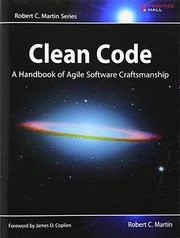
The single most cited book on the subject; it defines the vocabulary (meaningful names, small functions, DRY, etc.) that every other book in this curriculum references. Read it first to establish the baseline mental model.
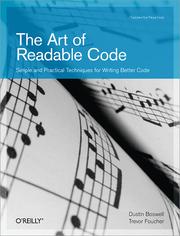
Complements Clean Code with a lighter, example-rich treatment of readability at the line and block level — great for immediately applying the principles you just read about in real code.
Craftsmanship & Professional Mindset
IntermediateUnderstand that clean code is inseparable from professional ethics, discipline, and practice — and adopt the habits (TDD, refactoring, continuous improvement) that sustain quality over time.
▸ Study plan for this stage
Pace: 8–10 weeks, ~40–50 pages/day (mix of reading and reflection). Allocate ~4–5 weeks to "The Pragmatic Programmer" and ~3–4 weeks to "The Clean Coder," with 1–2 weeks for integration and practice.
- The Pragmatic Programmer's philosophy: take responsibility for your craft, avoid duplication (DRY), and treat programming as a continuous learning discipline
- Pragmatic approaches to problem-solving: tracer bullets, prototyping, and estimating to build confidence and manage expectations
- Code as communication: writing code for humans first, machines second, and the role of naming, structure, and clarity in professional work
- Test-Driven Development (TDD) as a professional practice: writing tests first to drive design, catch defects early, and build confidence in refactoring
- Refactoring as a disciplined, incremental process: improving code structure without changing behavior, and recognizing when and how to refactor safely
- The professional mindset: managing your time, saying 'no' when necessary, continuous learning, and taking pride in your work despite pressure or deadlines
- Craftsmanship as habit: deliberate practice, code reviews, mentorship, and the long-term investment required to sustain quality
- What does it mean to be a 'pragmatic programmer,' and how does this mindset differ from simply writing code that works?
- Explain the DRY (Don't Repeat Yourself) principle and describe three concrete ways it improves code maintainability and reduces bugs.
- How does Test-Driven Development (TDD) influence design decisions, and what are the professional benefits of writing tests before implementation?
- What is refactoring, why is it essential to clean code, and what safeguards (from the books) help you refactor with confidence?
- Describe the relationship between professional ethics and code quality. Why should a clean coder refuse to compromise on code standards even under deadline pressure?
- How do 'tracer bullets' and prototyping fit into the pragmatic approach to problem-solving, and when should you use each?
- Implement a small feature (e.g., a calculator, to-do list, or string utility) using TDD: write failing tests first, then implement the minimal code to pass, then refactor. Document your thought process and how the tests guided your design.
- Take a piece of your own legacy code (or a provided example) and refactor it using the principles from both books: eliminate duplication, improve naming, break down complex functions, and add tests. Track what changed and why.
- Conduct a code review (of your own code or a peer's) using a checklist derived from the books: DRY violations, unclear naming, missing tests, opportunities for refactoring. Write a detailed review explaining each issue and suggesting improvements.
- Practice estimation: break down a small project into tasks, estimate each one, implement it, and compare actual vs. estimated time. Reflect on what you learned and how to improve your estimates.
- Write a 'coding standards' document for a hypothetical team, grounded in the pragmatic and clean coder philosophies. Include rules on naming, function size, testing, and refactoring practices.
- Pair program or mentor a junior developer on a feature, explicitly teaching TDD, refactoring, and the 'why' behind clean code practices. Reflect on what habits you modeled and reinforced.
Next up: This stage establishes that clean code is a professional discipline rooted in ethics, habits, and continuous practice—preparing you to dive into the technical mechanics of design patterns, architecture, and larger-scale code organization in the next stage.

Bridges code-level cleanliness to broader engineering habits (DRY, orthogonality, tracer bullets); reading it after Clean Code shows how micro-level discipline scales to a whole career.
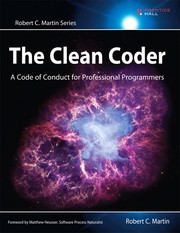
Martin's follow-up shifts from code to the programmer — professionalism, saying no, managing pressure, and TDD discipline. It answers 'why bother keeping code clean under deadlines?'
Design & Structure: Writing Code That Lasts
IntermediateApply clean-code principles at the design level — objects, responsibilities, dependencies, and patterns — so that entire modules and systems remain readable and changeable.
▸ Study plan for this stage
Pace: 8–10 weeks, ~40–50 pages/day (accounting for code examples and reflection time)
- Refactoring as a disciplined, incremental approach to improving code structure without changing behavior
- The Refactoring Catalog: recognizing common code smells and applying targeted refactoring techniques (Extract Method, Move Method, Replace Temp with Query, etc.)
- Seams and seam models as the foundation for introducing testability into legacy code
- The Sprout Method and Wrap Method patterns for isolating and testing difficult-to-test code
- Dependency injection and breaking dependencies to enable testing and modularity
- Characterization tests as a safe way to understand and document legacy code behavior before refactoring
- Identifying and managing hidden dependencies, global state, and tight coupling that prevent change
- Incremental change strategies: making small, verifiable improvements to legacy systems without rewriting
- What is a code smell, and how does it differ from an actual bug? Give three examples from Fowler's catalog and the refactoring techniques that address them.
- Explain the concept of a seam and a seam model. How do seams enable testing in legacy code, and what are the three types of seams Feathers describes?
- When would you use the Sprout Method versus the Wrap Method to add tests to legacy code? Describe a scenario for each.
- How do you write a characterization test, and why is it safer than refactoring legacy code without tests?
- What are the main barriers to testing legacy code, and how can breaking dependencies (through techniques like Dependency Injection or Extract Interface) help overcome them?
- Describe a refactoring sequence: start with a code smell, identify the refactoring technique, and explain how it improves the design.
- Code smell hunt: Take a small legacy codebase (or a deliberately messy code sample) and identify at least five code smells from Fowler's catalog. Document each one with line numbers and the refactoring technique that would address it.
- Refactoring kata: Pick one refactoring technique from Fowler (e.g., Extract Method, Move Method, Replace Temp with Query) and apply it to a provided code sample. Write before/after code and explain the improvement.
- Seam identification exercise: Given a tightly coupled legacy class, identify at least three seams (object seams, compile-time seams, link seams) where you could introduce tests. Sketch the seam model for each.
- Characterization test writing: Write 5–10 characterization tests for a legacy function or class to document its current behavior, then use those tests as a safety net while refactoring.
- Dependency breaking practice: Take a class with hard-coded dependencies (e.g., a database connection, file I/O, or external service call) and apply Feathers' techniques (Extract Interface, Dependency Injection, or Sprout Method) to make it testable.
- Refactoring sequence project: Refactor a small legacy module (100–200 lines) through 3–5 incremental steps, writing tests at each stage. Document the code smells you found, the refactorings applied, and the resulting design improvements.
Next up: This stage equips you with the tactical skills and mindset to improve code structure incrementally and safely; the next stage will elevate these practices to the architectural level, showing how to design systems and organize modules for long-term scalability and maintainability.

The definitive catalog of how to safely improve existing code structure; after learning what clean code looks like, this teaches the mechanics of getting there from messy reality.
Most real codebases are legacy; this book gives concrete techniques (seams, characterization tests) for applying everything learned so far to code you didn't write and can't rewrite.
Advanced Mastery: Architecture & Deep Design
ExpertThink about cleanliness and maintainability at the architectural scale — component boundaries, dependencies, and the principles that keep large systems comprehensible for years.
▸ Study plan for this stage
Pace: 8–10 weeks, ~40–50 pages/day. "A Philosophy of Software Design" (~360 pages) takes 3–4 weeks; "Clean Architecture" (~430 pages) takes 4–5 weeks, with 1–2 weeks for review, reflection, and capstone exercises.
- Complexity as the enemy of software design: recognizing and measuring accidental vs. intentional complexity
- Deep modules and shallow modules: designing interfaces that hide complexity and provide power
- Red flags in code (information leakage, temporal coupling, overengineering) and how to spot them early
- Dependency management and the dependency inversion principle: organizing code so high-level policies don't depend on low-level details
- Architectural boundaries and component cohesion: separating concerns so changes in one area don't cascade through the system
- The role of abstraction and naming in making large systems comprehensible over time
- Testability and independence as architectural properties, not afterthoughts
- Balancing pragmatism with principle: knowing when to break rules and why
- What is the difference between accidental and intentional complexity, and why does Ousterhout argue that reducing accidental complexity is the primary goal of software design?
- How do deep modules differ from shallow modules, and why does Martin's Clean Architecture emphasize the importance of clear architectural boundaries?
- What are the main red flags Ousterhout identifies in code, and how do they relate to Martin's discussion of architectural violations?
- Explain the dependency inversion principle and how it enables large systems to remain flexible and testable as they grow.
- How should a team decide on component boundaries, and what role do business rules, frameworks, and infrastructure play in that decision?
- Why is naming and abstraction critical to architectural clarity, and how do poor naming choices create hidden complexity?
- Audit a codebase you maintain: identify 3–5 instances of information leakage or temporal coupling (Ousterhout's red flags). Document them and propose refactorings that move toward deeper modules.
- Map the dependency graph of a real system: draw or generate a diagram showing which layers depend on which. Identify violations of the dependency inversion principle and sketch a corrected architecture.
- Refactor a shallow module into a deeper one: take a utility class or helper function that does too little and hides too little, and redesign its interface to be more powerful and hide more complexity.
- Design a new feature or subsystem from scratch using Clean Architecture principles: define clear boundaries between business logic, use cases, interface adapters, and frameworks. Justify each boundary decision.
- Conduct a naming audit: review a module or component and identify vague, misleading, or overly generic names. Rename them to reveal intent and reduce cognitive load.
- Write a short design document (2–3 pages) for a system you know well, explaining its architectural layers, component boundaries, and key dependencies. Then identify one architectural debt and propose a refactoring strategy.
Next up: This stage equips you to see and shape architecture as a tool for managing complexity and enabling teams to work independently; the next stage will likely focus on translating these principles into concrete practices—testing strategies, refactoring techniques, and team workflows that sustain clean architecture over time.
Offers a counterpoint and complement to Martin's rules-based approach, arguing from first principles about complexity, deep modules, and information hiding — sharpens critical judgment.

Extends clean-code discipline to system structure — SOLID principles, component cohesion, and dependency rules — completing the journey from a single clean function to a clean system.
Discussion
Keep reading
Paths that share books, cover the same subject, or open a related topic.