Behavioral finance: essential books on bias, markets, and money decisions
This curriculum builds a rigorous, layered understanding of behavioral finance starting from its psychological roots, moving through market-level phenomena, and culminating in advanced theory and real-world application. Because the learner starts at an intermediate level, the path skips introductory personal-finance basics and dives straight into the cognitive and emotional mechanics that distort judgment — then scales up to how those distortions aggregate into market mispricings and professional investment practice.
The Psychological Foundations
IntermediateUnderstand the core cognitive biases, heuristics, and dual-process thinking that underpin all of behavioral finance, building the mental vocabulary needed for every later stage.
▸ Study plan for this stage
Pace: 8–10 weeks, ~40–50 pages/day (Kahneman first: 4–5 weeks; Ariely second: 3–4 weeks). Kahneman is denser and foundational; Ariely builds on those concepts with applied examples.
- System 1 vs. System 2 thinking: automatic, fast, intuitive cognition versus deliberate, slow, analytical reasoning
- Anchoring bias and how initial numbers disproportionately influence judgment
- Availability heuristic: judging likelihood based on how easily examples come to mind
- Representativeness heuristic and the base-rate fallacy: overweighting similarity and ignoring statistical base rates
- Loss aversion and the endowment effect: the asymmetry between how we value gains versus losses
- Overconfidence and illusions of understanding: systematic overestimation of our knowledge and predictive ability
- Predictable irrationality: how humans deviate from rational choice theory in consistent, systematic ways across domains (pricing, effort, honesty, social norms)
- The role of emotions, context, and framing in decision-making: how the same choice presented differently triggers different responses
- What is the fundamental difference between System 1 and System 2 thinking, and why does System 1 dominate most of our daily decisions?
- How does anchoring bias work, and why do we remain influenced by initial numbers even when we know they are arbitrary?
- What is the availability heuristic, and how does it lead us to misjudge probabilities in real-world situations?
- Explain the representativeness heuristic and the base-rate fallacy: why do we ignore statistical information when a scenario 'feels' representative?
- What is loss aversion, and how does it differ from simple risk aversion? How does the endowment effect demonstrate loss aversion in action?
- Why are we systematically overconfident in our knowledge and predictions, and what does Kahneman mean by 'illusions of understanding'?
- Give three examples from Ariely's experiments showing how humans behave predictably irrational in ways that contradict standard economic theory.
- How does framing—the way a choice is presented—change our decisions? Provide an example from either book.
- Bias journal: For one week, record 5–10 real decisions you make (large or small). For each, identify which System 1 or System 2 thinking dominated, and which bias or heuristic might have influenced you. Reflect on whether the outcome matched your prediction.
- Anchoring experiment: Ask 5 friends to estimate the percentage of African nations in the UN. Before they answer, have half spin a wheel or pick a random number (high or low). Compare the two groups' estimates. Document how the arbitrary anchor shifts their answers.
- Availability audit: List 10 risks you worry about (plane crashes, shark attacks, car accidents, etc.). Research actual mortality rates. Identify which ones feel more available than they statistically are. Discuss why.
- Loss aversion simulation: Imagine you own a stock worth $100. Scenario A: sell it for a guaranteed $110 gain. Scenario B: 50/50 chance of $220 gain or break-even. Most people choose A. Now reverse it: you're down $100. Scenario C: guaranteed loss of $90. Scenario D: 50/50 chance of losing $200 or nothing. Most choose D. Reflect on why the same underlying risk tolerance flips based on framing.
- Predictable irrationality in your life: Choose one domain from Ariely (pricing, effort, honesty, social norms, procrastination). Design a small personal experiment to test whether you exhibit the irrational pattern he describes. Document your findings.
- Teach-back exercise: Explain System 1 vs. System 2, anchoring, and loss aversion to someone unfamiliar with behavioral finance in 10 minutes. Record yourself or present to a peer. Refine your explanation based on their questions.
Next up: This stage equips you with the cognitive vocabulary and mental models to recognize *why* markets misbehave and investors make systematic errors—the foundation for understanding market anomalies, asset pricing puzzles, and investor behavior in the next stage.

The canonical starting point: Kahneman's System 1 / System 2 framework is the single most-cited theoretical backbone in behavioral finance. Reading this first gives you the precise language — anchoring, availability, loss aversion, overconfidence — that every subsequent book assumes you know.

Ariely's controlled experiments show how irrational patterns are not random but systematic and repeatable, reinforcing Kahneman's theory with vivid economic examples. Reading it second cements the intuition that these biases reliably shape financial decisions.
Investor Psychology and Market Behavior
IntermediateSee how individual cognitive biases scale up to drive investor behavior, asset mispricing, bubbles, and crashes in real financial markets.
▸ Study plan for this stage
Pace: 10–12 weeks, ~40–50 pages/day (approximately 3 weeks per book with overlap for synthesis)
- Prospect theory and loss aversion: how investors overweight losses relative to gains, driving asymmetric risk-taking behavior
- Mental accounting: how investors compartmentalize decisions and treat money differently depending on its source or intended use
- Regret aversion and the disposition effect: why investors hold losers too long and sell winners too early to avoid regret
- Feedback loops between investor sentiment and asset prices: how collective psychology creates self-reinforcing bubbles and crashes
- Irrational exuberance and valuation disconnects: mechanisms by which investor optimism drives prices far above fundamental values
- Animal spirits (confidence, fairness, corruption, money illusion): non-rational psychological forces that systematically move markets
- Herding and information cascades: how investors rationally follow others despite private information, amplifying mispricing
- Anchoring and availability bias in price expectations: how past prices and salient events distort future price forecasts
- How does prospect theory explain why investors are more sensitive to losses than gains, and what does this imply for portfolio construction and market crashes?
- What is mental accounting, and how does Shefrin use it to explain the disposition effect in real investor behavior?
- How do feedback loops between investor sentiment and asset prices create and sustain bubbles, according to Shiller's framework?
- What are the four animal spirits identified by Akerlof and Shiller, and how does each one independently drive systematic deviations from rational pricing?
- How do herding and information cascades amplify the impact of individual cognitive biases on market-wide asset mispricing?
- What evidence does Shiller present that irrational exuberance, rather than rational expectations, best explains historical stock market bubbles and crashes?
- Analyze your own investment decisions (real or hypothetical) using prospect theory: identify where loss aversion or regret aversion may have driven your choices, and compare to what a rational model would predict.
- Create a mental accounting map of how you (or a case-study investor) treat different money sources (salary, bonus, inheritance, trading gains) differently—then evaluate whether this compartmentalization is rational.
- Track a specific asset bubble (historical or current) using Shiller's feedback-loop framework: identify the initial sentiment shift, the price acceleration, the peak, and the crash, noting how each phase reinforces investor psychology.
- Conduct a sentiment analysis on financial media coverage during a bull market vs. a bear market; categorize articles by which animal spirits they invoke (confidence, fairness, corruption, money illusion) and measure how sentiment precedes or lags price movements.
- Design a herding experiment: present a group with ambiguous financial information and observe whether they cascade into a consensus despite private signals; reflect on how this mirrors real market dynamics.
- Backtest a contrarian strategy that bets against extreme sentiment (e.g., short when retail investor positioning is most bullish); evaluate whether exploiting behavioral biases generates alpha in historical data.
Next up: This stage establishes that individual cognitive biases and psychological forces systematically move prices away from fundamentals; the next stage will explore how market microstructure, institutional constraints, and arbitrage limitations prevent rational traders from fully correcting these mispricings.
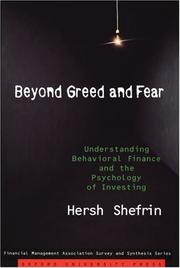
Shefrin directly bridges psychology and investing, showing how biases like representativeness and loss aversion manifest in portfolio decisions and analyst forecasts — the first book here that speaks the language of finance professionals.

Shiller's market-level analysis of speculative bubbles — backed by long-run data — shows how collective psychological forces drive entire asset classes away from fundamental value, a crucial macro complement to Shefrin's micro focus.

Akerlof and Shiller extend behavioral ideas into macroeconomics, explaining how confidence, fairness, and narrative drive economic cycles. Reading it after Shiller deepens the understanding of how psychology shapes markets at the systemic level.
Judgment, Decision-Making, and Bias in Practice
IntermediateDevelop a granular, evidence-based toolkit of specific biases and decision traps, and understand how experts — including financial professionals — fall prey to them.
▸ Study plan for this stage
Pace: 8–10 weeks, ~40–50 pages/day (mix of reading and reflection)
- Mental accounting and how people categorize money into separate mental buckets, affecting spending and investment decisions
- Anchoring bias and how initial numbers disproportionately influence final judgments, especially in financial valuations
- Loss aversion and the asymmetry between the pain of losses and pleasure of gains, driving risk-averse behavior
- Overconfidence and illusion of control, particularly how financial professionals overestimate their predictive ability
- The role of narratives and stories in shaping financial beliefs and behavior, often overriding rational analysis
- Behavioral life-cycle hypothesis and how people's financial choices vary predictably across life stages
- Temporal discounting and present bias: why people systematically undervalue future outcomes
- The interplay between luck, skill, and randomness in financial outcomes, and how people misattribute results
- How does mental accounting explain why people treat a $100 windfall differently from $100 earned through work, and what are the financial consequences?
- Describe anchoring bias with a specific example from investing or negotiation. How would you design a decision process to reduce its influence?
- Why do people experience greater pain from losing $1,000 than pleasure from gaining $1,000, and how does this shape portfolio construction?
- What evidence does Thaler present that even experts and financial professionals are subject to behavioral biases? Give at least two concrete examples.
- How do narratives and stories influence financial decision-making according to Housel? Provide an example of a financial narrative that led to poor outcomes.
- Explain the behavioral life-cycle hypothesis. How do people's financial priorities and behaviors shift across different life stages?
- What is present bias, and why do people consistently choose smaller immediate rewards over larger delayed rewards? How does this affect retirement savings?
- How should investors think about the role of luck versus skill when evaluating past financial performance?
- Mental accounting audit: Track your own spending for one week and categorize expenses into mental buckets (e.g., 'necessities,' 'fun money,' 'investments'). Identify one decision where mental accounting led you to treat similar money differently. Propose a more rational alternative.
- Anchoring experiment: Find three financial articles with initial price targets or valuations. Cover the number, read the analysis, then predict the outcome before revealing the anchor. Compare your prediction to the anchored estimate. Reflect on how the anchor influenced your thinking.
- Loss aversion case study: Analyze a real portfolio (yours or a public example) and identify positions held due to loss aversion rather than fundamental merit. Calculate the opportunity cost of holding these positions over the past 2–3 years.
- Expert overconfidence analysis: Review 5–10 financial forecasts from professional analysts or fund managers made 2–3 years ago. Compare predictions to actual outcomes. Quantify the error rate and discuss what this reveals about overconfidence.
- Narrative deconstruction: Select one major financial bubble or crash (e.g., dot-com, 2008, crypto). Identify the dominant narrative that drove behavior during the boom. Write a one-page analysis of how that narrative overrode rational risk assessment.
- Life-cycle financial plan: Map out your own financial priorities and behaviors across three distinct life stages (e.g., early career, mid-career, pre-retirement). Identify which stage you're in now and whether your current behavior aligns with the behavioral life-cycle hypothesis.
- Luck vs. skill assessment: Choose a financial decision you made (investment, career move, business venture). Break down the outcome into components attributable to skill, luck, and randomness. Discuss how this reframing changes your confidence in repeating the decision.
- Behavioral bias audit in practice: Interview a financial professional (advisor, analyst, trader, or colleague) about a recent decision. Listen for evidence of anchoring, overconfidence, narrative bias, or loss aversion. Write a brief case study without judgment, then discuss how awareness might improve future decisions.
Next up: This stage equips you with a concrete taxonomy of biases and decision traps that will prepare you to explore systemic solutions—how institutions, incentive structures, and behavioral design can mitigate individual irrationality at scale.

Thaler, a Nobel laureate and co-creator of nudge theory, narrates the intellectual history of behavioral economics from the inside, introducing mental accounting and the endowment effect with rigorous yet accessible depth.

Housel translates abstract behavioral concepts into concrete personal and market investing stories, serving as an ideal bridge between academic theory and the real-world financial decisions individuals and professionals actually face.
Advanced Theory and Market Anomalies
ExpertEngage with the academic frontier of behavioral finance — limits to arbitrage, prospect theory, noise trading, and the formal challenge to the Efficient Market Hypothesis.
▸ Study plan for this stage
Pace: 8–10 weeks, ~40–50 pages/day (with 2–3 days per week for deep review and exercises)
- Adaptive Markets Hypothesis (AMH) as an alternative to EMH: how markets adapt and evolve rather than remain perfectly efficient
- Limits to arbitrage: why rational traders cannot always eliminate mispricings due to noise, leverage constraints, and synchronization risk
- Prospect theory and loss aversion: how investors systematically deviate from rational expected utility maximization in decision-making
- Noise trading and irrational investors: the role of liquidity traders and their impact on price discovery and volatility
- Market anomalies and empirical evidence: documented patterns (momentum, reversals, seasonal effects) that challenge market efficiency
- Behavioral foundations of asset pricing: how cognitive biases and emotions drive systematic deviations in valuation and returns
- The formal mathematical and statistical frameworks for modeling behavioral phenomena in financial markets
- What are the key limitations of the Efficient Market Hypothesis, and how does the Adaptive Markets Hypothesis address them?
- Explain the concept of limits to arbitrage: why can't rational traders always eliminate mispricings, and what role does noise play?
- How does prospect theory explain investor behavior differently than traditional expected utility theory, and what are the implications for asset pricing?
- What are the main market anomalies discussed (e.g., momentum, reversals, seasonal patterns), and what behavioral explanations account for them?
- How do noise traders and liquidity constraints affect market efficiency, volatility, and price discovery?
- What is the relationship between behavioral biases (overconfidence, representativeness, anchoring) and observed market anomalies?
- Replicate Lo's statistical tests for market efficiency using historical price data; compare random walk predictions to actual returns and document deviations
- Build a simple agent-based model incorporating noise traders and rational arbitrageurs; simulate market dynamics and measure how mispricings persist or dissipate
- Analyze a real market anomaly (e.g., January effect, momentum) using prospect theory; write a 2–3 page memo explaining the behavioral mechanisms at work
- Conduct a critical literature review: select 3–4 empirical papers cited in Thaler's work and evaluate their evidence for behavioral anomalies versus alternative explanations
- Design a behavioral finance experiment (on paper or via simulation) testing one prediction from prospect theory or limits-to-arbitrage theory; document your hypothesis and expected outcomes
- Create a comparative table mapping market anomalies to specific behavioral biases and arbitrage constraints; identify which anomalies are most resistant to rational explanation
Next up: This stage equips you with the theoretical and empirical toolkit to understand why markets deviate from efficiency and how behavioral factors drive systematic patterns—preparing you to apply these insights to portfolio construction, risk management, and real-world trading strategy in the next stage.

Lo's empirical work systematically documents market anomalies and inefficiencies, providing the quantitative evidence base that formal behavioral finance theory is built upon — a necessary grounding before tackling pure theory.
This landmark academic anthology collects the field's most important papers — Shleifer on limits to arbitrage, De Bondt and Thaler on overreaction — giving the serious learner direct access to the primary literature that defines behavioral finance as a discipline.
Discussion
Keep reading
Paths that share books, cover the same subject, or open a related topic.