Annie Dillard Reading Order: Where to Start
This curriculum moves through Annie Dillard's work in the order she herself largely developed as a writer: first her landmark nature writing, then her more experimental and personal essays, and finally her celebrated book on the craft of writing. Each stage builds the reader's familiarity with her voice, her theological restlessness, and her dense, allusive prose style, so that by the end the craft book reads as both a culmination and a key to everything that came before.
Foundations: Dillard in the Natural World
BeginnerGet acquainted with Dillard's signature voice — her intense, microscopic attention to the natural world, her spiritual questioning, and her lyrical prose — through her most accessible and celebrated works.
▸ Study plan for this stage
Pace: 8–10 weeks total. Weeks 1–6: "Pilgrim at Tinker Creek" (~20–25 pages/day, reading one or two chapters at a sitting to honor its meditative pace). Weeks 7–10: "Teaching a Stone to Talk" (~15–20 pages/day, reading one essay per session and pausing to reflect before moving on).
- Radical Attention: Dillard's practice of sustained, almost obsessive observation of minute natural phenomena — a frog's deflation, a moth's immolation, a weasel's grip — as a spiritual and aesthetic discipline.
- The Stalking Metaphor: In 'Pilgrim at Tinker Creek,' the act of stalking light, animals, and meaning becomes a governing metaphor for how the writer/thinker must approach the world — with patience, stillness, and surrender of ego.
- Seeing vs. Knowing: Dillard's sustained meditation on two modes of perception — the innocent, unmediated 'seeing' of someone newly given sight versus the learned, categorizing vision of the educated adult — and the tension between them.
- The Problem of Fecundity and Cruelty in Nature: Dillard refuses to sentimentalize the natural world; she confronts its extravagant wastefulness, violence, and indifference, and asks what these facts mean for faith and meaning.
- Spiritual Questioning Without Resolution: Both books model a theology of open questions — Dillard circles God, presence, and transcendence without arriving at dogma, treating uncertainty itself as a form of reverence.
- The Essay as Pilgrimage: In 'Teaching a Stone to Talk,' each short essay enacts a journey — physical, intellectual, and spiritual — that mirrors the larger pilgrimage structure of 'Pilgrim at Tinker Creek.'
- Lyrical Prose Style: Dillard's signature techniques — the long, accumulating sentence; the sudden short declarative punch; the unexpected scientific fact dropped into mystical meditation; the shift from micro to cosmic scale within a single paragraph.
- The Writer as Witness: Dillard positions the attentive writer as a moral and almost sacred figure whose job is to see clearly and report faithfully, even when — especially when — what is seen is disturbing or inexplicable.
- In 'Pilgrim at Tinker Creek,' Dillard distinguishes between 'seeing' and 'looking.' What does she mean by each, and why does she consider the former so difficult to recover as an adult?
- How does Dillard reconcile — or deliberately refuse to reconcile — the beauty and the brutality she witnesses in nature? Use specific scenes from 'Pilgrim at Tinker Creek' (e.g., the frog drained by the giant water bug, the Polyphemus moth) to support your answer.
- What role does solitude play in both books? How does being alone in a landscape change what Dillard is able to perceive and articulate?
- In 'Teaching a Stone to Talk,' the title essay meditates on silence and the human hunger for a word from the natural or divine world. What is Dillard ultimately saying about whether that word ever comes?
- How does Dillard use scientific and biological information — about insects, light, evolution, parasites — not as mere fact but as a springboard for philosophical or spiritual inquiry? Give two or three examples across the two books.
- By the end of both books, what portrait of the ideal 'attentive life' has Dillard constructed? What does she seem to believe we owe to the world we inhabit?
- Observation Journal (ongoing): Each week, spend 20–30 minutes outside observing a single small thing — an insect, a patch of bark, a puddle — and write one full page about it in Dillard's mode: begin with pure description, then let the observation spiral outward into memory, question, or metaphor. Compare your instincts to Dillard's technique as you read.
- Sentence Dissection: Choose one paragraph from 'Pilgrim at Tinker Creek' that you find especially powerful. Copy it out by hand, then annotate it: mark every shift in scale (micro to macro), every tonal shift (lyrical to clinical), and every rhetorical move. Write a one-paragraph reflection on what makes it work.
- The Two-Modes-of-Seeing Exercise: After reading Dillard's chapter on seeing, spend five minutes looking at a familiar room or outdoor space as if you have never seen it before — no labels, no categories. Then write for ten minutes. Afterward, write a second passage about the same space using all your knowledge and categorization. Reflect on the difference in what you noticed.
- Essay-to-Essay Dialogue: Pick one essay from 'Teaching a Stone to Talk' and identify its central question. Then find the chapter in 'Pilgrim at Tinker Creek' that most directly speaks to the same question. Write a one-page 'conversation' between the two texts: where do they agree, where do they diverge, and what does the juxtaposition reveal?
- Imitation Piece: Write a 400–600 word personal essay in Dillard's style about a moment of unexpected encounter with the non-human world (an animal, a weather event, a plant). Deliberately practice her techniques: the grounding concrete detail, the pivot to a large question, and at least one surprising fact woven into the meditation.
- Reading Aloud Sessions: Once per week, read a passage of at least one full page aloud. Pay attention to rhythm, breath, and where sentences demand you slow down. Keep a brief log of which passages felt most 'musical' and try to articulate why — this builds sensitivity to her prose style that silent reading alone may miss.
Next up: Mastering Dillard's observational voice and spiritual questioning in these nature-centered works gives the reader the interpretive tools needed to follow her as she turns that same fierce attention inward — toward memory, craft, and the life of the writer itself — in her more autobiographical and meta-literary works.
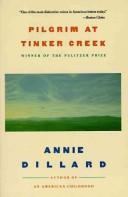
Her Pulitzer Prize-winning masterpiece and the essential starting point. A year of solitary observation in Virginia's Blue Ridge introduces every major theme — presence, violence, beauty, and God — in her most sustained and accessible nature writing.
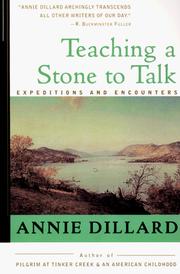
A collection of short essays that extends the nature writing of Tinker Creek into new landscapes (the Galápagos, the Arctic, the Pacific Northwest). Reading it second lets you see how her ideas travel and compress into the essay form.
Going Deeper: Memoir and Place
IntermediateUnderstand how Dillard turns autobiography and specific place into literature, moving from pure nature observation toward the personal and historical essay.
▸ Study plan for this stage
Pace: 6–7 weeks total: Weeks 1–4 for "An American Childhood" (~30 pages/day, reading slowly and annotating for sensory detail and memory craft); Weeks 5–7 for "The Writing Life" (~20 pages/day, pausing after each chapter to journal reflections on Dillard's writerly self-portrait).
- Autobiographical consciousness: how Dillard constructs a 'self' on the page through selective memory rather than chronological biography, especially in 'An American Childhood'
- Place as character: Pittsburgh in 'An American Childhood' is not backdrop but an active shaping force — its geography, seasons, and social texture form the narrator's identity
- The awakening of perception: Dillard's central theme in 'An American Childhood' — the child's gradual discovery that she is a conscious being in a world of things — and how prose style mirrors that awakening
- Prose as obsession: 'The Writing Life' reframes writing itself as a subject worthy of memoir, showing that the act of making literature is as dramatic and place-bound as any adventure
- The writer's physical world: in 'The Writing Life,' specific locations (the study, the cabin, the Stunt Pilot's sky) become metaphors for the creative process, extending Dillard's place-making technique
- Metaphor and analogy as argument: Dillard uses extended metaphors (the moth and flame, the stunt pilot, chopping wood) not as decoration but as the primary vehicle of her ideas
- Self-erasure and self-revelation: both books balance intimacy and reticence — Dillard reveals the interior life while deliberately withholding conventional confessional detail
- The personal essay as a form of inquiry: both books demonstrate that memoir and the essay are not records of conclusions but enacted processes of thinking and noticing
- In 'An American Childhood,' how does Dillard use the city of Pittsburgh — its rivers, neighborhoods, and seasons — to externalize the internal development of her consciousness? Cite at least two specific passages.
- What does Dillard mean by 'waking up' in 'An American Childhood,' and how does this metaphor of awakening organize the book's structure and prose style?
- In 'The Writing Life,' how does Dillard transform the mundane physical facts of writing (the desk, the schedule, the failed drafts) into a form of high drama? What literary techniques make this possible?
- Both books are, in different ways, memoirs — yet neither reads like a conventional autobiography. What does Dillard leave out, and what does that omission reveal about her definition of a meaningful life on the page?
- How does the 'stunt pilot' chapter in 'The Writing Life' function as an extended analogy? What is Dillard actually arguing about the craft of writing through Rahm's flying?
- Taken together, how do 'An American Childhood' and 'The Writing Life' redefine 'place'? Is place always geographical, or does Dillard expand the concept to include mental and creative space?
- Imitation paragraph: Choose one scene from 'An American Childhood' in which a specific Pittsburgh location triggers a memory or insight. Write a 300-word imitation passage in which your own childhood place performs the same function — let the place do the psychological work, not explicit statement.
- Metaphor mapping: In 'The Writing Life,' identify every extended metaphor Dillard uses (moth/flame, log-splitting, the stunt pilot, etc.). For each, write one sentence explaining the exact aspect of the writing process it illuminates. Then invent one original metaphor for a creative struggle of your own.
- Structural outline of 'An American Childhood': Map the book's chapters against the 'awakening of perception' arc. Where does the narrator's consciousness shift? Create a simple timeline or diagram showing how Dillard escalates the child's awareness — use chapter titles and key scenes as your markers.
- Close-reading journal: Select three passages (one from each book, plus one of your choice) where Dillard's sentence rhythm changes noticeably — speeds up, slows down, or fragments. Annotate each passage: what is the rhythm doing emotionally and intellectually at that moment?
- Omission exercise: Write a one-page autobiographical sketch of a formative year, then deliberately cut everything that is 'merely biographical' (dates, family facts, plot). What remains? Compare your surviving sentences to Dillard's technique of selective self-revelation.
- Discussion or written reflection: Both books end on images rather than conclusions. Reread the final two pages of each book. Write a comparative paragraph arguing what each ending 'says' about Dillard's relationship to the past and to the act of writing itself.
Next up: Mastering how Dillard fuses personal memory and specific place in these two books equips the reader to tackle her more philosophically and historically ambitious work, where the 'self' expands outward to encompass theology, science, and civilization itself.
Her memoir of growing up in 1950s Pittsburgh shows the same fierce attentiveness she brings to nature now turned inward on memory and consciousness — a crucial bridge between her nature writing and her more personal essays.
A short, luminous meditation on what it costs to write. Placed here — after you know her voice well — it reads as intimate self-disclosure, and its metaphors (the weasel, the stunt pilot) echo works you have already read.
The Full Range: Essays, Fiction, and History
ExpertEncounter Dillard at her most experimental and ambitious — her historical novel, her collected essays, and her account of witnessing a total solar eclipse — to see the full arc of her literary project.
▸ Study plan for this stage
Pace: 6–8 weeks total: Weeks 1–4 for *For the Time Being* (~20–25 pages/day, allowing time to pause and re-read dense passages); Weeks 5–8 for *The Abundance* (~15–20 pages/day, reading each essay as a self-contained unit before moving on).
- Fragmentation as form: how *For the Time Being* uses discontinuous, braided sections (sand, birth, China, Teilhard, numbers, now) to mirror its philosophical argument about individuality and mass existence
- The 'now' problem: Dillard's sustained meditation on what it means to exist as a singular person within the overwhelming crush of human history and sheer population
- Teilhard de Chardin's influence: how the Jesuit paleontologist's ideas about the noosphere and divine immanence in matter thread through *For the Time Being* as both subject and structural spine
- The essay as revelation: in *The Abundance*, how each collected piece — including the solar eclipse account 'Total Eclipse' — treats the act of witnessing as a moral and aesthetic obligation
- Radical attention and its cost: across both books, Dillard's insistence that truly seeing the world (a solar eclipse, a Tao worker's deformed babies, a Hasidic tale) is destabilizing, even dangerous
- Collage and juxtaposition: how Dillard places wildly disparate materials — geology, theology, travel reportage, natural history — side by side to generate meaning through friction rather than argument
- The writer as witness and pilgrim: the recurring autobiographical stance in both books of a narrator who travels, watches, and reports back from the edge of comprehension
- Mortality and scale: how both books force a confrontation with human smallness — against geological time in *For the Time Being*, against the blotted-out sun in 'Total Eclipse'
- In *For the Time Being*, what is Dillard ultimately arguing about the value of the individual human life when set against the billions who have lived and died — and does she resolve the tension or leave it open?
- How does the recurring figure of Teilhard de Chardin function in *For the Time Being* — is he a hero, a foil, a structural device, or something more ambiguous?
- In 'Total Eclipse' (collected in *The Abundance*), Dillard describes the experience as terrifying rather than merely beautiful — what does that terror reveal about her larger philosophy of attention and perception?
- How does the braided, non-linear structure of *For the Time Being* reinforce or complicate its thematic content? Would a conventional essay or narrative form have produced the same meaning?
- Across the essays gathered in *The Abundance*, what consistent preoccupations or obsessions emerge — and how do they reframe or deepen what you encountered in *For the Time Being*?
- By the end of both books, how would you characterize Dillard's relationship to religious or spiritual belief — is she a mystic, a skeptic, an agnostic witness, or something that resists easy categorization?
- Structural mapping: Draw or chart the recurring section-titles of *For the Time Being* (Sand, Birth, China, Tao, Numbers, Israel, Encounters, Now, Evil) and, for each, write one sentence on its dominant image and one sentence on how it connects to the book's central question about mass humanity and individual meaning.
- Imitation exercise: Choose any two-page spread from *For the Time Being* where Dillard juxtaposes two seemingly unrelated subjects. Write your own two-page braided passage that places a personal observation alongside a historical or scientific fact, using white space and section breaks the way Dillard does.
- Close reading of 'Total Eclipse': Read the essay twice — once straight through, once with a pencil. On the second pass, mark every moment where Dillard shifts register (from reportage to metaphor, from terror to analysis). Write a one-page reflection on how those shifts create the essay's cumulative effect.
- Comparative essay: Write 500–700 words comparing how *For the Time Being* and at least two essays from *The Abundance* handle the theme of scale — specifically, the contrast between the cosmic or geological and the intimately human.
- Research dialogue: Read a short passage by or about Teilhard de Chardin (his concept of the Omega Point or the noosphere). Then return to the Teilhard sections of *For the Time Being* and annotate them: where is Dillard faithful to his ideas, where does she push back, and where does she seem to use him as a mirror for her own doubts?
- Reading journal — 'the sentence of maximum pressure': Throughout both books, collect 8–10 sentences that feel, to you, like the most compressed or explosive in the text. For each, write two or three sentences explaining what makes it work — syntactically, imagistically, and philosophically.
Next up: Having now traced the full arc of Dillard's literary project — from fragmented meditation to collected revelation — the reader is equipped to step back and engage with critical and biographical perspectives that contextualize her entire body of work within American literary and intellectual history.
Her most philosophically demanding book, weaving together Teilhard de Chardin, Chinese archaeology, and Jewish mysticism. The density rewards readers who already know her habits of mind from earlier works.

A career-spanning anthology of her best prose, selected and revised by Dillard herself. Reading it last lets you trace the full arc of her development and revisit earlier themes with fresh eyes.
Discussion
Keep reading
Paths that share books, cover the same subject, or open a related topic.