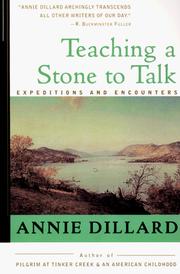
Start with Teaching a Stone to Talk. This is a deliberate break from the standard advice, and the reason is practical: Dillard's prose is intense, aphoristic and relentlessly attentive, and it either thrills you or exhausts you. The essay collection lets you find out in forty pages instead of three hundred. It also contains "Total Eclipse", which is probably the best single piece of prose she ever wrote and one of the best American essays of the century.
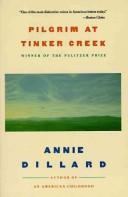
If it lands, go immediately to Pilgrim at Tinker Creek. That is the book she is famous for, it won the Pulitzer at twenty-nine, and it is a genuine achievement — a year of close observation along a Virginia creek that turns into a sustained theological argument about a world containing both mantis reproduction and light on water. The reason not to start there is simply that it is three hundred pages at a single pitch of intensity, with no narrative to carry you, and readers who meet Dillard there frequently give up in the first fifty pages and conclude she is not for them.
The middle books
An American childhood is the memoir and the most conventionally enjoyable thing she wrote — a Pittsburgh girlhood, a mother who was very funny, the specific moment a child notices that she is a person noticing. If someone in your life reacts badly to nature writing, this is the Dillard to give them.
The writing life is short, famous among writers, and worth an honest caveat: it is not a craft manual, whatever its shelf placement suggests. It is a set of parables about the difficulty and strangeness of the work, including the stunt-pilot chapter that has almost nothing to do with sentences. Read it in an afternoon and take it as testimony, not instruction. Writers looking for technique will be frustrated.
The hard one
For the time being is the late book and the most demanding. It braids together clouds, sand, birth defects, a Chinese archaeological dig, Hasidic teaching and the theology of Teilhard de Chardin, cutting between them without transitions and refusing to resolve the question it is circling, which is how to hold a benevolent creation alongside random suffering. Readers split on it sharply: some think it is her masterpiece, others find the collage technique evasive. It is unquestionably not a place to begin.
The shortcut, and when to take it
The abundance is a career-spanning selection, drawing from the books above and adding an introduction. It is a legitimate alternative entry point if you would rather sample than commit, and it is the right gift for someone who has never heard of her. The reason it is not our recommended start is that Dillard's long books are built as arguments, and the excerpts, however good, cut them into fragments.
How to actually read her
Two concrete pieces of advice, both born from watching people bounce.
Read short. Twenty pages of Pilgrim at Tinker Creek at a sitting is plenty. The prose is written at the density of poetry and consuming it at novel speed flattens it into a list of beautiful sentences.
Do not expect a thesis. Dillard poses the problem of a world that is simultaneously gorgeous and appalling, and she does not solve it. If you come looking for a conclusion, the books will read as evasive. If you come for the quality of attention, they are close to unmatched.
Explore more essay and nature writing paths on Discover.
Follow the full ordered path here: Annie Dillard Reading Order: Where to Start.