Aesthetics: The Best Books on the Philosophy of Art, in Order
This curriculum is designed for expert-level readers who already possess philosophical literacy and want to master aesthetics and the philosophy of art from its classical roots through contemporary debates. The path moves from the foundational texts that established the core problems — beauty, taste, form, and expression — through the analytic turn that redefined what counts as art, and finally into cutting-edge theory that challenges, extends, and critiques the canon. Each stage presupposes the conceptual vocabulary built in the one before it.
The Classical Foundations
ExpertCommand the originating questions of aesthetics: the nature of beauty, the sublime, taste as a faculty, and the relationship between art and truth, as posed by the discipline's founding figures.
▸ Study plan for this stage
Pace: 12–14 weeks, ~40–50 pages/day (approximately 3–4 weeks per book, accounting for dense philosophical prose requiring multiple readings of key passages)
- Mimesis and catharsis: Aristotle's account of how art represents reality and produces emotional and moral effects through tragedy and comedy
- The transcendental conditions of aesthetic judgment: Kant's theory of disinterested pleasure, the free play of imagination and understanding, and the universal communicability of taste
- The sublime as a distinct aesthetic category: the difference between beauty and the sublime in Kant, and how the sublime reveals the limits of sensible representation
- Art as the sensuous manifestation of truth: Hegel's conception of art as a mode of truth-disclosure alongside religion and philosophy, and the historical development of art forms
- Form and content in aesthetic experience: how the three thinkers understand the relationship between a work's material form and its meaning or effect
- The faculty of taste: competing accounts of whether aesthetic judgment is subjective, universal, or grounded in reason across Aristotle, Kant, and Hegel
- The relationship between art and nature: imitation, purposiveness, and the organic unity of artworks
- Historical consciousness in aesthetics: how Hegel's framework introduces historical development and the 'end of art' as a challenge to earlier foundational assumptions
- What is mimesis in Aristotle's account, and how does it differ from mere copying? How does catharsis function as the proper effect of tragedy?
- Explain Kant's concept of disinterested pleasure and why he argues that aesthetic judgments about beauty are subjective yet universal. What role do the imagination and understanding play?
- How does Kant distinguish between beauty and the sublime, and what does the sublime reveal about human reason and sensibility?
- According to Hegel, what is the relationship between art and truth? How does art differ from religion and philosophy as modes of truth-disclosure?
- Compare the three thinkers' accounts of taste: Is taste a faculty grounded in reason (Aristotle), in the free play of cognitive powers (Kant), or in historical consciousness (Hegel)?
- What is the significance of form in aesthetic judgment across these three texts? How do Aristotle's unity of action, Kant's purposiveness without purpose, and Hegel's organic form relate?
- Close-read Aristotle's definition of tragedy (Poetics VI) and trace how each element (plot, character, thought, diction, melody, spectacle) contributes to catharsis; apply this framework to analyze a contemporary film or play
- Map Kant's argument in the 'Analytic of the Beautiful' (Critique of Judgment §1–22): diagram the four moments of aesthetic judgment and explain why each supports the claim that taste is subjective yet universal
- Write a comparative analysis of how Aristotle and Kant each explain why we find pleasure in representations of painful or fearful things (tragedy, the sublime)
- Analyze a single artwork (painting, sculpture, poem) through Hegel's lens: identify how it embodies the sensuous manifestation of a universal truth, and consider what historical moment it belongs to
- Create a three-column table comparing Aristotle, Kant, and Hegel on: the nature of beauty, the role of the artist's intention, the relationship between form and content, and the universality of aesthetic judgment
- Debate the 'end of art' thesis: using evidence from all three texts, argue for or against Hegel's claim that art's historical role as a primary vehicle of truth has been superseded by philosophy and religion
Next up: This stage establishes the foundational questions and competing frameworks that all subsequent aesthetics must either build upon, refine, or reject—preparing you to engage with modern and contemporary challenges to these classical positions (such as the critique of taste, the expansion of art's definition, and the politics of aesthetic judgment).
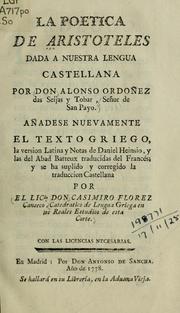
The first systematic theory of art as mimesis, establishing the vocabulary of form, plot, catharsis, and genre that every subsequent theory must reckon with. Read first to anchor all later debates in their origin.

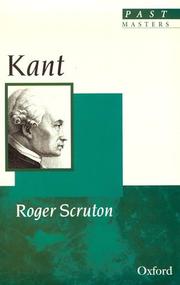
The pivotal text of modern aesthetics: Kant's analysis of pure judgments of taste, the free play of faculties, the sublime, and aesthetic disinterestedness sets the agenda for virtually all analytic and continental aesthetics that follows.
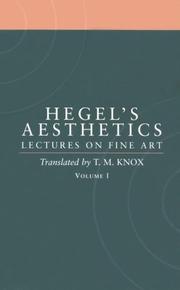
Hegel's grand theory of art as the sensuous shining of the Idea, his tripartite history of symbolic/classical/romantic art forms, and his provocative 'end of art' thesis make this the essential counterweight to Kant before entering modern theory.
Expression, Form, and Experience
ExpertUnderstand the major 19th–20th century theories — expressionism, formalism, and pragmatist aesthetics — that reacted against Kantian and Hegelian idealism and grounded art in feeling, form, and lived experience.
▸ Study plan for this stage
Pace: 12–14 weeks, ~40–50 pages/day. Collingwood (4 weeks), Dewey (4 weeks), Adorno (4–5 weeks). Allocate extra time for Adorno's dense theoretical apparatus and cross-textual synthesis.
- Collingwood's distinction between craft and art: art as imaginative expression of emotion, not technical production or imitation
- The amusement theory and its rejection: why art is not entertainment or magic, but a vehicle for emotional clarification
- Dewey's continuity thesis: art emerges from ordinary experience and aesthetic experience is a heightened form of natural interaction with the world
- Dewey's emphasis on the lived body and perception: how aesthetic experience integrates sensation, emotion, and meaning in dynamic interaction
- Formalism's focus on intrinsic properties: the artwork's material form, structure, and internal relations as primary to aesthetic meaning
- Adorno's negative dialectics applied to art: how artworks embody social contradictions and resist instrumental rationality through formal autonomy
- The culture industry critique: Adorno's analysis of how mass production and standardization undermine authentic aesthetic experience
- Reconciling expression, form, and experience: how these three theories address the gap between subjective feeling, objective structure, and historical mediation
- How does Collingwood distinguish genuine art from craft, amusement, and magic, and what role does emotion play in his definition?
- What is Dewey's continuity thesis, and how does it challenge the idea that aesthetic experience is separate from ordinary life?
- How do Dewey's concepts of 'having an experience' and the 'live creature' ground aesthetics in embodied, temporal perception?
- What is formalism's core claim about how artworks generate meaning, and how does it differ from expression theory?
- How does Adorno's negative dialectics and concept of 'autonomous art' respond to both mass culture and traditional aesthetics?
- What is the culture industry, and how does Adorno argue it prevents genuine aesthetic experience?
- Close reading: Select one chapter from Collingwood (e.g., Part III on 'The Theory of Imagination') and write a 2–3 page summary identifying his key arguments against craft and amusement theories.
- Comparative analysis: Choose a single artwork (painting, poem, or film) and analyze it through both Collingwood's expression theory and formalist principles—what does each theory reveal or obscure?
- Phenomenological observation: Spend 20–30 minutes with an artwork in person or in high-quality reproduction. Document your lived experience in detail (sensations, emotions, temporal unfolding), then reflect on how Dewey's categories ('having an experience,' integration of elements) apply.
- Culture industry audit: Identify three examples of mass-produced cultural products (e.g., streaming content, advertising, commercial music) and analyze them against Adorno's critique—where do they standardize, commodify, or foreclose critical thought?
- Synthesis essay: Write a 4–5 page essay addressing a tension between the three theorists—e.g., 'Can Dewey's pragmatist aesthetics accommodate Adorno's critique of the culture industry?' Use textual evidence from all three books.
- Dialectical mapping: Create a visual diagram or outline showing how Adorno's negative dialectics both incorporates and critiques elements of Collingwood's expressionism and Dewey's pragmatism.
Next up: This stage establishes how 20th-century thinkers grounded aesthetics in subjective expression, perceptual experience, and formal autonomy—preparing you to examine how later theories (poststructuralism, identity politics, institutional critique) challenge or decenter these humanist and modernist assumptions.
The most rigorous philosophical defense of the expression theory: art as the imaginative clarification of emotion. Read before Dewey to see the idealist version of the experience-centered approach.
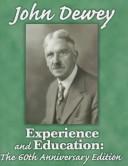
Dewey's pragmatist masterwork dissolves the boundary between art and ordinary experience, offering a naturalistic and democratic alternative to both formalism and idealism — essential for understanding 20th-century American aesthetics.
Adorno's posthumous magnum opus synthesizes Hegel, Kant, and Marx into a critical theory of modern art's autonomy and social truth-content, and is indispensable for understanding the Frankfurt School's lasting influence on aesthetics.
The Analytic Turn: Defining Art
ExpertMaster the analytic philosophy of art's central debates: the definition of art, the ontology of artworks, representation, expression, and the institutional and historical theories that emerged from Wittgenstein's challenge.
▸ Study plan for this stage
Pace: 8–10 weeks, ~40–50 pages/day with 2–3 days per week for reflection and exercises. Goodman (4 weeks), Danto (2.5 weeks), Dickie (1.5 weeks), final synthesis (1 week).
- Goodman's symbol systems and notational density: how artworks function as symbols that denote, exemplify, and express through different notational schemes (dense vs. discrete systems)
- Aesthetic properties and symptoms of the aesthetic: Goodman's rejection of the 'aesthetic attitude' in favor of analyzing how artworks engage cognitive systems differently than non-artworks
- Danto's indiscernibles problem: the philosophical puzzle that identical objects can have radically different ontological and aesthetic status depending on their history and interpretation (e.g., the Brillo Box)
- The transfiguration thesis: how artworks transform ordinary objects through interpretation, context, and narrative; the role of the artworld in conferring art status
- Institutional theory of art (Dickie): art is defined not by intrinsic properties but by an object's relationship to the artworld—the network of artists, critics, curators, and audiences that confers candidacy for appreciation
- The problem of definition: why traditional essentialist definitions of art fail and how analytic philosophy moves toward historical, contextual, and institutional criteria
- Representation and expression as learned, culturally-mediated systems rather than natural or universal capacities
- The ontological status of artworks: what kinds of things artworks are (types vs. tokens, abstract vs. concrete, historical vs. ahistorical)
- What is Goodman's critique of the 'aesthetic attitude,' and how does his account of symbol systems offer an alternative explanation for what makes something aesthetic?
- Explain the indiscernibles problem using Danto's Brillo Box example: why can two perceptually identical objects have different ontological statuses, and what role does interpretation play?
- How does Danto's concept of 'transfiguration' differ from Goodman's account of exemplification, and what does each theory emphasize about the relationship between artworks and their contexts?
- According to Dickie's institutional theory, what makes something a candidate for appreciation as art, and how does the 'artworld' function in conferring art status?
- What are the strengths and weaknesses of each theory (Goodman, Danto, Dickie) in addressing the problem of defining art? Can they be integrated?
- How do these three philosophers respond to the challenge posed by ready-mades and conceptual art to traditional definitions of art?
- Close reading exercise: Select one chapter from Goodman on symbol systems (e.g., on notation or exemplification). Annotate it, identify his main argument, and write a 500-word summary explaining how his framework differs from traditional aesthetics.
- Indiscernibles mapping: Take Danto's Brillo Box and create a visual/conceptual map showing all the contextual, historical, and interpretive factors that make it art (vs. a commercial product). Then apply this framework to a contemporary artwork of your choice.
- Institutional theory application: Attend or research a real artworld event (gallery opening, artist talk, museum acquisition, etc.). Document the roles of artists, curators, critics, and audiences. Write a 750-word analysis of how Dickie's theory explains what happened.
- Comparative case study: Choose an artwork that challenges all three theories (e.g., a found object, a performance piece, or a conceptual work). Write a 1000-word essay analyzing how Goodman, Danto, and Dickie would each account for it, and identify gaps in their frameworks.
- Symbol system analysis: Select a non-Western artwork or a contemporary multimedia work. Using Goodman's vocabulary (denotation, exemplification, expression, density, repleteness), analyze how it functions as a symbol system and what aesthetic properties it activates.
- Debate preparation: Prepare arguments for and against each theory (Goodman's cognitive approach, Danto's interpretive approach, Dickie's institutional approach). Practice articulating the strongest objection to each and the best response.
Next up: This stage establishes the analytic philosophy framework for defining art and understanding artworks as ontologically complex objects embedded in historical, institutional, and interpretive contexts—preparing you to examine how these definitions handle specific art forms (literature, music, visual art) and how they address aesthetic experience, value, and criticism in subsequent stages.

Goodman's rigorous symbol-theoretic framework — autographic vs. allographic arts, denotation, exemplification — transformed the philosophy of art into a branch of epistemology and set the terms for analytic debates on representation and ontology.
Danto's response to Warhol's Brillo Box produces the most influential institutional/historical definition of art ('the artworld') and the concept of 'aboutness'; read after Goodman to see how ontology and interpretation intersect.

Dickie's refined institutional theory directly engages and corrects Danto, making explicit the social and procedural conditions for art-status — a compact, essential text for mastering the definition debate.
Ontology, Interpretation, and Value
ExpertEngage the deepest contemporary problems: the ontological status of artworks across media, the logic of interpretation, the nature of aesthetic experience, and the relationship between aesthetic and moral value.
▸ Study plan for this stage
Pace: 8–10 weeks, ~40–50 pages/day, with 2–3 days per week dedicated to synthesis and reflection
- Ontological status of artworks: distinguishing between types (physical objects, abstract objects, performances, installations) and their persistence conditions across media
- The work-object distinction: understanding how artworks relate to their material substrates and why this matters for identity and value
- Interpretation as a constrained but open-ended practice: the logic of multiple valid interpretations without collapsing into relativism
- Aesthetic experience as a distinctive mode of engagement: its phenomenological character and relationship to cognitive and emotional responses
- The autonomy and normativity of aesthetic judgment: how aesthetic claims differ from factual claims while remaining objective
- Aesthetic value versus moral value: whether aesthetic and ethical evaluation can conflict, and how they relate to human flourishing
- Medium-specificity and cross-media aesthetics: how ontological categories shift across literature, visual art, music, and performance
- The role of intention, convention, and context in determining what counts as an artwork and how it should be interpreted
- What is the ontological status of a literary work, a painting, and a musical composition, and how do their persistence conditions differ?
- How does Lamarque distinguish between a work and its object(s), and why is this distinction philosophically important?
- Can an interpretation be both constrained by textual/artistic features and genuinely open-ended? How does Lamarque resolve this tension?
- What makes aesthetic experience distinctive from other modes of engagement (e.g., moral, cognitive, practical), and what role does disinterestedness play?
- How can aesthetic judgments be objective or normative without being reducible to facts about the object or the subject's psychology?
- Is there a genuine conflict between aesthetic and moral value, or are they ultimately compatible? What does Lamarque argue?
- How do the ontological categories and interpretive practices differ across different artistic media, and what does this reveal about art as such?
- Ontological mapping exercise: Select three artworks from different media (e.g., a novel, a painting, a film). For each, write a detailed account of its ontological status—what is the work itself? What are its material substrates? How does it persist through time and change? Compare your analyses.
- Work-object analysis: Choose a specific artwork and identify all the distinct objects that could be said to constitute or instantiate it. Explain which Lamarque's framework would identify as the work and which as objects, and defend your interpretation.
- Interpretation case study: Take a literary text or artwork with multiple plausible interpretations. Write three competing interpretations, then analyze which features of the work constrain or support each one. Reflect on whether all three can be valid simultaneously and why.
- Aesthetic experience journal: Over two weeks, document 4–5 instances of aesthetic engagement (art, music, nature, design). For each, describe the phenomenology: What was your attention focused on? What emotions or thoughts arose? How did this differ from non-aesthetic engagement with similar objects?
- Aesthetic vs. moral value debate: Identify a case where aesthetic and moral values seem to conflict (e.g., a morally troubling artwork that is aesthetically powerful). Write a structured argument for why one value should take precedence, then write the opposing view. Evaluate how Lamarque's framework illuminates the disagreement.
- Medium-specificity analysis: Compare how a story functions as a novel versus as a film adaptation. What interpretive possibilities open or close? How does the ontological status of the work shift? What does this reveal about medium-specific aesthetics?
Next up: This stage establishes the foundational ontological and evaluative frameworks necessary for the next stage, which will likely apply these theoretical tools to specific contemporary debates—such as digital art, appropriation, institutional critique, or the aesthetics of the everyday—where the questions of what artworks are and how we should value them become urgently practical.
A rigorous analytic treatment of what artworks are as a distinct ontological category — neither mere physical objects nor abstract types — synthesizing decades of debate and providing a stable platform for questions of interpretation and value.
Eaton's careful examination of the relationship between aesthetic and moral value — including the ethicism vs. autonomism debate — is essential reading for understanding how contemporary aesthetics engages normative philosophy.

A comprehensive, analytically rigorous survey of the entire field that doubles as a research tool: read last in this stage to consolidate and map all the debates encountered across the curriculum.
Discussion
Keep reading
Paths that share books, cover the same subject, or open a related topic.