Yuval Noah Harari Reading Order: Where to Start
Harari's popular work is only four books, written to be read in the order he published them: Sapiens on the past, Homo Deus on the future, 21 Lessons on the present, and Nexus on information. That is a short path, and this one does not pad it with the illustrated adaptations, which cover the same ground for a different audience. What it does add is the academic military history he wrote before Sapiens, and a final stage of books by specialists who dispute his central claims — because Harari's grand narratives are exactly the kind that read as settled fact until you meet the argument on the other side.
Start Here: Sapiens
BeginnerGet the shared-fiction thesis that every later Harari book assumes, and the sweep of human history it is built on.
▸ Study plan for this stage
Pace: 3–4 weeks for 456 pages. Sapiens is written to be read quickly and most people do — 30 pages a day is unhurried. Read it that way first, then slow down. One framing note before you start, offered neither as endorsement nor as dismissal: Sapiens is one of the most widely read history books of the cen
- The shared-fiction thesis: Homo sapiens dominates because we can believe collectively in things that do not exist independently of that belief — money, nations, corporations, human rights, gods
- The Cognitive Revolution around seventy thousand years ago is Harari's starting point, and he treats a change in language and imagination as the hinge of the whole species' history
- The Agricultural Revolution is presented as history's biggest fraud — more calories, worse lives, and a trap that could not be exited once populations grew
- The three great unifiers Harari identifies — money, empire and universal religion — are the organising frame of the book's middle third
- The Scientific Revolution in his account begins with the admission of ignorance, which is what links it to European imperialism and to capitalism as a single package
- Harari's method is aggressive compression: seventy thousand years in four hundred pages means every chapter is choosing one interpretation from several available ones, usually without saying so
- Every later Harari book is an extension of this argument and none of them restates it, which is why this is the only correct starting point
- What exactly is a shared fiction in Harari's sense, and what distinguishes it from a lie, a convention or a fact?
- What is his case that the Agricultural Revolution made individual lives worse, and what evidence does he offer for it?
- How do money, empire and religion each unify, and does the three-part scheme illuminate the evidence or organise it?
- Where does Sapiens state a contested interpretation as though it were settled? Find at least two places.
- What is Harari's account of why Europe rather than China or the Ottoman world produced the Scientific Revolution?
- What does the book's confidence do to you as a reader, and would you have noticed the compression without being told about it?
- Read it once at normal speed for the argument, then go back and mark every place where a large claim rests on a single example. That list is what the final stage of this path will test.
- Write the shared-fiction thesis in three sentences of your own. Everything else in Harari depends on it and most readers absorb it without being able to restate it.
- Note which chapters make you most confident and which most uneasy. In this book they are usually not the same chapters, and the discrepancy is informative.
- Keep a running list of the disciplines Harari is drawing on — archaeology, primatology, economics, agricultural history. Being aware of how many fields he crosses makes the specialist objections in the last stage easier to understand.
- Resist looking up criticism until you have finished. Meeting the objections after forming your own view is far more useful than reading the book pre-armed.
Next up: With the central thesis in hand, the remaining popular books can be read as what they are — the same argument pushed forward into the present and the future, none of which restate the foundation you now have.
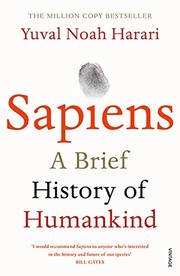
Seventy thousand years in four hundred pages, organised around the claim that Homo sapiens dominates because we can believe in things that do not exist — money, nations, corporations, gods. Start here without exception: the other three books are extensions of this argument and none of them restates it.
The Rest of the Popular Work
BeginnerFollow the argument forward from prehistory to the present and into the near future, in publication order.
▸ Study plan for this stage
Pace: 8–10 weeks for roughly 450, 400 and 544 pages. All three read at the same brisk pace as Sapiens. One purchasing note first: the catalogue entry for Homo Deus here is a two-volume box set that pairs it with Sapiens. If you already own Sapiens, buy Homo Deus on its own rather than paying for a duplica
- Homo Deus projects the Sapiens thesis forward: if humanism is itself a shared fiction, what replaces it when algorithms know us better than we know ourselves?
- Dataism — the idea that value comes from information flow rather than from human experience — is Homo Deus's central invention and its most speculative claim
- Homo Deus refers back to Sapiens constantly and does not restate its foundations, which is why it cannot be read first
- 21 Lessons for the 21st Century is the present-tense book and the weakest of the four: a set of essays on work, immigration, terrorism, education, war and meaning, several adapted from newspaper columns
- 21 Lessons should be read as commentary rather than as argument; its chapters do not build on each other and its claims are not defended at length
- Nexus, from 2024, covers information networks from writing through printing and bureaucracy to artificial intelligence, and is the most focused thing Harari has written since Sapiens
- Nexus is also the book where the historical detail is most load-bearing, which makes it the best final Harari and the fairest test of whether his method survives close attention
- What does Homo Deus mean by dataism, and what would count as evidence for or against it?
- How does Homo Deus get from the Sapiens thesis to its predictions, and where in that chain is the weakest link?
- What distinguishes 21 Lessons from Homo Deus in method, and does the essay form serve Harari well?
- In Nexus, what is the distinction between information and truth, and how does Harari use it to explain how networks behave?
- Is Nexus a better book than Sapiens? Say what specifically is better or worse rather than which you enjoyed more.
- Across four books, has Harari's argument developed, or has it been restated at different scales?
- Check the edition before buying Homo Deus so you do not pay twice for Sapiens. The box set and the single volume are both widely sold.
- For Homo Deus, separate the descriptive chapters from the predictive ones in your notes. Harari moves between them without flagging it and the two deserve different levels of trust.
- Read 21 Lessons selectively — pick the five chapters on subjects you know something about and read those closely. It is a collection and completeness adds little.
- In Nexus, check three historical examples against a reference source. It is the book most exposed to that test and doing it once tells you a lot about how the rest of his work is built.
- Write a one-paragraph summary of each book. If two of the summaries turn out to be nearly the same, that is a finding rather than a failure of note-taking.
Next up: Having read all four popular books, the academic monographs show what kind of historian was writing them — narrow, archival and completely unlike the bestsellers.

The sequel, projecting the Sapiens thesis forward: if humanism is itself a shared fiction, what replaces it when algorithms know us better than we know ourselves? It refers back to Sapiens constantly, so it cannot go first.
The present-tense book, and the weakest of the four — a set of essays on work, immigration, terrorism, education and meaning. Read it third, and treat it as commentary rather than argument.

The 2024 book, on information networks from writing to artificial intelligence, and the most focused thing he has written since Sapiens. It is also the one where the historical detail is most load-bearing, which makes it a good final Harari.
The Academic Harari
IntermediateSee the specialist military historian who existed before the bestsellers, and judge the popular books against his actual scholarly range.
▸ Study plan for this stage
Pace: 8–10 weeks for 248 and 386 pages. These are scholarly monographs published by academic presses and read at perhaps a third the speed of Sapiens; fifteen pages a sitting is realistic. They are also harder to obtain and considerably more expensive. Read Special Operations in the Age of Chivalry first,
- Special Operations in the Age of Chivalry, 1100–1550 is Harari's first academic monograph, on medieval raids, assassinations, castle infiltrations and the small-scale operations that conventional military history overlooks
- It is narrow, archival and completely unlike Sapiens in method — long on primary sources, short on generalisation — which is exactly why it is worth knowing it exists
- The Ultimate Experience studies how European soldiers between 1450 and 2000 came to understand combat as a source of revelation and self-knowledge
- The Ultimate Experience is the clearest link between the academic and popular halves of the career: it is already a book about the stories people tell themselves to make experience meaningful
- Both books demonstrate that Harari can work at the evidentiary standard he is accused of abandoning, which is a genuine data point for and against the criticisms in the final stage
- The specialism is medieval and early modern European military history — a long way from prehistory, agriculture, economics or artificial intelligence, which is the substance of most specialist objections to the popular books
- Reading these makes concrete what a historian's own field actually looks like, and therefore what it means when someone writes far outside it
- What does Special Operations argue about medieval warfare that the chivalric picture obscures?
- How does Harari's use of primary sources here differ from his use of secondary syntheses in Sapiens?
- What is the argument of The Ultimate Experience, and how does it prefigure the shared-fiction thesis?
- Given that Harari's training is in medieval and early modern European military history, which parts of Sapiens is he writing as a specialist and which as a synthesiser?
- Does reading the monographs increase or decrease your confidence in the popular books? Be specific about why.
- Read the introduction and conclusion of each monograph even if you read nothing else. They contain the arguments and the methodological statements, and the case-study chapters are illustration.
- Compare a paragraph of The Ultimate Experience with a paragraph of Sapiens on a related theme. The difference in hedging, sourcing and confidence is the single most useful observation available in this stage.
- Note how much of each monograph is spent establishing rather than asserting. That ratio is what specialist critics mean when they object to the popular books.
- If the monographs are hard to obtain, read the published abstracts and a review of each rather than skipping the stage. Knowing what they contain matters more than reading every page.
Next up: Knowing what Harari's own field is, and how carefully he works inside it, is the right preparation for reading three specialists who argue that his account of everything outside it is wrong.
His first academic monograph, on medieval raids, assassinations and castle infiltrations. Narrow, archival and completely unlike Sapiens — which is exactly why it is worth knowing it exists.

A study of how European soldiers from 1450 to 2000 came to understand combat as a source of revelation and self-knowledge. The most interesting of the academic books, and the clearest link to the popular ones: it is already about the stories people tell themselves.
Read Him Against the Specialists
IntermediateTest the Sapiens narrative against archaeologists, anthropologists and historians who argue it is wrong, and come away able to say which parts hold.
▸ Study plan for this stage
Pace: 12–16 weeks for 312, 704 and 704 pages. Against the Grain is short and sharp and can be done in a fortnight. The Dawn of Everything and The WEIRDest People in the World are both long and densely argued, and neither is written to be read quickly — 25 pages a day is honest. Read them in the order give
- Against the Grain, by the political anthropologist James C. Scott, is a direct challenge to the agricultural-revolution story Sapiens tells: early states were coercive, unhealthy and frequently abandoned, and farming did not simply produce civilisation
- Scott's core evidence is the long gap between the domestication of crops and the appearance of states, and the repeated collapse or desertion of early states — facts that a linear progress narrative has to work around
- The Dawn of Everything, by David Graeber and David Wengrow, is the most sustained attack on exactly the genre Sapiens belongs to: it argues that prehistoric humans experimented with many political forms rather than passing through fixed stages
- Graeber and Wengrow's method is to lead with the archaeological anomalies — seasonal cities, monumental sites built by foragers, societies that changed structure annually — that grand narratives have to omit
- The WEIRDest People in the World, by the evolutionary anthropologist Joseph Henrich, gives an alternative account of how modern Western psychology arose, grounded in cross-cultural experimental data rather than in narrative sweep
- Henrich's book is the most useful methodological contrast: it shows what the same questions look like when a working researcher rather than a synthesiser asks them, including the parts that stay unresolved
- None of these three is a rebuttal pamphlet — each is a substantial work of its own, which is what makes the disagreement worth reading rather than just noting
- What does Scott say actually happened between domestication and the first states, and how does it undercut Sapiens's account of agriculture as a trap?
- Which specific claims in Sapiens does The Dawn of Everything contradict, and on what evidence?
- What is Graeber and Wengrow's objection to the very idea of a stage-based human history, and does it apply to Harari's book specifically or to the genre?
- How does Henrich's evidentiary standard differ from Harari's, and what can he claim as a result that Harari cannot?
- Where do these three critics disagree with each other? They are not a single position, and noticing that is part of reading them properly.
- Which parts of Sapiens survive all three challenges intact, and which do not? This is the question the whole path exists to let you answer.
- Take the list of single-example claims you made while reading Sapiens and check each against these three books. That is the concrete work of this stage and it is more useful than any general verdict.
- Read Against the Grain first even if you are short of time. At 312 pages it is the most efficient counterweight in the path.
- For The Dawn of Everything, read the introduction and the chapters on the archaeological cases before the theoretical argument. The evidence is more persuasive than the framing and reading it first is fairer to the book.
- Note every place where a critic concedes something to the narrative approach. Both Scott and Henrich do, and honest reading means recording the concessions as well as the attacks.
- Write a page assessing Sapiens that a specialist would accept as fair — neither promotional nor dismissive. If you can do that, this path has done its job.
Next up: This is the end of the path: four popular books, the scholarship behind them, and three serious specialists arguing with their central claims — so the natural next step is deeper into whichever field interested you most, since each of these critics has a discipline behind them rather than just a counter-argument.

A direct challenge to the agricultural-revolution story Sapiens tells: Scott argues early states were coercive, unhealthy and frequently abandoned, and that farming did not simply lead to civilisation. The shortest and sharpest counterweight.
Written with David Wengrow, and the most sustained attack on exactly the genre Sapiens belongs to — the claim that prehistoric humans experimented with many political forms rather than marching through fixed stages. Read it and Sapiens together and the disagreement is the education.

An alternative account of how modern Western psychology came about, grounded in cross-cultural data rather than narrative sweep. It shows what the same questions look like when a working researcher rather than a synthesiser asks them, which is the right note to end on.
Discussion
Keep reading
Paths that share books, cover the same subject, or open a related topic.