Understand your taxes: keep more of what you earn
This curriculum takes a complete beginner from "how does a tax bracket even work?" to confidently applying legal tax-minimization strategies. Each stage builds on the last: first you learn the language and basic mechanics, then you master deductions and tax-advantaged accounts, and finally you adopt the long-term mindset and advanced moves that let you legally keep more of what you earn.
Foundations: Money Basics & the Tax Mindset
BeginnerUnderstand how personal finance and taxes fit together, learn key vocabulary (gross income, net income, withholding, refund), and shed any fear or confusion about the tax system.
▸ Study plan for this stage
Pace: 6–8 weeks total: Weeks 1–3 cover "The Total Money Makeover" (~25–30 pages/day, including Baby Steps chapters); Weeks 4–6 cover "I Will Teach You to Be Rich" (~20–25 pages/day, focusing on automation and account-setup chapters); Week 7–8 reserved for review, exercises, and reflection.
- Gross income vs. net income: understanding why your paycheck is smaller than your salary, introduced through Ramsey's budgeting framework in The Total Money Makeover
- The concept of 'taking control' of your money: Ramsey's core mindset shift that financial stress — including tax anxiety — comes from ignorance, not complexity
- Withholding basics: how employers pre-pay your taxes on your behalf throughout the year, and why a refund simply means you overpaid (a concept Ramit Sethi demystifies in I Will Teach You to Be Rich)
- The 'latte factor' reframed as a tax mindset: Sethi's argument that small, automated decisions compound over time — the same logic applies to tax-advantaged accounts like 401(k)s and Roth IRAs introduced in his book
- Automation as a financial superpower: Sethi's system for automating savings and bill pay, which naturally connects to automating tax-advantaged contributions
- Debt and taxes as two sides of the same coin: Ramsey's Baby Steps framework shows that eliminating high-interest debt and understanding your tax burden are both essential to building a financial foundation
- Key vocabulary in context: gross income, net income, withholding, tax refund, tax-advantaged accounts (401k, Roth IRA) — all encountered organically across both books
- Shedding financial shame and fear: both Ramsey and Sethi emphasize that confusion about money (and taxes) is normal, fixable, and not a reflection of intelligence
- After reading The Total Money Makeover, can you explain in your own words the difference between gross income and net income, and identify both figures on a real or sample pay stub?
- What does Dave Ramsey mean when he says most people are 'broke' not because they earn too little but because they lack a plan — and how does that mindset apply to how people approach tax season?
- According to Ramit Sethi in I Will Teach You to Be Rich, why is a large tax refund not necessarily a good thing, and what does it reveal about your withholding?
- How does Sethi's automation system (conscious spending plan) connect to tax-advantaged accounts, and what is the difference between a traditional 401(k) and a Roth IRA as he describes them?
- What are two specific money behaviors — one from each book — that directly affect how much tax you owe or how much you keep after taxes?
- Having read both books, how would you describe the 'tax mindset' to a friend who is afraid to file their taxes for the first time?
- Pay stub breakdown: Obtain a real pay stub (yours or a sample found online). Label every line item — gross wages, federal withholding, state withholding, Social Security, Medicare, and net pay — using the vocabulary from both books as your guide.
- Build a bare-bones budget using Ramsey's framework from The Total Money Makeover: list your gross monthly income, subtract all withholdings, and arrive at your true take-home (net) income. Note how taxes are already the largest 'expense' before you spend a dollar.
- Withholding experiment: Use the IRS Tax Withholding Estimator (free, online) to check whether you are over- or under-withheld. Reflect on Sethi's point about refunds and write 2–3 sentences on whether you'd prefer a refund, a bill, or to break even — and why.
- Automation mapping exercise inspired by I Will Teach You to Be Rich: Draw or diagram Sethi's 'automatic money flow' and add a tax layer — identify which accounts (401k, Roth IRA, HSA) reduce your taxable income and where they fit in the flow.
- Vocabulary flashcards: Create a set of at least 10 flashcard terms (gross income, net income, withholding, W-4, W-2, refund, tax bracket, 401k, Roth IRA, FICA) with a definition in your own words and a page reference from one of the two books.
- Mindset journal entry: After finishing both books, write a one-page reflection answering: 'What did I believe about taxes before this stage, and what specifically from Ramsey or Sethi changed or challenged that belief?'
Next up: By establishing a fear-free vocabulary and a clear picture of where taxes fit inside a personal budget, this stage gives the reader the confidence and conceptual scaffolding needed to move into the mechanics of actually filing taxes — understanding forms, deductions, and credits — in the next stage.

Establishes a clear, jargon-free foundation for how income, spending, and taxes interact in everyday life — giving beginners the financial vocabulary they need before diving into tax mechanics.
Introduces tax-advantaged accounts (401k, Roth IRA) in plain language alongside budgeting, making the connection between earning money and sheltering it from taxes feel concrete and actionable from the start.
Core Tax Mechanics: Brackets, Deductions & Filing
BeginnerUnderstand exactly how progressive tax brackets work, the difference between standard and itemized deductions, credits vs. deductions, and how a tax return is actually assembled.
▸ Study plan for this stage
Pace: 6–8 weeks total. Week 1–2: Read "Taxes Made Simple" cover to cover (~20–25 pages/day; it's ~130 pages) — treat it as your conceptual primer. Week 3–6: Work through the relevant chapters of "J.K. Lasser's Your Income Tax 2023" thematically (~25–35 pages/day), focusing on Parts covering income types,
- Progressive tax brackets: how marginal rates work and why your 'tax bracket' is NOT the rate applied to all your income (core theme in Piper's plain-language breakdown)
- Taxable income vs. gross income: the chain of subtractions (gross → AGI → taxable income) explained step-by-step in Taxes Made Simple and reinforced with real line-item detail in J.K. Lasser
- Standard deduction vs. itemized deductions: when each makes sense, what qualifies for itemization (mortgage interest, state/local taxes, charitable contributions, medical expenses), and the SALT cap — covered conceptually by Piper and with full schedules in J.K. Lasser
- Above-the-line vs. below-the-line deductions (adjustments to income vs. deductions from AGI): a distinction Piper introduces clearly and J.K. Lasser catalogs exhaustively
- Tax credits vs. tax deductions: why a $1,000 credit is worth more than a $1,000 deduction, and the difference between refundable and non-refundable credits as explained in both books
- Filing status (Single, MFJ, MFS, HOH, QSS): how each status affects bracket thresholds and the standard deduction amount, detailed in J.K. Lasser's opening filing chapters
- Anatomy of Form 1040: how every concept maps to an actual line on the return — Piper provides the conceptual map; J.K. Lasser provides the line-by-line reference
- The Alternative Minimum Tax (AMT) basics: who it affects and why it exists, introduced in Taxes Made Simple and expanded in J.K. Lasser
- If your taxable income is $95,000 (single filer, 2022 rates), what is your actual federal tax liability — and what is your effective tax rate vs. your marginal rate? Can you show the bracket-by-bracket math as Piper teaches it?
- A homeowner paid $9,500 in mortgage interest, $4,200 in state/local taxes, and donated $1,800 to charity. Should they itemize or take the standard deduction? What does J.K. Lasser say qualifies under each category?
- What is the difference between an above-the-line deduction (e.g., student loan interest, HSA contribution) and a below-the-line deduction, and why does it matter for your AGI?
- A taxpayer qualifies for a $2,000 non-refundable credit and a $2,000 deduction. They are in the 22% bracket and owe $1,500 before credits. Walk through the exact dollar impact of each — which is more valuable and why?
- What are the five filing statuses, and what conditions must be met to claim Head of Household as described in J.K. Lasser?
- Trace a hypothetical W-2 employee's tax situation from gross wages on their pay stub all the way to the bottom line of Form 1040 — identifying every stop (adjustments, standard deduction, tax calculation, credits) using both books as your guide.
- Bracket math drill: Using the current tax brackets from J.K. Lasser's tables, manually calculate the federal income tax for three scenarios — a single filer at $45,000, a married-filing-jointly couple at $130,000, and a single filer at $210,000. Verify your effective vs. marginal rate for each, following Piper's method.
- Standard vs. itemized decision worksheet: Invent a realistic taxpayer profile (pick a mortgage balance, property tax bill, charitable giving amount, and any medical expenses). List every potential itemized deduction, check it against J.K. Lasser's qualifying rules, total them up, and compare to the standard deduction to make the call.
- Build a 1040 skeleton: Draw or print a blank Form 1040. Using Piper's conceptual walkthrough as your map, label each major section (income, AGI adjustments, deductions, taxable income, tax, credits, payments, refund/owed). Then use J.K. Lasser to annotate at least 10 specific line items with the rule that governs them.
- Credit vs. deduction comparison table: Create a two-column table of five common tax credits (e.g., Child Tax Credit, Earned Income Credit, American Opportunity Credit) and five common deductions (e.g., student loan interest, charitable contributions, mortgage interest). For each, note: above/below the line, refundable or not, and the dollar value to someone in the 22% bracket — sourcing details fr
- Filing status flowchart: Using J.K. Lasser's filing status chapter, draw a decision-tree flowchart that leads a taxpayer through a series of yes/no questions to determine their correct filing status. Test it on three different hypothetical household situations.
- Mock tax return: Using a simple hypothetical (W-2 income, one above-the-line deduction, standard deduction, one tax credit), fill out or annotate a real Form 1040 (downloadable from IRS.gov) end-to-end. Cross-check every entry against the relevant section in J.K. Lasser to confirm you've applied the rules correctly.
Next up: Mastering how a basic 1040 is assembled — income types, deductions, credits, and brackets — creates the essential framework for the next stage, where you'll layer in more complex income sources (investments, self-employment, rental income) and the specialized schedules and strategies that attach to them.

The clearest plain-English walkthrough of the U.S. income tax system available — brackets, deductions, credits, and filing status — written specifically for people with no accounting background.

The definitive annual reference guide that shows every major deduction and credit with real examples; read after Piper so you already have the mental model and can use this as a practical lookup tool.
Tax-Advantaged Accounts & Investing
IntermediateMaster the full landscape of tax-sheltered accounts — 401(k), IRA, Roth, HSA, 529 — understand how investment taxes (capital gains, dividends) work, and learn to coordinate accounts for maximum tax efficiency.
▸ Study plan for this stage
Pace: 6–8 weeks total: Weeks 1–3 cover "The Little Book of Common Sense Investing" (~20–25 pages/day, including reflection time); Weeks 4–7 cover "Retire Before Mom and Dad" (~25–30 pages/day); Week 8 is a dedicated review and exercise week to synthesize both books and complete hands-on account mapping.
- The tyranny of costs: how expense ratios and fund fees silently erode long-term investment returns, as Bogle quantifies across decades of compounding (The Little Book of Common Sense Investing)
- Index funds vs. active management: why Bogle argues the average actively managed fund mathematically cannot beat the market net of costs, and what this means for choosing investments inside tax-advantaged accounts
- The role of asset allocation: how to divide investments among stocks, bonds, and other asset classes based on time horizon and risk tolerance — a foundation for deciding what goes in which account
- The full landscape of tax-sheltered accounts: traditional 401(k) and IRA (pre-tax, tax-deferred growth), Roth 401(k) and Roth IRA (after-tax, tax-free growth), HSA (triple tax advantage), and 529 plans (tax-free growth for education), as detailed in Retire Before Mom and Dad
- Capital gains and dividend taxation: the difference between short-term (ordinary income rates) and long-term capital gains rates, and how qualified dividends are taxed — and why account placement matters
- Asset location strategy: Berger's principle of placing tax-inefficient assets (bonds, REITs, high-dividend funds) in tax-deferred accounts and tax-efficient assets (index funds, growth stocks) in taxable accounts to minimize the overall tax drag
- The FI Number and savings rate math: Berger's framework for calculating your 'freedom number' and how aggressive use of tax-advantaged accounts accelerates the path to financial independence
- Roth vs. Traditional decision-making: how to evaluate current vs. expected future tax brackets to choose between pre-tax and after-tax contributions — a practical framework Berger walks through in detail
- After reading Bogle, can you explain in plain language why a low-cost total market index fund inside a 401(k) is likely to outperform most actively managed funds offered in the same plan — and calculate the dollar difference a 1% expense ratio makes over 30 years on a $10,000 investment?
- Can you describe the contribution limits, tax treatment on the way in, tax treatment on growth, and tax treatment on withdrawal for each of the following: Traditional 401(k), Roth 401(k), Traditional IRA, Roth IRA, HSA, and 529?
- Using Berger's framework, how would you decide whether to contribute to a Traditional IRA or a Roth IRA if you are currently in the 22% bracket and expect to be in the 24% bracket in retirement?
- What is asset location, and using the accounts you have available, where would you place a bond index fund, a total stock market index fund, and a REIT fund — and why?
- How does Berger define the 'FI Number,' and how does maximizing contributions to tax-advantaged accounts change the timeline to reach it?
- What is the difference between a short-term and long-term capital gain, and how does holding investments inside a Roth IRA or 401(k) change your exposure to both types of investment taxation?
- Expense ratio audit: List every fund available in your current or a sample 401(k) plan, record each fund's expense ratio, and calculate the 20-year cost difference between the cheapest index fund option and the most expensive actively managed fund on a $50,000 balance — use Bogle's compounding logic as your guide.
- Account inventory spreadsheet: Create a personal spreadsheet listing every tax-advantaged account you have or are eligible to open (401(k), IRA, HSA, 529), with columns for: account type, 2024 contribution limit, current balance, tax treatment (in/growth/out), and whether you are maximizing it — then identify your single highest-priority gap.
- Roth vs. Traditional calculator exercise: Using your current marginal tax bracket and two retirement income scenarios (one lower, one higher than today), work through Berger's decision framework to determine which contribution type wins in each scenario and write a one-paragraph justification.
- Asset location map: Draw a three-column table (Tax-Deferred | Tax-Free/Roth | Taxable Brokerage). Place each of the following into the optimal column and write one sentence explaining why: total US stock market index fund, US bond index fund, international stock index fund, REIT index fund, individual growth stocks held long-term.
- FI Number calculation: Following Berger's method, estimate your annual retirement spending, calculate your FI Number (annual spending × 25), then model two scenarios — one where you max all tax-advantaged accounts and one where you contribute only enough to get an employer match — and compare how many years each scenario takes to reach your FI Number.
- Capital gains tax simulation: Sketch a hypothetical portfolio with $5,000 in short-term gains and $8,000 in long-term gains held in a taxable account. Calculate the tax owed at your current bracket. Then compare what the tax bill would be if those same gains were realized inside a Roth IRA — and write down what that difference means for your investment strategy.
Next up: By mastering how tax-advantaged accounts shelter investment returns and how asset location minimizes tax drag, the reader is now equipped to move into more advanced tax strategy — including tax-loss harvesting, backdoor Roth conversions, required minimum distributions, and multi-decade tax bracket management — which require this account-level fluency as their foundation.
Explains how investment returns are eroded by taxes and costs, building the intuition for WHY tax-advantaged accounts matter so much before you learn the specifics of each account type.

Walks through every major tax-advantaged account in accessible detail, showing how to stack and sequence them — ideal for cementing the practical knowledge of sheltering investment income.
Legal Tax Reduction: Strategy & Planning
IntermediateLearn the principles of proactive tax planning — timing income and deductions, self-employment taxes, real estate tax benefits, and the difference between tax avoidance (legal) and tax evasion (illegal).
▸ Study plan for this stage
Pace: 6–8 weeks total. Week 1–4: "Lower Your Taxes - Big Time!" by Sandy Botkin (~25–30 pages/day, including time to re-read chapters on home-office and business deductions). Week 5–8: "The Book on Tax Strategies for the Savvy Real Estate Investor" by Amanda Han (~20–25 pages/day, with slower passes over
- Tax avoidance vs. tax evasion: Botkin's foundational distinction between aggressive-but-legal planning and illegal evasion, and why the line matters in practice
- Converting personal expenses into legitimate business deductions: Botkin's strategies for home-office, auto, meals, travel, and family employment — and the documentation standards the IRS requires
- Timing of income and deductions: accelerating deductible expenses into the current year and deferring taxable income to lower your effective rate across years
- Self-employment tax mechanics: understanding SE tax on net self-employment income, the above-the-line deduction for half of SE tax, and Botkin's entity-selection guidance (sole prop vs. S-corp) to reduce SE tax exposure
- Depreciation as a wealth-building tool: Han's treatment of cost segregation, bonus depreciation, and how accelerated depreciation generates paper losses that offset active or passive income
- Passive activity rules and the real estate professional designation: Han's explanation of how qualifying as a real estate professional unlocks unlimited passive-loss deductions against ordinary income
- The 1031 like-kind exchange: Han's step-by-step framework for deferring capital gains indefinitely by rolling proceeds into replacement properties
- Entity structuring for real estate: Han's comparison of LLCs, S-corps, and partnerships for liability protection, pass-through taxation, and long-term tax efficiency
- According to Botkin, what six documentation habits must a taxpayer maintain to defend business deductions in an IRS audit, and why is a contemporaneous log more valuable than reconstructed records?
- Botkin outlines several strategies for employing a spouse or child in a business. What are the tax advantages, and what IRS rules govern reasonable compensation to keep the arrangement legitimate?
- Using Han's framework, explain how cost segregation accelerates depreciation on a rental property and what types of assets are typically reclassified from 39-year to 5- or 7-year property.
- What is the real estate professional designation under IRC §469, what hour thresholds must be met, and how does qualifying change the treatment of rental losses on Han's investor's tax return?
- Walk through the 45-day identification and 180-day closing windows of a 1031 exchange as described by Han. What happens if either deadline is missed, and what is a reverse exchange?
- How does Botkin recommend using an S-corporation to reduce self-employment tax, and what is the risk of setting an unreasonably low officer salary?
- Documentation audit: For one full week, log every potential business expense (meals, mileage, home-office use, phone) in a contemporaneous journal using the format Botkin recommends — date, amount, business purpose, and people present. Review at week's end for gaps.
- Deduction conversion worksheet: List 10 current personal expenses and, using Botkin's criteria, classify each as (a) fully deductible, (b) partially deductible with proper structuring, or (c) non-deductible. Write one sentence of legal justification for each classification.
- SE tax comparison model: Build a simple spreadsheet comparing tax liability for a self-employed individual earning $120,000 net as a sole proprietor vs. as an S-corp paying a $60,000 reasonable salary. Quantify the SE tax savings and note the added compliance costs Botkin flags.
- Depreciation schedule exercise: Using a hypothetical rental property purchase (e.g., $400,000 purchase price, 80% allocated to building), calculate straight-line depreciation over 27.5 years, then sketch how a cost segregation study — reclassifying 20% of building value to 5-year property — changes Year 1 deductions, following Han's examples.
- 1031 exchange timeline drill: Draft a mock 1031 exchange checklist for a property sold on a date of your choosing. Map out the 45-day identification deadline, list three potential replacement properties with addresses and values, and mark the 180-day closing deadline on a calendar.
- Entity selection decision tree: Using Han's entity-structure chapter, create a one-page decision tree that guides a new real estate investor through the choice of sole proprietorship → LLC → S-corp → partnership, with the key tax and liability question at each branch.
Next up: Mastering proactive deduction strategies and real estate tax mechanics here builds the analytical foundation needed for the next stage, where readers will tackle more advanced topics such as retirement account optimization, estate and gift tax planning, and multi-year tax projection — all of which require the same disciplined income-timing and entity-structure thinking introduced by Botkin and Han
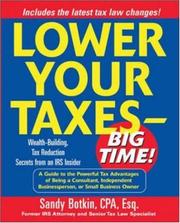
Written by a former IRS attorney, this book systematically covers legal deductions most people miss — especially for self-employed individuals — and explains the rules clearly enough for non-accountants.

Introduces depreciation, passive losses, and real-estate-specific tax advantages — concepts that reveal how the tax code rewards asset ownership, broadening the reader's strategic toolkit.
Advanced Mindset: Wealth, Tax Efficiency & the Long Game
ExpertInternalize how wealthy individuals and sophisticated investors think about lifetime tax minimization — Roth conversions, asset location, charitable strategies, and building a tax-efficient wealth plan.
▸ Study plan for this stage
Pace: 6–8 weeks total: Weeks 1–4 cover "Tax-Free Wealth" (~20–25 pages/day, including reflection time); Weeks 5–7 cover "The Power of Zero" (~15–20 pages/day, a shorter but denser read); Week 8 is dedicated to integration, review, and completing all exercises.
- The Tax Code as a Map, Not a Maze (Wheelwright): The tax code is written by governments to incentivize specific behaviors (real estate investment, business ownership, job creation) — wealthy individuals use it proactively, not reactively.
- Permanent vs. Temporary Tax Deductions (Wheelwright): Understanding the difference between deductions that reduce taxes once versus strategies (like depreciation and cost segregation) that create recurring, compounding tax reduction year after year.
- The Business & Real Estate Wealth Engines (Wheelwright): How owning a business and/or real estate are the two primary vehicles the tax code rewards most generously, and how to structure them for maximum legal tax reduction.
- The Three Buckets Framework (McKnight): Organizing assets into Taxable, Tax-Deferred, and Tax-Free buckets — and why the goal is to move as much wealth as possible into the Tax-Free bucket before tax rates potentially rise.
- The 0% Tax Bracket as the Ultimate Goal (McKnight): The concept of engineering your retirement income so that your total taxable income falls at or near 0%, making future tax-rate increases largely irrelevant to your financial life.
- Roth Conversions as a Strategic Weapon (McKnight): How and when to systematically convert tax-deferred assets (Traditional IRA/401k) into tax-free assets (Roth), using current lower tax rates as a window of opportunity before potential rate increases.
- Tax-Free Life Insurance (LIRP) as a Supplemental Tool (McKnight): How a properly structured Life Insurance Retirement Plan can serve as a third tax-free vehicle alongside Roth IRAs and Roth 401(k)s, providing tax-free growth and income.
- Lifetime Tax Minimization vs. Annual Tax Minimization (Both books): The advanced mindset shift from 'how do I pay less tax this year?' to 'how do I architect my entire financial life to pay the least tax over my lifetime?'
- According to Wheelwright, what is the fundamental purpose of the tax code, and how does understanding that purpose change the way a sophisticated taxpayer approaches tax planning?
- What are the most powerful permanent tax reduction strategies Wheelwright identifies, and why does he argue that real estate and business ownership are the cornerstones of tax-free wealth?
- According to McKnight's three-bucket framework, what are the risks of having the majority of your retirement savings in the tax-deferred bucket, and what specific future event makes this especially dangerous?
- What is McKnight's case for urgency around Roth conversions — what is the 'window of opportunity' he describes, and what factors could close it?
- How do the strategies in 'Tax-Free Wealth' (business/real estate tax reduction) and 'The Power of Zero' (bucket optimization/Roth conversions) complement each other in a single, cohesive lifetime tax plan?
- What is a LIRP, under what conditions does McKnight recommend it, and what are the criteria that must be met for it to function as a legitimate tax-free retirement vehicle?
- Map Your Own Tax Buckets: List every account and asset you currently own and categorize each into Taxable, Tax-Deferred, or Tax-Free (McKnight's framework). Calculate the percentage of your net worth in each bucket. Identify your single biggest tax vulnerability.
- Run a Roth Conversion Scenario: Using your current marginal tax rate and a projected retirement income need, calculate how much you would need to convert annually over 10–15 years to reach McKnight's 0% tax bracket goal. Use a free tool like the 'Roth Conversion Calculator' at Bankrate or a spreadsheet.
- Audit Your Income Sources Through Wheelwright's Lens: For each source of income you have (or plan to have), write one paragraph on how the tax code treats it — ordinary income, capital gains, passive income, depreciation shelter — and identify one legal strategy Wheelwright describes to reduce the tax on that source.
- Design Your 'Tax-Free Wealth' Business or Real Estate Strategy: Based on Wheelwright's chapters on business and real estate, draft a one-page outline of how you could (or already do) use one of these vehicles. Include at least three specific deductions or strategies he names (e.g., home office, depreciation, cost segregation, entity structure).
- Write a One-Page Lifetime Tax Minimization Plan: Synthesizing both books, write a personal plan with three time horizons — Next 5 Years, Years 5–15, and Retirement. For each horizon, name the primary tax strategy you will employ, the account types involved, and the target outcome (e.g., 'convert $X/year to Roth,' 'acquire one rental property for depreciation benefits').
- Stress-Test Against a Tax Rate Increase: Using your current retirement projections, model what happens to your after-tax retirement income if marginal tax rates rise by 10 percentage points. Then model the same scenario with McKnight's 0% tax bracket strategy in place. Document the difference — this is your 'cost of inaction.'
Next up: Mastering lifetime tax minimization through these two books equips the reader with the strategic mindset and core vehicles needed to tackle the next frontier: advanced estate planning, generational wealth transfer, and the intersection of tax law with legacy — where the stakes and the complexity scale up further.

Written by a CPA and Robert Kiyosaki collaborator, this book reframes the tax code as a map of government incentives — showing how to build a business and investment life that is structurally tax-efficient.

Makes the compelling case for moving assets into tax-free buckets over a lifetime and explains Roth conversion strategies in depth — the perfect capstone for thinking about taxes across decades, not just this April.
Discussion
Keep reading
Paths that share books, cover the same subject, or open a related topic.