Understanding Roland Barthes: books to read, in order
Roland Barthes changed his mind in public for thirty years, and the standard complaint that there are several Barthes is really the reason to read him in order: the semiologist who wanted a science of signs becomes the theorist who kills the author, and ends as a writer of fragments about grief and desire. This path follows that arc. It mixes primary texts with one short secondary guide and a biography, and each note says which it is. Everything primary is translated from French, and a few of the catalogue records here carry French-market or marketplace display titles; those are noted where they occur.
Start with Mythologies
BeginnerMeet Barthes at his most immediately usable — reading wrestling, steak and chips, soap powder and a magazine cover as ideological signs — and get a short scholarly account of how the career hangs together before the harder books.
▸ Study plan for this stage
Pace: Two weeks for 289 pages, and the easiest entry point of any thinker path. Mythologies is 161 pages and most of it is two- and three-page essays on wrestling, steak and chips, soap powders and a Paris Match cover — read one or two a night for a fortnight, or the lot in a weekend, either works. The ex
- Myth as a second-order semiological system: a sign becomes the signifier of a further meaning
- The conversion of history into nature, which is Barthes's specific account of what ideology does
- Denotation and connotation, and why the distinction is political rather than merely descriptive
- The everyday object as a legitimate and revealing subject for analysis
- Culler's frame — mythologist, critic, semiologist, hedonist, writer — as a way of holding a career that changes direction repeatedly
- The bourgeois as an anonymous class in Myth Today, and the claim that its power lies in not being named
- How does the second-order system work? Take one essay and identify the first-order sign and the myth built on it.
- What does Barthes mean by saying myth turns history into nature, and why does he think that is the whole trick?
- Which of the essays in Mythologies has aged worst, and is that a problem for the method or only for the example?
- Culler splits Barthes into roles rather than periods. What does that gain, and what does it obscure?
- Myth Today is theory written after the essays. Does it describe what the essays did, or reinterpret it?
- Write your own mythology: two pages on a contemporary object or image, in Barthes's form, ending with the myth it naturalises.
- Diagram the second-order system from Myth Today on a specific example, labelling signifier, signified and sign at both levels.
- Read Culler's chapter on the semiologist before starting the next stage, and list what he says the scientific ambition was for.
- Pick three essays from Mythologies and identify, for each, the political claim Barthes never states outright.
Next up: Myth Today points straight at the systematic ambition of the next stage, which is Barthes trying to turn the trick into a science.
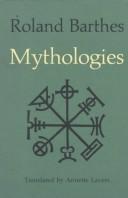
Short essays on 1950s French popular culture plus the theoretical closing piece, Myth Today. It is the most enjoyable thing Barthes wrote and the reason anyone reads him at all; the record's 1953 year is the French original's period rather than the English edition.
Secondary, and the best short guide, organised by the roles Barthes occupied — mythologist, critic, semiologist, hedonist, writer — rather than by chronology. Read it after Mythologies, so the roles have something concrete to attach to; catalogued under the bare title Barthes.
The science of signs
IntermediateFollow the structuralist ambition at full stretch: literature stripped of its supposed naturalness, a general semiology modelled on Saussure, and a book-length attempt to describe fashion as a formal system. This is the driest Barthes, and it is where the vocabulary the later work plays with is built.
▸ Study plan for this stage
Pace: Five weeks, and the count on this stage is misleading in two directions. Writing degree zero and elements of semiology is recorded at 111 pages, but the record is a combined volume printing two separate works: Writing Degree Zero, the first book, and Elements of Semiology, a technical primer of defi
- Writing (ecriture) as a third term between language and style — the level at which a writer's choices are historical and moral
- Writing degree zero: the attempt at a neutral, colourless writing that escapes literature's ideological weight
- The Saussurean apparatus in Elements of Semiology — signifier and signified, langue and parole, syntagm and system, denotation and connotation
- Written clothing as against real clothing and image clothing, which is the whole move of the fashion book
- The ambition to make semiology a science on the model of linguistics, and Barthes's later verdict that this was a phase
- The quarrel with Raymond Picard and academic literary history, which made Barthes a public figure
- What is ecriture, and how does it differ from both language and personal style?
- Is a writing of degree zero actually possible on Barthes's own account, or is the concept self-defeating?
- Take three pairs from Elements of Semiology and give a non-linguistic example of each.
- Why does the fashion book analyse written clothing rather than garments? What does that decision make possible and what does it cost?
- What was the Picard controversy actually about, and which side has the better of it on the evidence of Critical Essays?
- Work through Elements of Semiology with a notebook, writing each opposition and one worked example. Treat it as a set of exercises, not as reading.
- Take a fashion or product description from any magazine or retail site and analyse it with the fashion book's method. Twenty minutes of this teaches more than fifty pages of it.
- In Critical Essays, find the piece where Barthes is most obviously enjoying the polemic and mark where the argument gives way to the pleasure of arguing. That tension is the subject of stage three.
- Write a paragraph in what you take to be writing degree zero. Then write what makes it fail.
Next up: The systematic ambition peaks here and immediately breaks; the next stage is Barthes deciding that the reader, not the code, is where meaning happens.
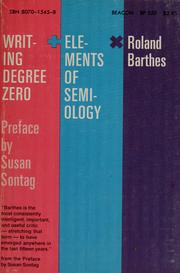
The first book: literary style is never innocent, and modern writing is an attempt to escape the ideological weight of literary language. The catalogue record here is the combined volume Writing Degree Zero and Elements of Semiology, so it also contains the semiology primer — you do not need to buy that separately.
The pieces from the years of the quarrel with academic literary history, including the polemics that made Barthes a public figure. Read them as the working papers between the first book and the fashion project.
The most rigorous and least loved book — clothing described not as garments but as the written language magazines use about them. Barthes himself came to regard the scientific ambition as a phase, which is exactly why reading it makes the turn in the next stage legible; the record's display title is in shouting capitals.
The death of the author and the pleasure of the text
IntermediateReach the turn: meaning is produced by the reader, not deposited by the author, and criticism's job shifts from decoding to enjoying. This stage contains the single most cited essay in modern literary theory and the shortest, strangest book of theory on the path.
▸ Study plan for this stage
Pace: Four weeks for 660 pages. Image-Music-Text is 220 pages and is the essential English collection — it contains The Death of the Author, The Rhetoric of the Image on advertising, and the photography essays Camera Lucida later revisits. If you read one Barthes volume after Mythologies, read this one; a
- The death of the author: the text as a tissue of quotations whose unity lies in its destination, not its origin
- Work against text — an object on a shelf against a methodological field
- Plaisir and jouissance, pleasure and bliss, and the reason the second is untranslatable
- The readerly and the writerly, and what makes a text one or the other
- The reality effect: descriptive detail that signifies nothing except that this is the real
- The rhetoric of the image — how a photograph's caption anchors meanings that would otherwise float
- The shift in Barthes's own form, from essay to fragment, as itself part of the argument
- What exactly dies in The Death of the Author, and what survives? Be precise: the claim is more limited than its reputation.
- Distinguish plaisir from jouissance using an example of your own reading experience.
- How does the reality effect work, and what does it imply about realism as a technique?
- The Rhetoric of the Image analyses an advertisement. Redo the analysis on a current one and see which of Barthes's categories survive.
- Why does The pleasure of the text refuse continuous argument? Is the refusal a position or an evasion?
- Take a passage of nineteenth-century realist description and mark every detail that does no narrative work. That list is The Reality Effect's evidence.
- Write a one-paragraph defence of authorial intention against The Death of the Author, then Barthes's reply.
- Read The pleasure of the text twice in a week, the second time out of order. Note whether the order mattered — that is the experiment the book is proposing.
- Set From Work to Text beside Elements of Semiology from the previous stage and write what has been abandoned between them.
Next up: The system is renounced and the fragment is now the form, which is exactly what the late books are made of.
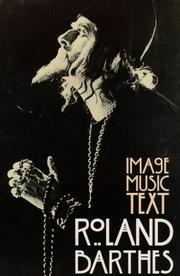
The essential English collection, containing The Death of the Author, The Rhetoric of the Image on advertising, and the essays on photography that Camera Lucida later revisits. If you read one Barthes volume after Mythologies, read this one; catalogued as Image-Music-Text.

Fewer than seventy pages of fragments distinguishing pleasure from bliss and refusing to build a system. It is the formal break as well as the argumentative one, and it explains the shape of everything he wrote afterwards.

The later essays, including From Work to Text and The Reality Effect, which are the closest thing to a considered statement of the post-structuralist position. Read after The Pleasure of the Text; it is that book's argument in expository form.
The late, personal Barthes
IntermediateRead the last phase, in which the fragment becomes the form and the subject becomes Barthes himself — Japan as a country of signs without meanings, an autobiography that refuses to be one, a lexicon of love, and a book about photography and his mother's death.
▸ Study plan for this stage
Pace: Five weeks, and this is the stage where the catalogue is least helpful: only Camera Lucida carries a page count, at 124 pages. The other three are recorded without lengths, so budget them by shape rather than by number. Empire of Signs is a short book of brief fragments with images, comfortably read
- Japan in Empire of Signs as an invented system of surfaces, explicitly not a description of a real country
- The empty centre as a structural figure — Tokyo, haiku, the packaged gift with nothing inside
- The fragment as a form that refuses the authority of continuous argument
- The autobiography that opens by declaring itself the speech of a character in a novel, turning the death of the author on its own author
- The figure in A Lover's Discourse: not a narrative of love but a lexicon of its recurring postures
- Studium and punctum — the coded interest of a photograph against the detail that pierces the viewer
- The noeme of photography, that-has-been, and the connection Barthes draws between the photograph and death
- Empire of Signs disclaims any account of the real Japan. Does that disclaimer solve the problem it anticipates, or restate it?
- How does the alphabetical arrangement of A Lover's Discourse change what can be said about love?
- Define punctum precisely. What stops it from meaning simply whatever the viewer happens to notice?
- Camera Lucida turns on a photograph the book does not show. Why, and does the withholding work?
- Is the late Barthes a break with the semiologist of stage two, or the same project pursued by other means?
- Choose a photograph that matters to you and write its studium and its punctum. Then try to write the punctum for someone else's photograph, and see why Barthes says you cannot.
- Write three figures of your own in the form of A Lover's Discourse, alphabetically placed. The constraint is the argument.
- Take five entries from Roland Barthes by Roland Barthes and identify which ones a conventional autobiography would have had to expand into a chapter.
- Apply the Empire of Signs method to a place you have visited briefly, being explicit that you are describing a system and not a country. Then note what that honesty licenses and what it excuses.
Next up: Camera Lucida was written out of a specific grief and a specific set of notes, and the last stage is both.
Japan read as a system of surfaces — food, packaging, calligraphy, the empty centre of Tokyo — explicitly not as a description of a real country. The first of the fragment books; the Open Library record is filed under a mangled marketplace string beginning with a bracket, but the work is the 1970 Empire of Signs.

An autobiography in alphabetised fragments, opening with the instruction that it must all be considered as spoken by a character in a novel. The book where the death of the author is turned on its own author.
Eighty figures of the lover's mind — waiting, jealousy, the unbearable — arranged alphabetically and voiced in the first person. His best-selling book by far and the one people who dislike theory still love; the catalogue record carries a bookseller's description as its title.
The last book, on what photography is, written in mourning for his mother and organised around the distinction between studium and punctum. It is the culmination of the path: the semiologist finally admitting that the thing that matters in an image cannot be coded.
Grief and the life
IntermediateClose with the private notes behind the last book and a full biography, so the arc from the systematic 1950s to the fragmentary 1970s can be read against the life rather than only against the theory.
▸ Study plan for this stage
Pace: Three weeks. Our record for Mourning diary carries no page count; it is a posthumously published collection of the index cards Barthes wrote almost daily in the two years after his mother's death, so it is short in extent and slow in effect — read it in a week, a few cards at a sitting, directly aft
- The card as Barthes's working unit, in the diary and in the published fragment books alike
- The difference between grief written for publication and grief written on an index card at night
- Samoyault's use of the archive, including the notes for the novel Barthes never wrote
- The arc from the systematic 1950s to the fragmentary 1970s read against a life rather than only against a theory
- The teaching career and the Collège de France lectures as the setting of the late work
- How much of the corpus is occasional — commissioned, lectured, serialised — which the biography makes visible
- What does Mourning diary show that Camera Lucida deliberately transformed?
- Does Samoyault's biography support Culler's role-based account of the career, or a developmental one?
- Which of Barthes's changes of position does the biography explain by circumstance rather than by argument, and is that a reduction?
- Having read the path, what would you say the constant is across a career that renounces its own positions three times?
- Which single book would you now hand to someone who has read no Barthes, and why not Mythologies?
- Read the Mourning diary entries from the weeks in which Camera Lucida was being written and mark every phrase that reappears in the book.
- Using Samoyault, write a corrected timeline of the career and place each book from all five stages on it.
- Write a 600-word answer to the question the path opened with: whether there are several Barthes or one, citing books from at least four stages.
- Reread the two-page essay in Mythologies you liked best in stage one. Write down what you now see in it that you did not.
Next up: This is the end of the path: from the wrestling ring to the index cards, and you should now be able to say what held the thirty years together.

The index cards Barthes wrote daily in the two years after his mother's death, published long posthumously. Read directly after Camera Lucida, which was written in the same period and out of the same material.

Secondary, and the major modern life, drawing on the full archive and taking the writing as seriously as the events. Placed last because a biography of Barthes is a much better book once you know the work; it is catalogued under the bare title Barthes.
Discussion
Keep reading
Paths that share books, cover the same subject, or open a related topic.