The House of Niccolo Reading Order: Where to Start
Dorothy Dunnett's second historical sequence follows Nicholas vander Poele, a dyer's apprentice in fifteenth-century Bruges who becomes one of the most dangerous men in Europe. Eight books, publication order, no alternatives — the plot is one continuous machine and skipping is not survivable. On the perennial Dunnett question of whether to read Niccolo before or after the Lymond Chronicles, the answer this path takes is Niccolo first, and the reason is below.
Start here, and settle the Lymond question
IntermediateMeet Nicholas, learn Dunnett's method of withholding her protagonist's intentions, and decide the reading-order question before you are eight books deep in the wrong one.
▸ Study plan for this stage
Pace: 4-5 weeks for Niccolo Rising alone. It is around 470 pages and the first 150 are the hardest reading in either of Dunnett's sequences — a large cast of Flemish and Italian merchant families, business detail presented without explanation, and a protagonist whose interior life is deliberately withheld
- Dunnett's central technique: she never tells you what Nicholas is thinking, so his plans are visible only in their effects, several chapters later
- The first hundred pages read as comedy — a good-natured apprentice, practical jokes, an indulgent household — and then quietly stop being one, which is the design
- Fifteenth-century Bruges as a functioning commercial system: dyeing, courier routes, bills of exchange, and a widow's company that is a real business
- Nicholas's head for numbers as the actual superpower of the series; every major reversal in eight books is arithmetic executed early
- The Charetty company, Marian de Charetty, and the household that constitutes Nicholas's obligations and his leverage
- The Vatachino, the St Pol family, and a question of parentage that is planted here and paid off seven volumes later
- Dunnett's research density: real merchants, real politics, real dates, with the fiction fitted into gaps in the record
- Publication order is the only order — the plot is one continuous machine and no volume stands alone
- What is Nicholas actually doing in the opening chapters, and how long is it before you realise a scene was a manoeuvre?
- Who is Marian de Charetty and what does she owe and want?
- What is the St Pol quarrel about, and what has it to do with Nicholas's birth?
- How does Dunnett convey Nicholas's intelligence without ever entering his thoughts?
- What does a bill of exchange do, and why does the plot keep depending on them?
- Which order will you read the two sequences in, and what are you accepting as the cost?
- Keep a running cast list with family and city. Dunnett's readers all do this and the ones who do not give up in book one.
- When something surprising happens, go back and find the scene where it was set up. It is always there, usually two hundred pages earlier.
- Do not look up the series online — Dunnett spoiler discussion is unusually careless and the sequence's revelations are its engine.
- Give the book 150 pages before judging. That is the honest threshold; almost nobody who reaches page 200 quits.
- Decide the Lymond question now and write it down, so you are not tempted to switch mid-sequence.
Next up: Bruges establishes the company, the enemies and the method; the next three books take that machinery out into the trading world and let Nicholas use it on purpose.
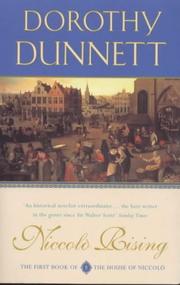
Bruges, 1460, and an apparently good-natured apprentice with an extraordinary head for numbers. Dunnett never tells you what Nicholas is thinking, so the first hundred pages feel like a comedy and then quietly stop being one. On the order debate: read Niccolo first. It is set eighty years earlier, its ending connects forward, and Lymond is the more emotionally direct series, which makes it the better second course. Readers who go Lymond first often find Nicholas cold by comparison — but they get
The core
BeginnerFollow the Charetty company from Bruges into the trading world, and watch Nicholas's methods become deliberate.
▸ Study plan for this stage
Pace: 12-15 weeks for the three. Each runs 450-550 pages and they are dense — 25 pages a day is a realistic sustained rate, and these are books where re-reading a page is normal rather than a failure. Do not leave long gaps between volumes; the cast carries over and Dunnett assumes you remember minor char
- The Spring of the Ram takes the company to Trebizond on the eve of its fall to the Ottomans — the first volume where Nicholas's schemes are visibly premeditated rather than reconstructed after the fact
- The cost accounting begins here: Dunnett starts showing what Nicholas's cleverness does to the people standing near it
- Race of Scorpions puts him in Cyprus between two claimants to a throne, both of whom want to own him, with sugar as the commodity and the war as the market
- Catherine, Zacco and the Cypriot court — the sequence's tightest plotting and the point most readers become unable to stop
- Scales of Gold crosses the Sahara to Timbuktu, and is only partly a commercial expedition; the change of register is deliberate and it is the most beautiful of the eight
- Gelis van Borselen, whose relationship with Nicholas becomes the sequence's central and most destructive thread
- Dunnett's habit of putting real historical crises on a precise timetable and making Nicholas's business decisions the way you experience them
- The pattern established across these three: a new theatre each book, the same enemies compounding, and the family question advancing a step in each
- At what point in The Spring of the Ram do you first know that Nicholas planned something in advance, and what tipped you off?
- What does Trebizond's fall cost the company, and what does Nicholas get out of it?
- In Race of Scorpions, what do Zacco and Carlotta each want from Nicholas, and why can he not simply refuse both?
- What is Nicholas looking for in Africa, and is the commercial cover convincing?
- How does the relationship with Gelis change what Nicholas is willing to do?
- Which people are damaged by his successes in these three books, and does the text hold him responsible?
- Keep a chronology of real historical events alongside the plot. Dunnett times everything to the month and the fiction reads better when the history is visible.
- After each volume, write three sentences on what Nicholas gained and what it cost someone else. The ledger is the series.
- Mark the sentences where Dunnett gives you access to Nicholas's feeling; they are rare and each one is load-bearing.
- If you need a break, take it after Scales of Gold — it is the cleanest stopping point in the eight.
Next up: The middle books turn inward: the parentage question planted in Bruges moves from background to plot, and Nicholas's schemes start being aimed at his own family.
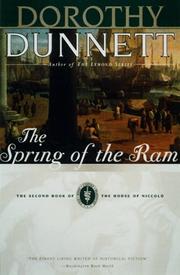
A trading expedition to Trebizond on the eve of its fall to the Ottomans. The first book where Nicholas's schemes are visibly premeditated, and where the cost to other people starts being counted.
Cyprus, sugar, and a civil war between rival claimants who both want him. The plotting tightens sharply here and this is where most readers stop being able to put the series down.
Across the Sahara to Timbuktu, on a quest that is only partly commercial. The most self-contained volume and a genuine change of register.
The deeper cuts
BeginnerTake on the two middle-late books where the long-running family mystery moves to the centre.
▸ Study plan for this stage
Pace: 10-12 weeks for the two. The Unicorn Hunt is the most difficult book in the sequence and the one readers argue about most — the confusion is engineered, it lasts a long time, and it does resolve. Expect to be genuinely lost for stretches and keep going; 20-25 pages a day. To Lie with Lions is easier
- The Unicorn Hunt moves between Scotland, Egypt and Sinai, driven entirely by a question about a child's parentage
- Deliberate reader disorientation: Dunnett withholds not just motive but basic fact here, and the withholding is the plot rather than a stylistic tic
- Gelis and Nicholas as antagonists conducting a private war through other people, which is the sequence's most disturbing material
- The alum trade, Scottish court politics and Egyptian diplomacy as the machinery through which the personal war is fought
- To Lie with Lions in Iceland and Scotland: the volume where Nicholas's revenges begin destroying him instead of his targets
- The turn from a protagonist who is dangerous to one who is culpable, and Dunnett's refusal to excuse it
- The family mystery moving to the centre — everything the St Pol material has been implying since Niccolo Rising
- Why these two are the sequence's hinge: the first six books build a man who wins, and these show what winning has made him
- What is the question about the child, and what does each party believe about it at each stage?
- Where does Dunnett deliberately mislead you in The Unicorn Hunt, and how does she keep it fair?
- What are Gelis and Nicholas actually doing to each other, and who else pays for it?
- In To Lie with Lions, which act is the one Nicholas cannot come back from?
- Does the sequence ask you to keep sympathising with him, and on what grounds?
- How much of the St Pol mystery can you now reconstruct, and what is still withheld?
- In The Unicorn Hunt, write down what you think is true about the child's parentage at the end of each part. Comparing the list afterwards is the best way to see the machinery.
- Do not skim when confused; go back a chapter instead. The information is present.
- Keep a note of every character Nicholas uses and discards across these two books.
- Read To Lie with Lions within a few weeks of finishing The Unicorn Hunt; the consequences lose force at a distance.
Next up: With Nicholas broken by his own methods, the last two books take him out of Europe entirely and then bring him back for the resolution of everything.
Scotland, Egypt and Sinai, driven by a question about a child's parentage. Difficult and much-argued-about; the confusion is engineered and it resolves.

Iceland, Scotland and the consequences of the previous book's cruelties. The point at which Nicholas's revenges start destroying him rather than his enemies.
The finish
BeginnerReach the ending that reframes the whole eight-book sequence.
▸ Study plan for this stage
Pace: 12-14 weeks for the two. Caprice and Rondo is around 500 pages and is the slowest of the eight — exile in Poland and the Crimea, with Nicholas at his lowest and the plot moving sideways rather than forward. Know that going in; it is doing necessary work for the finale rather than failing. Gemini is
- Caprice and Rondo as the recovery volume: Nicholas outside his own world, without the company, and forced to be someone other than the man who wins
- The Crimean and Polish material as Dunnett's least familiar territory and her most patient writing
- Gemini returns to Scotland and closes every thread — the St Pol inheritance, Gelis, Jodi, the Scottish crown, and the question of what Nicholas is owed
- The resolution of the parentage mystery, which recontextualises eight books of behaviour rather than merely explaining it
- Dunnett's endings are famously worth the wait, and this is the largest of them; the last hundred pages are the reason the sequence exists
- The forward connection to the Lymond Chronicles, which is what makes the reading-order question consequential rather than academic
- What the sequence has been arguing about talent, damage and obligation, stated at last in the final volume
- Finishing Gemini is the whole point of the path; there are no further Niccolo books
- What does Nicholas become in exile, and is it a return to who he was in Bruges or something new?
- Why does the sequence need a slow book here rather than going straight to the finale?
- What is the answer to the parentage question, and which earlier scenes change once you know it?
- What does Gemini resolve about Gelis, and does it earn it?
- How does the ending connect to the Lymond Chronicles, and does that change your view of the order you chose?
- Looking back over eight books, when did Nicholas stop being sympathetic — and did he ever start again?
- Before starting Gemini, reread your cast notes from Niccolo Rising. Characters from book one return in the last hundred pages.
- Read Gemini's ending in as few sittings as possible; it is built as a single sustained release.
- After finishing, reread the first chapter of Niccolo Rising. It is a different book.
- Then decide whether to start the Lymond Chronicles, which this site covers in its own path.
Next up: This is the end of the path — eight books, one machine, fully resolved, with Lymond waiting as a separate sequence whenever you want it.

Exile in Poland and the Crimea, with Nicholas at his lowest. Slower than the books either side of it and necessary to what follows.
Back to Scotland for the resolution of every thread laid down since Bruges. Dunnett's endings are famously worth the wait and this is the largest of them; finishing it is the whole point of the path.
Discussion
Keep reading
Paths that share books, cover the same subject, or open a related topic.