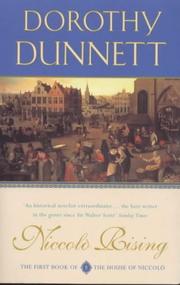
Start with Niccolo Rising. Publication order is the only order — the plot is one continuous machine and no volume stands alone — so the real question a new reader faces is not where to start within the sequence but whether to start with this sequence at all.
Settle that now rather than eight books in. Dorothy Dunnett wrote two historical sequences, and the House of Niccolo is set roughly eighty years before the Lymond Chronicles. This path recommends taking Niccolo first, for two reasons: its ending reaches forward toward Lymond, and Lymond is the more emotionally direct of the two, which makes it the better second course rather than the better first.
The counter-argument is real and worth stating. A Lymond-first reader gets one enormous revelation in the late Niccolo books that a Niccolo-first reader simply cannot get, because it depends on knowing the later sequence already. Either choice costs something. Nothing here requires Lymond, and it is a separate path on this site whenever you want it.
The opening, which is the hardest part
Niccolo Rising runs around 470 pages and the first 150 are the hardest reading in either sequence: a large cast of Flemish and Italian merchant families, business detail delivered without explanation, and a protagonist whose interior life is deliberately withheld. Twenty to 25 pages a day through the opening, then it accelerates.
Dunnett never tells you what Nicholas is thinking. His plans are visible only in their effects, several chapters later, and his head for numbers is the actual superpower of the series — every major reversal across eight books is arithmetic executed early. The first hundred pages read as comedy, with a good-natured apprentice and practical jokes, and then quietly stop being one. That is the design, not a change of mind.
Fifteenth-century Bruges is presented as a functioning commercial system: dyeing, courier routes, bills of exchange, and a widow's company that is a real business. A question of parentage is planted here and paid off seven volumes later.
The core
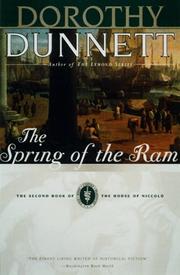
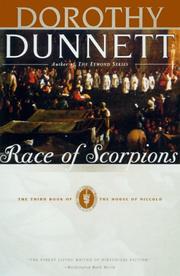
The spring of the ram, Race of scorpions, Scales of gold. Each runs 450 to 550 pages and 25 pages a day is a realistic sustained rate; re-reading a page is normal rather than a failure.
Do not leave long gaps. The cast carries over and Dunnett assumes you remember minor characters from two books back. If you must take a break, Scales of gold is the most self-contained of the eight and the easiest to return to.
The spring of the ram takes the company to Trebizond on the eve of its fall, and is the first volume where Nicholas's schemes are visibly premeditated rather than reconstructed after the fact. Race of scorpions puts him in Cyprus between two claimants to a throne who both want to own him, and is the sequence's tightest plotting. Scales of gold crosses the Sahara to Timbuktu and is the most beautiful of the eight; the change of register is deliberate.
The hinge
The unicorn hunt and To lie with lions, read close together.
The unicorn hunt is the most difficult book in the sequence and the one readers argue about most. The confusion is engineered, it lasts a long time, and it does resolve — Dunnett withholds not just motive but basic fact here, and the withholding is the plot rather than a stylistic tic. Expect to be genuinely lost for stretches and keep going.
To lie with lions is easier to follow and much harder to take, because it is where the consequences arrive. Across the two, Nicholas turns from a protagonist who is dangerous into one who is culpable, and Dunnett declines to excuse it. The first six books build a man who wins; these show what winning has made him.
The finish
Caprice and Rondo is the slowest of the eight — exile in Poland and the Crimea, with Nicholas at his lowest and the plot moving sideways rather than forward. Know that going in. It is doing necessary work for the finale rather than failing.
Gemini is the longest at roughly 700 pages and resolves threads laid down in the first chapter of Niccolo Rising, so do not attempt it with the earlier books cold. Give its last two hundred pages as few interruptions as you can manage. The resolution of the parentage mystery recontextualises eight books of behaviour rather than merely explaining it.
Where to stop
There is no stopping point. That is the honest answer: this is one novel in eight volumes, finishing Gemini is the entire point of the path, and abandoning it midway leaves you with a machine that has not run. There are no further Niccolo books. If you want a sense of what else is built this way, look through the other paths.
Follow the full ordered path here: The House of Niccolo Reading Order: Where to Start.