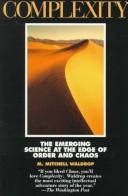
Complexity
M. Mitchell Waldrop · 1992 · 380 pages
As an Amazon Associate we earn from qualifying purchases. Some book links are affiliate links; you pay the same price and we may earn a small commission.
About this book
"In a rented convent in Santa Fe, a revolution has been brewing. The activists are not anarchists, but rather Nobel Laureates in physics and economics such as Murray Gell-Mann and Kenneth Arrow, and pony-tailed graduate students, mathematicians, and computer scientists down from Los Alamos. They've formed an iconoclastic think tank called the Santa Fe Institute, and their radical idea is to create a new science called complexity." "These mavericks from academe share a deep impatience with the kind of linear, reductionist thinking that has dominated science since the time of Newton. Instead, they are gathering novel ideas about interconnectedness, coevolution, chaos, structure, and order - and they're forging them into an entirely new, unified way of thinking about nature, human social behavior, life, and the universe itself." "They want to know how a primordial soup of simple molecules managed to turn itself into the first living cell - and what the origin of life some four billion years ago can tell us about the process of technological innovation today. They want to know why ancient ecosystems often remained stable for millions of years, only to vanish in a geological instant - and what such events have to do with the sudden collapse of Soviet communism in the late 1980s. They want to know why the economy can behave in unpredictable ways that economists can't explain - and how the random process of Darwinian natural selection managed to produce such wonderfully intricate st
Appears in these reading paths



Systems thinking: see how everything connects
Related reading guides
Reader reviews
Ratings and notes from readers — tagged with how deep into the subject they were.
Loading reviews…