Policing: The Best Books on Police, Power and Reform, in Order
American policing is argued about mostly through slogans, and the books that would settle the arguments are rarely the ones being quoted. This path reads the subject from several directions on purpose: two street-level accounts that disagree with each other, then the history that explains how the institution acquired its shape, then the machinery as it currently runs, then the accountability question, and finally the reform debate itself — including the case for order-maintenance policing, which is usually left out of reading lists like this one.
Two views from the street
BeginnerHold two incompatible-sounding claims at once: that Black neighbourhoods are over-policed for minor offences and under-policed for homicide.
▸ Study plan for this stage
Pace: Three to four weeks for 664 pages — Leovy's Ghettoside at 384 and Moskos's Cop in the Hood at 280. Read them in that order and close together; the whole point of the stage is holding both at once, and a gap between them lets the first settle into a conclusion before the second complicates it. Both a
- Leovy's central claim, which is the reason this book goes first: the deepest injustice in South Los Angeles is not too much policing but too little of a particular kind — murders of Black men go uncleared, and the state effectively withdraws from the most serious crime.
- Clearance rate as the measurable form of that claim. A homicide clearance rate is a fact about how often killings are solved, and Leovy's argument stands or falls on what those rates are and what they do to a community.
- The consequence Leovy draws: where the state does not reliably punish killing, informal enforcement fills the gap, and the cycle of retaliation is a rational response to an absence rather than a cultural pathology.
- Moskos's contribution is different in kind — a sociologist who went through the police academy and worked a year as a Baltimore patrol officer, reporting what the job consists of hour to hour rather than what it is supposed to be.
- The incentive structure Moskos describes: arrest numbers as the measure of productivity, the drug war as the source of most low-level arrests, and the way both push officers toward volume in minor offences rather than toward difficult investigative work.
- Why these two books are not actually in contradiction. Over-policing for minor offences and under-policing for homicide are two consequences of the same set of incentives, and seeing that is the analytical work of the stage.
- Participant observation as evidence, with its strengths and limits: unmatched access and detail, a single site, and an observer whose presence and perspective shape what is recorded.
- The habit this path is trying to build, established here: read for the argument and the evidence behind it rather than for confirmation, and take the strongest version of each position seriously.
- State Leovy's thesis precisely. What evidence does she offer, and what would count against it?
- What is a homicide clearance rate, what were the rates Leovy reports, and why does she treat that number as the central fact?
- According to Moskos, what does a patrol officer actually spend a shift doing? How much of it is what the public imagines?
- Which incentives does Moskos identify as driving low-level arrest volume, and where do those incentives come from?
- Reconcile the two books. Explain how the same system can over-police minor offences and under-police homicide without contradiction.
- What are the limits of a one-officer, one-city participant account as evidence? What would you want alongside it?
- Write both theses on one page, then write the strongest objection to each. Keep the page; you will return to it at the end of the path.
- Look up current homicide clearance rates for two cities and compare them by neighbourhood or district where the data allows. Leovy's argument is empirical and can be checked.
- Diagram the incentive structure Moskos describes: what is measured, what is rewarded, what behaviour follows. This diagram explains most of stage three in advance.
- Note, honestly, which of the two books you found more congenial before reading either. That prior is what the rest of the path is designed to test.
Next up: You have two street-level accounts that appear to conflict and do not; the next stage explains how an institution with these incentives came to exist in the first place.
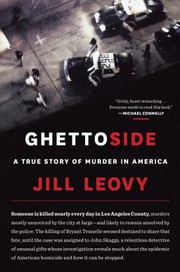
Leovy followed LAPD homicide detectives in South Los Angeles and argues that the deepest injustice is not too much policing but too little — that murders of Black men go uncleared and the state effectively withdraws. It is the book most likely to unsettle whatever view you arrive with, which is why it goes first.
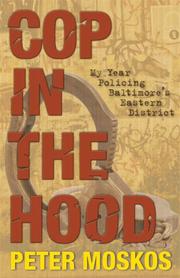
A sociologist who went through the academy and worked a year as a Baltimore patrol officer. The best available account of what the job actually consists of hour to hour, and of how the drug war shaped the incentives. Read it directly after Leovy; they are describing the same problem from opposite ends.
How it got here
IntermediateTrace the institution's origins and expansions — slave patrols, the criminalisation of Black life, the automobile, the Cold War — and stop treating the current arrangement as natural.
▸ Study plan for this stage
Pace: Two to three months for 1,305 pages of academic history — Hadden's Slave Patrols at 360, Muhammad's The Condemnation of Blackness at 392, Seo's Policing the Open Road at 167 in the record held here, and Schrader's Badges Without Borders at 386. Read them in the order given, which is roughly chronolo
- Hadden's archival history of slave patrols in Virginia and the Carolinas. This is the origin claim most often asserted and least often sourced, and Hadden is the source — while being considerably more careful about the lines of descent to modern departments than the slogan version is.
- Continuity and discontinuity as a historical question. Whether a modern police department descends from a slave patrol, resembles one, or merely occupies a similar function is three different claims, and Hadden lets you distinguish them.
- Muhammad's argument in The Condemnation of Blackness: crime statistics were constructed at the turn of the twentieth century in a way that made Blackness itself evidence of criminality, while equivalent immigrant crime was explained environmentally.
- The asymmetry is the key finding — the same data producing a structural explanation for one population and a racial one for another. This is the intellectual history underneath everything in the later stages.
- Seo's argument that the automobile is what turned police into an everyday presence in ordinary people's lives. Mass car ownership required mass regulation, and mass regulation required discretionary enforcement against everyone.
- The Fourth Amendment consequences Seo traces: the car exception, the pretextual stop, and the accumulation of doctrine that made the traffic stop the most common police-citizen encounter there is.
- Schrader's overseas half of the story: American counterinsurgency and police assistance programmes abroad, and the return of those doctrines, personnel and equipment to domestic departments.
- Why Schrader belongs before Balko. Rise of the Warrior Cop describes militarisation largely at the level of equipment and tactics; Schrader supplies the institutional mechanism by which it happened, which is the more durable explanation.
- The cumulative point of the stage: the current arrangement is a series of contingent historical choices rather than a natural or inevitable form, and knowing which choices were made when is what makes reform arguments assessable.
- What does Hadden actually establish about slave patrols, and what does she decline to claim about their descent to modern policing?
- Distinguish three versions of the slave-patrol origin claim by strength. Which does the evidence support?
- Describe the asymmetry Muhammad identifies in how crime statistics were interpreted. What made the asymmetry possible?
- How did the automobile change the frequency and character of police contact with ordinary people? Give Seo's mechanism, not just her conclusion.
- What Fourth Amendment doctrines does Seo trace to the car, and what is their combined effect on the traffic stop?
- What is the mechanism Schrader identifies for the return of counterinsurgency practice to domestic policing? Name the specific channels.
- Build a timeline of American policing from the slave patrols through the Progressive-era statistical work, the automobile, and the Cold War assistance programmes. Mark on it what each development made possible.
- Take one modern police practice — the pretextual stop, the SWAT raid, a crime statistic — and trace it back through these four books to its origin.
- Write the slave-patrol origin claim at three levels of strength and assess each against Hadden's evidence. This exercise is the best defence against both overclaiming and dismissal.
- Find a contemporary crime statistic and ask Muhammad's question of it: what is being counted, who decided what to count, and what explanation does the framing invite?
- Read Schrader's account of one assistance programme and list every channel by which it influenced a domestic department.
Next up: With the historical mechanisms in place, the next stage examines the three systems those mechanisms produced, as they currently run.
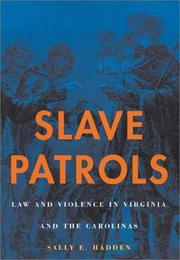
The archival history of slave patrols in Virginia and the Carolinas. It is the origin claim most often asserted and least often sourced; Hadden is the source, and she is more careful about the lines of descent than the slogan version is.

How crime statistics were constructed at the turn of the twentieth century to make Blackness itself evidence of criminality, and how that shaped urban policing for a century. The intellectual history under everything that follows.

A legal historian's argument that the car is what turned police into an everyday presence in ordinary people's lives, and hollowed out the Fourth Amendment doing it. It explains the traffic stop, which is the most common police-citizen encounter there is.

The overseas half of the story: counterinsurgency assistance abroad and its return to American departments. Read it before Balko — it supplies the historical mechanism that Rise of the Warrior Cop mostly describes at the level of equipment.
The machinery now
IntermediateUnderstand the three systems that produce most contact between police and the public: militarised tactics, the misdemeanour process, and the investigatory stop.
▸ Study plan for this stage
Pace: Six to eight weeks for 1,016 pages — Balko's Rise of the Warrior Cop at 401, Natapoff's Punishment Without Crime at 352 and Epp and colleagues' Pulled Over at 263. Read in that order: the militarisation history, then the misdemeanour system, then the survey research that measures the encounter both
- Balko's account of militarisation: SWAT proliferation from a rare tactical resource to routine warrant service, the spread of no-knock raids, and the federal transfer of surplus military equipment to local departments through the 1033 programme.
- Balko writes from a libertarian position rather than a left one, which is worth noting because it means the militarisation critique is not the property of one political tradition. A reading list that omits him is narrower than it looks.
- The tactical escalation argument: equipment and training shape the situations officers create, so a department with a SWAT team serves warrants differently from one without, independent of the threat level.
- Natapoff's central finding, and the most underrated fact on this reading list: the overwhelming majority of criminal cases are misdemeanours, and they are processed rather than adjudicated — guilt decided in minutes, often without meaningful defence.
- Consequences of a misdemeanour conviction — fines and fees, licence loss, employment and housing exclusion, immigration effects — which are frequently more severe and more lasting than the nominal penalty.
- The reframing Natapoff performs: policing is the front end of a processing machine rather than the beginning of an adjudicative process, which changes what an arrest is for.
- The investigatory stop versus the traffic-safety stop, which Epp and colleagues separate cleanly. One enforces driving law; the other uses a minor violation as a pretext to investigate the driver.
- The measured racial disparity is concentrated in the investigatory category rather than the safety category, and the survey design is what allows that distinction to be made rather than asserted.
- The trust effect: Epp and colleagues measure what investigatory stops do to confidence in police among those subjected to them, which supplies an empirical link between the encounter and the legitimacy problem the last stage argues about.
- Trace SWAT from exceptional resource to routine warrant service. What drove each step in Balko's account?
- Balko is a libertarian critic of policing. Where does his framing lead him to emphasise something a left critique would not, and does it strengthen or weaken the argument?
- What proportion of criminal cases are misdemeanours, and what does Natapoff mean by calling the system a processing machine rather than an adjudicative one?
- List the collateral consequences of a misdemeanour conviction. Why are they often more severe than the sentence?
- How do Epp and colleagues distinguish investigatory from traffic-safety stops, and why does the distinction matter for measuring disparity?
- How does the survey evidence in Pulled Over connect to Seo's historical account of the automobile in the previous stage?
- Do these three books describe one system or three? Make the case that they are aspects of a single arrangement.
- Look up whether your local department participates in the federal equipment transfer programme and what it has received. Balko's argument is checkable at the level of your own city.
- Find local data on misdemeanour case volume and disposition times. Natapoff's claim about minutes rather than trials is the kind that becomes real when you see the local numbers.
- Read the methods section of Pulled Over carefully and write out how the survey distinguishes the two stop types. Then assess what could still confound the result.
- Combine all three books into a single account of the most common police-citizen encounter, from the stop through the charge to the plea and its consequences.
- Return to the incentive diagram you drew after Moskos and annotate it with what these three books add.
Next up: You now know how most contact between police and the public is produced; the next stage takes up the rarest and gravest form of that contact and the remedies that are supposed to answer for it.
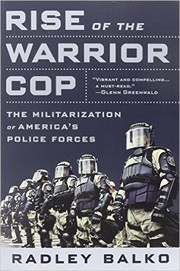
The standard account of militarisation — SWAT proliferation, no-knock raids, the 1033 programme. Balko writes from a libertarian position rather than a left one, which makes this list broader than it would otherwise be.

The misdemeanour system, where the overwhelming majority of criminal cases actually live and where guilt is decided in minutes. The single most underrated book on this subject; it reframes policing as the front end of a processing machine.

Survey research on investigatory traffic stops, distinguishing them cleanly from traffic-safety stops and measuring the racial disparity and its effect on trust. This is the empirical backbone of the stage — read it as the evidence for what Seo describes historically.
Force and accountability
IntermediateKnow what the data on police killings actually shows and why the legal remedies so rarely work.
▸ Study plan for this stage
Pace: Four to six weeks. Zimring's When Police Kill is 320 pages of quantitative criminology and should be read slowly and with attention to the tables; Schwartz's Shielded has no page count in the catalogue record and is a legal account written for a general reader, so it moves faster. Read Zimring first
- Zimring's starting point, which is itself a finding: there was no reliable national count of people killed by police, and constructing one from non-official sources was the first substantial contribution of the book.
- The measured picture — how many, in what circumstances, with what weapons, and how the American rate compares with other wealthy countries. The international comparison is the single most important number in this stage.
- Zimring's disaggregation of the circumstances of police killings, and his argument that a substantial share are potentially preventable through specific tactical and policy changes rather than through cultural transformation.
- The policy levers he identifies: use-of-force policy, reporting requirements, tactical rules on shooting at vehicles and on foot pursuits, and the demonstrated effect of departmental policy on the number.
- Reading criminology properly: what the denominator is, how the data was assembled, what is being compared with what. Zimring is careful about this and the stage is partly a lesson in that carefulness.
- Schwartz's subject is why civil suits against police almost never succeed, and her contribution is to show it as a stack of specific legal doctrines rather than as a general culture problem.
- Qualified immunity as one component among several. Schwartz's more interesting finding is that indemnification, municipal liability rules, plaintiff-side economics and pleading standards each independently obstruct recovery, so removing any one would change less than its advocates expect.
- Indemnification specifically: officers overwhelmingly do not pay judgments personally, which severs the deterrent link between individual conduct and financial consequence that the tort remedy assumes.
- The distinction between accountability as a legal mechanism and accountability as a political outcome. Schwartz is precise about which she is discussing, and the argument in the last stage frequently is not.
- How did Zimring construct a count of police killings, and what are the weaknesses of that construction?
- How does the American rate compare with other wealthy countries, and what explanations does Zimring consider for the difference?
- Which categories of police killing does Zimring identify as most amenable to policy change, and what evidence supports that?
- Name four distinct legal obstacles to a successful civil suit against an officer. Which would matter most if removed, and would removing it be sufficient?
- What does indemnification do to the deterrent logic of civil liability?
- Zimring gives numbers and Schwartz gives doctrine. What question does neither answer, and where in the next stage does it get taken up?
- Find the current national estimates of people killed by police and compare them with what Zimring worked from. Note who is producing the data now and how.
- Take one policy lever Zimring identifies and find a department that adopted it, then look for evidence on what happened to its numbers.
- Diagram a civil suit against an officer as a sequence of hurdles from filing to recovery, marking where Schwartz says most cases die.
- Write a page on what would have to change for civil liability to function as a deterrent, and assess how likely each change is.
- Set Zimring's preventable-share estimate beside the abolition and reform arguments you are about to read, and note in advance which of them the number supports.
Next up: With the data on force and the mechanics of accountability in hand, the final stage takes up the arguments about what to do — each of which makes empirical claims you are now equipped to check.

Zimring is a criminologist and this is the careful quantitative treatment: how many, under what circumstances, compared with what other countries, and which policy levers move the number. Read it before any of the arguments about what to do.

A law professor's account of why civil suits against police almost never succeed — qualified immunity, indemnification, municipal liability rules. It explains the accountability gap as a set of specific legal doctrines rather than as a culture problem.
The argument about what to do
IntermediateBe able to state the abolitionist case, the order-maintenance case and the reformist middle in their strongest forms, and say which parts of each the evidence supports.
▸ Study plan for this stage
Pace: Six to eight weeks for 975 pages — Vitale's The End of Policing at 272, Kelling and Coles's Fixing Broken Windows at 319 and Brooks's Tangled Up in Blue at 384. Read them in that order: the abolitionist case, then the order-maintenance case it is largely arguing against, then the account that sits i
- Vitale's argument is about substitution rather than absence: most police functions — mental health crisis response, school discipline, homelessness, drug use, sex work — were assigned to police by default and could be assigned elsewhere. Stating it that way is the difference between engaging the arg
- The chapters of The End of Policing vary considerably in evidentiary strength, and Vitale is stronger where a well-studied alternative exists — crisis response, harm reduction — than where the alternative is more speculative. Noticing which is which is the analytical work.
- Fixing Broken Windows is the book-length case for order-maintenance policing, which is the position almost every other book on this path argues against. It is included so that you can assess the criticism against the original claim rather than against a summary of it.
- What broken windows actually claims, as opposed to what it is often taken to claim: that visible disorder signals an absence of social control and invites more serious crime, and that maintaining order is therefore a crime-prevention function. It is not identical to zero-tolerance mass misdemeanour
- The empirical record is heavily contested. Studies attempting to separate order-maintenance effects from the broader crime decline have produced mixed results, and the gap between the theory and its implementation is where much of the dispute actually sits.
- The gap between a theory and its implementation is the general lesson here, and it applies to the abolitionist proposals as much as to broken windows. A policy's record is a record of how it was carried out, not only of what it claimed.
- Brooks's position is genuinely unusual: a law professor who became a reserve officer in Washington DC, so she can read the reform literature and work a shift. Neither perspective is borrowed.
- She reaches no tidy conclusion, and the path ends there deliberately. A reading list on this subject that resolves into a position is misrepresenting the state of the evidence.
- The synthesis this stage is for: which specific claims in each position does the evidence from the previous four stages support? Leovy's under-policing finding, Natapoff's misdemeanour data, Epp's disparity measurement and Zimring's preventable share each bear on these arguments in different directi
- State the abolitionist case in its strongest form, as an argument about substitution. Which of Vitale's proposed substitutions has the best evidence behind it, and which the weakest?
- State the broken-windows theory as Kelling and Coles state it. How does it differ from zero-tolerance enforcement as implemented?
- What is the empirical record on order-maintenance policing, and what makes it hard to evaluate cleanly?
- Where does Leovy's under-policing finding cut against Vitale's argument, and where does it support it?
- How does Natapoff's evidence on the misdemeanour system bear on broken windows in practice?
- Why does Brooks reach no conclusion? Is that intellectual honesty or evasion? Argue it.
- Write your own position on one specific policy question — not on policing in general — and cite which book supports each element of it.
- Take Vitale's chapters one at a time and grade each on the strength of its evidence for the proposed substitution. The variation across chapters is the most useful thing this book offers a careful reader.
- Read Kelling and Coles's original statement and then find a summary of broken windows in the press. Write down every way the summary differs from the original.
- Build a table with each policy proposal from the whole path in one column and the evidence for and against it from the previous stages in the others. This table is the deliverable of the entire reading list.
- Return to the page you wrote in stage one with Leovy's and Moskos's theses and their objections. Revise it with everything you now know, and note what changed.
- Write a final page naming the strongest argument on the side you agree with least, and the weakest argument on the side you agree with most. If you cannot do both, reread the stage that made you most uncomfortable.
Next up: This is the end of the path: two street-level accounts, the institutional history, the machinery as it runs, the data on force and the law of accountability, and the reform argument in its strongest competing forms — with no tidy conclusion, because the evidence does not supply one.

The best-known statement of the abolitionist position, and an argument about substitution rather than absence — that most police functions were assigned to police by default and could be assigned elsewhere. Read it as the strongest version of the case, and notice which of its chapters are better evidenced than others.
Kelling and Coles's book-length case for order-maintenance policing, which is the position almost every other book here is arguing against. It is included deliberately: the broken-windows theory has been heavily criticised empirically, and you cannot assess that criticism without having read the original claim rather than a summary of it.

A Georgetown law professor who became a reserve DC police officer, which gives her the rare position of understanding both the reform literature and the shift. She reaches no tidy conclusion, and that is the honest place for this path to end.
Discussion
Keep reading
Paths that share books, cover the same subject, or open a related topic.