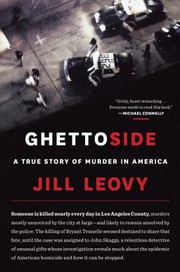
Start with Ghettoside. Jill Leovy followed LAPD homicide detectives in South Los Angeles and argues that the deepest injustice in Black neighbourhoods is not too much policing but too little — that murders of Black men go uncleared and the state effectively withdraws from the one crime it exists to answer. It is the book most likely to unsettle whatever position you arrive holding, which is exactly why it goes first.
American policing is argued about mostly through slogans, and the books that would inform the argument are rarely the ones being quoted. This path is assembled so the disagreement stays visible: abolitionist, reformist and order-maintenance positions are all here in their authors' own words, and each entry below says where its author is standing. It does not adjudicate between them, because the empirical questions underneath — what policing causes, what it prevents, and what would happen without it — are genuinely open in the research literature.
Two views from the street
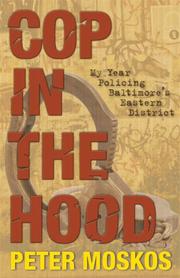
Cop in the Hood is the natural second book. Peter Moskos is a sociologist who went through the Baltimore academy and worked a year on patrol, and this is the best available account of what the job consists of hour by hour and of how drug enforcement shaped the incentives. Leovy and Moskos are describing the same neighbourhoods from opposite ends: one argues the state does too little, the other that what it does do is aimed at the wrong thing.
How the institution got its shape
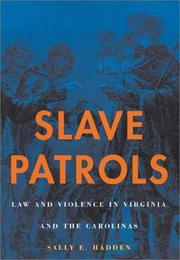
Slave patrols is Sally Hadden's archival history of patrols in Virginia and the Carolinas. The claim that American policing descends from slave patrols is asserted far more often than it is sourced; Hadden is the source, and she is considerably more careful about the lines of descent than the slogan version is. The condemnation of blackness is Khalil Gibran Muhammad on how crime statistics were constructed around 1900 so that Blackness itself read as evidence of criminality — the intellectual history under most of what follows.
Policing the Open Road is a legal historian's argument that the automobile turned police into an everyday presence in ordinary people's lives and hollowed out Fourth Amendment protection in the process; it explains the traffic stop, which is the most common police-citizen encounter there is. Badges Without Borders is Stuart Schrader on American counterinsurgency assistance abroad and its return home, and it belongs before Balko because it supplies the historical mechanism that a purely equipment-focused account describes only at the surface.
The machinery now
Rise of the Warrior Cop is the standard account of militarisation — SWAT proliferation, no-knock raids, the surplus-equipment programme. Radley Balko writes from a libertarian rather than a left position, which is part of why the list is broader than it would otherwise be. Punishment Without Crime is Alexandra Natapoff on the misdemeanour system, where the overwhelming majority of criminal cases actually live and where guilt is often settled in minutes; it reframes policing as the front end of a processing machine. Pulled Over is survey research by Epp, Maynard-Moody and Haider-Markel that separates investigatory stops from traffic-safety stops and measures the racial disparity and its effect on trust — the empirical backbone for what Seo describes historically.
Force and accountability
When police kill is the criminologist Franklin Zimring's quantitative treatment: how many, under what circumstances, against what international comparison, and which policy levers actually move the number. Read it before any argument about what to do. Shielded is Joanna Schwartz, a law professor, on why civil suits against police almost never succeed — qualified immunity, indemnification, municipal liability doctrine — which recasts the accountability gap as a set of specific legal rules rather than a culture problem.
The argument about what to do
The End of Policing is the best-known statement of the abolitionist case, and Alex Vitale's argument is about substitution rather than absence: that most police functions were assigned to police by default and could be assigned elsewhere. Fixing Broken Windows is the opposite pole, and it is on this list deliberately. Kelling and Coles make the book-length case for order-maintenance policing, the position nearly every other book here is arguing against; broken windows has been heavily criticised empirically, and you cannot weigh that criticism without having read the original claim rather than a summary of it. Tangled up in Blue closes the path — Rosa Brooks is a Georgetown law professor who became a reserve DC officer, and she reaches no tidy conclusion, which is the honest ending. Related subject guides sit on Discover.
Follow the full ordered path here: Policing and Police Reform: The Best Books to Read, in Order.
Ready to learn something deeply?
Build a reading path — free