The history of policing: books to read, in order
This is a history, not a reform argument. The point is to find out where modern police forces actually came from — which turns out to involve eighteenth-century London thief-takers, southern slave patrols, northern city machines that needed a payroll, and a professionalisation movement that succeeded at almost everything except its stated goal. The path is deliberately archival and chronological: English origins first, then the two separate American lineages, then the reform movements of 1900-1970, then the construction of the link between race and crime that shaped the century, and finally two theoretical frames worth having. Contemporary reform arguments are a different subject and are covered elsewhere on this site; here the aim is to be able to say what the institution was built to do, on the evidence.
Before the police, and the English invention
BeginnerUnderstand what policing looked like before uniformed forces — constables, watchmen, thief-takers, private prosecution — and be able to state what was genuinely new about the 1829 Metropolitan Police and what was continuous with what came before.
▸ Study plan for this stage
Pace: Four weeks for 789 pages. Beattie's Policing and Punishment in London, 1660-1750 is 502 pages of archival social history built from court and parish records, and it is the more demanding of the two — allow two to three weeks and read the chapters on the watch, the reward system and the courts closel
- What policing consisted of before uniformed forces: unpaid parish constables serving by rotation, a night watch, private prosecution by victims, and the courts as the institution that actually did most of the work.
- Thief-takers and the reward system: statutory rewards for convictions created a professional class of private detectives with an obvious incentive problem, which is the corruption story that runs from Jonathan Wild to the Bow Street office.
- That private prosecution was the norm — a victim who wanted a case brought had to pay for it — and what that meant for who received the law's protection.
- What was genuinely new in 1829: a uniformed, salaried, hierarchical, preventive force under central control, patrolling on a fixed beat and defined by visibility rather than by detection.
- What was continuous: the beat itself, much of the personnel, the reliance on public cooperation, and the magistracy the new force answered to.
- The two standard interpretations Emsley refuses — consent freely given to a benign institution, and a force imposed on the working class to suppress it — and the evidence that complicates each.
- Policing by consent as a claim to be examined rather than a description: it was asserted from the beginning as part of the case for the force, which makes it a piece of evidence about the founders' strategy.
- Describe how a theft would have been investigated and prosecuted in London before the Metropolitan Police. Who did what, and who paid?
- What incentive did the reward system create, and what specific abuses followed from it?
- Name four features of the 1829 force that were new and three that were not. Which set is longer, and does that change what 1829 means?
- Why does Emsley reject both the consent story and the class-suppression story? What evidence does each fail to accommodate?
- If policing existed before the police, what exactly was invented? Answer as precisely as Beattie's evidence allows.
- Build a table of pre-police policing functions from Beattie — detection, apprehension, prosecution, punishment — and mark who performed each. Then mark which the new force absorbed and which it did not.
- Trace one thief-taker case through Beattie's account, from the offence to the reward, and identify each point at which the incentive distorted the outcome.
- Write out the Peelian principles as they were actually promulgated, then check each against Emsley's account of how the force behaved in its first decades. Note which were description and which were public relations.
- Write half a page on what would count as evidence that a police force enjoys consent. Keep the answer — the American stages test it repeatedly.
Next up: The English model was exported, but American policing has two origins rather than one, and only part of it descends from Peel.
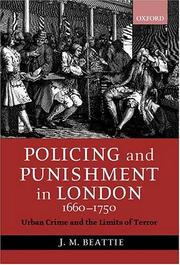
The archival foundation, covering 1660-1750: the parish constables and night watch, the Bow Street runners' predecessors, the reward system that produced professional thief-takers, and the courts that all of it fed. It establishes that London had policing long before it had police, which is the fact that makes 1829 interpretable. Catalogued with its date range.

The standard political and social history of the English police from Peel to the twentieth century, by the historian who did most to establish the field. Emsley is sceptical of both the official story of consent freely given and the radical story of a force imposed to suppress the working class. His later The Great British Bobby covers the same ground through the cultural myth of the constable if you want that angle too.
The two American lineages
IntermediateTrace the southern slave patrols and the northern municipal departments as genuinely separate origins, and be able to state carefully what the evidence does and does not support about the line of descent from the former — this is the most asserted and least sourced claim in the subject.
▸ Study plan for this stage
Pace: Six weeks for four books and 1,159 pages, and none is long. Hadden's Slave Patrols is 360 pages of archival history covering Virginia and the Carolinas — who served, under what law, and what happened to the institution after emancipation; a fortnight, and read her rather than a summary of her, becau
- The southern lineage: slave patrols as legally constituted bodies with defined membership, powers of search and correction, and a mandate to control the movement of enslaved people — a form of policing with no northern equivalent.
- What Hadden's evidence actually supports about descent. Patrol personnel and practices fed into postbellum policing and into other institutions, and the careful claim is about continuities of practice and personnel rather than a single unbroken institutional line. This is the most asserted and least
- The northern lineage: departments emerging out of the older watch system in response to riot, immigration and vice rather than to crime as such, which is Lane's finding for Boston and the earliest documented version of the story.
- Monkkonen's reframing, which is the most surprising thing in this stage: for their early decades American police spent most of their effort on order maintenance, poor relief and lodging the homeless, and the crime-fighting identity is a later acquisition.
- Why that matters for everything downstream: an institution's original function is not its present one, and the shift from social service to crime control is a historical event that can be dated.
- Mitrani's class-formation account, grounded in Chicago's records: a department built by a business elite that needed a reliable instrument against strikes and disorder, which is the strongest version of that argument because it is a case study rather than an assertion.
- Municipal machine politics as the third force: departments as patronage employers, with appointments, promotions and non-enforcement as currency, which is the condition the next stage's reformers were reacting against.
- The methodological spread on display here — one archival institutional history, one city case study, one comparative quantitative study, one argument-driven monograph — and what each design can and cannot establish.
- Describe a slave patrol as a legal institution: who served, under whose authority, with what powers, and subject to what oversight.
- State the continuity claim about slave patrols and southern policing at the strength Hadden's evidence supports. Then state the stronger version and say what it would need.
- Why did Boston create a police department, on Lane's account? Rank the causes he identifies.
- What did American police actually do in their first decades, according to Monkkonen's data? How does he know, and what is his evidence unable to see?
- State Mitrani's argument and its evidence. Would it generalise beyond Chicago, and what would you need to check?
- Two lineages, one institution. Where and when do they converge, and what does the answer do to any single origin story?
- Build a two-column comparison of the southern and northern lineages: legal basis, personnel, powers, target population, and what happened to each after the Civil War.
- Take Monkkonen's activity data and produce a chart of what police effort was spent on by decade. Then write a paragraph on when the crime-fighting identity took over and what the evidence says drove it.
- Test Mitrani's argument against Lane's Boston: does the class-formation account fit a city with a different economy and labour history? Say what would settle it.
- Write two paragraphs on the descent question — one that Hadden's archive supports and one that goes beyond it — and mark every sentence in the second that you could not source.
- Return to your consent test from stage one and apply it to each of these four cases. Note where the question does not even make sense.
Next up: Machine-run departments produced a century of reform movements, and the next stage is about what those reforms actually changed.
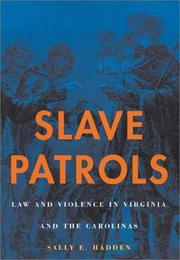
The archival history of slave patrols in Virginia and the Carolinas: who served, under what law, and what happened to the institution after emancipation. Hadden is more careful about the lines of continuity than the slogan version of her argument is, and reading her rather than a summary of her is the whole point of putting her first.

Boston 1822-1885, and the first serious study of an American department's creation. Lane shows the force emerging from the older watch system in response to riot, immigration and vice rather than to crime as such — the northern origin story in its earliest documented form. A 1967 book and still the model for the ones that followed.

The comparative quantitative study, covering the departments of the largest American cities between 1860 and 1920. Monkkonen's finding — that police spent most of their early decades on order maintenance, poor relief and lodging the homeless rather than on crime — reframes what the institution was originally for. Catalogued with its date range.

A single-city case study with an explicit argument: Mitrani reads Chicago's department as built between 1850 and 1894 by a business elite that needed a reliable instrument against strikes and disorder. The strongest available statement of the class-formation account, grounded in one city's records rather than asserted generally.
Professionalisation, and what it actually achieved
IntermediateFollow the reform movement from Vollmer and Wilson to the patrol car and the radio, and be able to explain why a century of professionalisation reduced overt corruption while increasing the distance between police and the neighbourhoods they worked in.
▸ Study plan for this stage
Pace: Four to five weeks for 778 pages, the shortest of the American stages. Fogelson's Big-City Police is 379 pages covering reform from the 1890s to the 1970s in two waves, and it supplies the organising insight of the stage — that each reform solved the previous generation's problem while creating the
- The two waves of reform: the Progressive attack on machine politics — civil service, centralised command, insulation from ward politicians — and the postwar professional model of a technically expert, legalistic, crime-focused department.
- Vollmer and Wilson as the architects of the professional model, and the specific things it meant in practice: recruitment standards, training, records, radio dispatch, and preventive patrol by car.
- Fogelson's organising insight: each reform was a solution to the previous generation's problem and the source of the next generation's, which is why the reform literature repeats itself across a century.
- The patrol car and the radio as the decisive technologies. They made rapid response possible and simultaneously removed officers from the street, converting a foot presence into a series of dispatched encounters.
- The measurable achievement — a real reduction in overt corruption and in ward-level political control of departments — set against the cost, which was distance from the neighbourhoods being policed.
- Walker's scepticism: professionalism was substantially an idea promoted by police leaders about themselves, and the gap between the claim and the practice is itself the historical object.
- The Black officers Dulaney recovers: Reconstruction-era hiring, the departments that refused, the restrictions imposed on those hired, and the fraternal associations formed in response.
- What Dulaney's material does analytically — it makes it impossible to treat a department as a single actor with a single interest, which most of the reform literature implicitly does.
- Describe the two reform waves and say what problem each was attacking. What did each achieve on its own terms?
- Explain Fogelson's cycle with two concrete examples of a reform that created the next problem.
- How did the patrol car change policing? Give the intended effect and at least two unintended ones.
- Walker argues professionalism was largely self-presentation. What evidence supports that, and what would count against it?
- What restrictions were placed on early Black officers, and what does their existence show about how departments understood their own authority?
- A century of professionalisation reduced corruption and increased distance. Were those two outcomes connected, or coincidental? Argue it.
- Build a reform timeline with three columns: the reform, the problem it addressed, and the problem it created. Fogelson gives you most of it; fill the third column yourself.
- Take the professional model's stated goals and score each against Walker's evidence: achieved, partly achieved, or asserted only.
- Write out what a beat officer's day looked like before and after the patrol car, and mark every interaction that disappears in the second version.
- Using Dulaney, list the ways a department could hire Black officers while limiting their authority. Then say what each limitation reveals about the department's conception of policing.
Next up: Reform ran in parallel with a change in how crime itself was counted and explained, which is the subject of the next stage.
The classic account of American police reform from the 1890s to the 1970s, in two waves — the Progressive attack on machine politics, then the postwar professional model. Fogelson's argument that each reform solved the previous generation's problem while creating the next is the organising insight of this stage.

Walker's study of the emergence of professionalism as an idea, and of how much of it was self-presentation by police leaders rather than change in practice. Read it against Fogelson. Note that the catalogue record's display title has a missing space, rendered as 'policereform' — it is the right book. His Popular Justice sets the same story in a full history of American criminal justice.
The history of Black officers from Reconstruction onward — the towns that hired them, the departments that would not, the restrictions on arresting white citizens, and the associations they formed. It is the part of the professionalisation story that the standard accounts omit, and it complicates any picture of the department as a single actor.
Race, statistics, and the twentieth-century turn
IntermediateUnderstand how crime statistics were constructed and interpreted around 1900, how urban policing and Black urban populations came into their twentieth-century relationship, and how federal money reshaped local departments after 1965.
▸ Study plan for this stage
Pace: Six weeks for 1,221 pages. Muhammad's The Condemnation of Blackness is 392 pages of intellectual history on how post-emancipation crime statistics were assembled and read, and it should be read first because it changes how you read every number in the other two books; a fortnight. Johnson's Street J
- Muhammad's central finding: the same kind of crime statistics were read as evidence of inherent criminality when they concerned Black Americans and as evidence of poverty and disorganisation when they concerned European immigrants — the difference being in the interpretive frame, not in the data.
- How the statistics themselves were produced: arrest and conviction counts generated by policing decisions, then treated as measures of underlying behaviour, which builds the policing pattern into the number that is used to justify it.
- That this is a circularity with a mechanism, not a slogan: more policing produces more arrests, which produce statistics, which justify more policing.
- Johnson's long-run pattern of accountability: an incident, public outrage, an investigation or commission, a set of recommendations, partial implementation, and recurrence — repeated across a century and a half in one city.
- What a very long case study establishes that a contemporary one cannot: that the accountability problem is structural rather than an artefact of any particular era, department leadership or political moment.
- Hinton's argument: the punitive turn began inside the Great Society rather than as a reaction against it, with the same administration and often the same programmes funding both social provision and police capacity.
- The mechanism of federal influence on local departments — grant programmes, equipment, training and data requirements — which is how national policy reshapes institutions it does not command.
- Why Hinton is the last strictly historical book on the path: after this the material becomes contemporary policy argument, which is a different subject and is covered elsewhere on this site.
- Explain the interpretive asymmetry Muhammad documents, with a specific example of the same statistic read two ways.
- How are crime statistics produced, and what does that mean for using them as evidence about behaviour?
- Describe Johnson's accountability cycle with two examples from different eras. What is the same in both?
- What is Hinton's evidence that the punitive turn began inside the Great Society? Name programmes, not tendencies.
- How did federal money change local departments? Trace one specific mechanism from a federal programme to a change in local practice.
- Muhammad shows a circularity between policing and its own statistics. What research design could break it?
- Take a modern crime statistic and write out its production chain: the behaviour, the reporting decision, the policing decision, the arrest, the record. Mark every step where discretion enters.
- Chart Johnson's incidents by decade with the reform response to each. The repetition is the argument, and seeing it laid out is different from reading it.
- From Hinton, list the federal programmes and what each funded. Then mark which had a social provision purpose and which a policing one, and note how many are in both columns.
- Return to Monkkonen's finding about what police originally did, and set it against Hinton's account of what federal money later funded. Write half a page on the institution's changing job description.
- Write a paragraph on how you would evaluate a claim about crime rates over time, given everything Muhammad establishes about the numbers.
Next up: The historical record is now in hand, and the final stage supplies two theoretical frames for making sense of it.

The intellectual history underneath everything in this stage: how post-emancipation crime statistics were assembled and read so that Blackness itself became evidence of criminality, while identical statistics about immigrant populations were read as evidence of poverty. It changes how you read every subsequent number.

A history of police violence in New York from the 1840s to the 1990s — the specific incidents, the investigations, the reform commissions, and the recurring pattern by which each was absorbed. The best long-run case study of the accountability problem as a historical rather than a contemporary phenomenon.

The archival history of federal crime policy from Johnson through Reagan, arguing that the punitive turn began inside the Great Society rather than as a reaction against it — the same administration, often the same programmes. The bridge from this history into the present, and the last strictly historical book on the path.
Two frames worth having
IntermediateBe able to use two influential theoretical accounts of policing — as a moral-panic-driven response to a crisis of hegemony, and as a form of state violence work that crosses the boundary between domestic and imperial — and to say what each explains and what it strains to fit.
▸ Study plan for this stage
Pace: Four to five weeks for 745 pages, and both books are harder than their length suggests. Policing the Crisis is 433 pages and is a theoretically committed Birmingham study of a British street-robbery panic, written by Stuart Hall with Chas Critcher, Tony Jefferson, John Clarke and Brian Roberts; it a
- The moral panic as an analytical concept: a wave of public concern disproportionate to any change in the underlying behaviour, driven by the press, and generating policing responses that then supply evidence for the concern.
- The specific case Hall and his colleagues reconstruct: how a category of street robbery was assembled in the press, attached to a racialised figure, and made the occasion for exceptional sentencing and policing.
- The hegemony argument: that the panic worked as a response to a political and economic crisis by displacing it into a crime problem, so that policing becomes the answer to a question that is not about crime.
- What the frame explains well — the disproportion between coverage and incidence, the speed with which a category becomes common sense — and what it strains to fit, which is a case where the underlying behaviour did in fact change.
- Seigel's frame: policing as violence work, a state function distributed across institutions and borders, with the domestic and imperial forms continuous rather than analogous.
- Her evidence: American police advisers working abroad, the training and equipment flows, and the return of practices and personnel to domestic departments — a traceable traffic rather than an analogy.
- That both books are theoretically committed and say so, and that reading a committed book is a different exercise from reading an archival history — you are testing whether the frame earns its keep against the record.
- The honest test to apply to each: name a case it explains better than the histories in stages one to four, and a case it explains worse.
- Define moral panic as Hall and his co-authors use it. What distinguishes it from ordinary public concern about a real problem?
- Reconstruct their account of how the category was assembled. Which actors did what, and in what order?
- What is the hegemony argument claiming about the relationship between economic crisis and crime policy? What would falsify it?
- State Seigel's continuity claim and the evidence for it. Is the claim causal, or about shared character?
- For each frame, give one episode from the earlier stages it explains better than a straight archival account does, and one it explains worse.
- Both books are openly committed. Does that make them less reliable, or only differently reliable? Answer with a specific passage.
- Take a recent crime story and analyse it with the moral panic apparatus: the initiating incident, the press amplification, the category formation, the official response. Note where the model fits and where it does not.
- Test Seigel's continuity claim against Hadden's slave patrols and Mitrani's Chicago. Does the violence work frame illuminate either, and what does it add to what those authors already say?
- Write out both frames as explicit claims with the evidence each rests on. Then apply the test from this stage's key concepts: one case each explains better, one worse.
- Write a final page answering the question the whole path was set to answer — what modern police forces were actually built to do — with each claim sourced to a specific book, and with the parts that remain genuinely contested marked as such rather than resolved.
Next up: The path ends with the historical record and two frames for reading it, deliberately short of the contemporary reform argument, which is a different subject.

The 1978 Birmingham study of the British 'mugging' panic, and one of the most influential books in the social sciences: how a crime wave was manufactured in the press, and how policing became the answer to a political crisis that was not about crime. Dense, theoretically committed, and unavoidable if you want to read the field. Written with Critcher, Jefferson, Clarke and Roberts.

The recent argument that police are best understood as a form of state violence work whose domestic and imperial forms were never really separate — traced through US police advisers abroad and the traffic back home. Contested and worth engaging. Michel Foucault's Discipline and Punish is the other frame commonly applied here, though it is about the prison and the wider disciplinary order rather than about police.
Discussion
Keep reading
Paths that share books, cover the same subject, or open a related topic.