Design a permaculture garden
This curriculum takes a beginner from first principles all the way to confident landscape design, moving through four tightly sequenced stages. Each stage builds on the last: you first absorb the philosophy and pattern language of permaculture, then master the living soil and water systems that make it work, then learn to assemble those elements into productive plant guilds and food forests, and finally develop the design methodology to plan and implement a whole landscape from scratch.
Foundations: Philosophy & First Principles
BeginnerUnderstand what permaculture is, why it works, and how its ethics and principles reframe the way you see land, nature, and human intervention.
▸ Study plan for this stage
Pace: 6–8 weeks total. Week 1–4: "Gaia's Garden" (~20–25 pages/day, reading in chapter clusters with reflection days). Week 5–8: "The One-Straw Revolution" (~15–18 pages/day — shorter but philosophically dense; re-read key chapters twice).
- Permaculture ethics: Earth Care, People Care, Fair Share — the moral foundation underlying every design decision in Gaia's Garden
- Zones and sectors: organizing a garden by human-use frequency and natural energy flows, as introduced by Hemenway to minimize labor and maximize yield
- Guilds and stacking functions: grouping plants so each element serves multiple roles and supports others, the core design pattern throughout Gaia's Garden
- Closing the loop — composting, water harvesting, and sheet mulching as practical expressions of cycling resources rather than extracting them (Gaia's Garden, Chapters 3–5)
- Fukuoka's 'do-nothing' farming (natural farming): the philosophy that human intervention should be reduced to what is strictly necessary, letting natural processes do the work
- The four principles of natural farming (Fukuoka): no tillage, no fertilizer, no pesticides, no weeding — and the reasoning behind each as a rejection of reductionist agriculture
- Observation before action: both Hemenway and Fukuoka insist that careful, patient observation of a site is the prerequisite to any intervention
- Nature as the model, not the obstacle: the shared philosophical thread that reframes 'weeds,' 'pests,' and 'disorder' as information rather than problems to be eliminated
- In your own words, what are permaculture's three core ethics as presented in Gaia's Garden, and can you give one concrete garden example of each?
- How does Hemenway's zone system change the way you would physically lay out a home garden, and what problem is it solving?
- What does Fukuoka mean by 'do-nothing' farming — is he literally advocating doing nothing, and how does his rice/barley rotation illustrate the real meaning?
- Both Hemenway and Fukuoka reject conventional soil tillage. What reasons does each author give, and where do their arguments overlap or diverge?
- How does the concept of a 'guild' in Gaia's Garden relate to Fukuoka's observation that natural ecosystems sustain themselves without human inputs?
- After reading both books, how has your definition of 'a productive garden' changed — what would you now include that conventional gardening leaves out?
- Observation journal (ongoing): Spend 10–15 minutes daily sitting in your garden, yard, or a nearby green space. Sketch what you see — which insects visit which plants, where water pools, where the sun hits first. Do this throughout both books and compare your early and late entries.
- Zone mapping: Draw a rough overhead map of your home and outdoor space. Using Hemenway's zone descriptions (Zones 0–5), assign each area a zone number and write one sentence justifying each choice. Revise it after finishing the book.
- Guild design on paper: Choose three plants you already grow or want to grow. Using Gaia's Garden's guild examples as a template, research and add 3–4 companion plants around them so that each plant serves at least two functions (e.g., nitrogen-fixing, pest-repelling, ground-covering).
- Sheet mulch a small patch: Following Hemenway's sheet-mulching instructions, convert even a 4×4 ft area of lawn or bare soil — cardboard, compost, mulch layers. Document it with photos and notes on what you observe over the following weeks.
- Fukuoka reflection essay: After finishing The One-Straw Revolution, write a one-page response to this prompt: 'Fukuoka says modern science fragments nature to understand it, and in doing so loses the whole. Do you agree? Where have you seen this in conventional gardening advice?'
- Side-by-side principles comparison: Create a simple two-column chart — Hemenway's permaculture principles on one side, Fukuoka's four natural farming principles on the other. Draw lines connecting ideas that share a philosophical root and annotate each connection in one sentence.
Next up: Internalizing the ethics and 'why' of permaculture from these two books gives you the philosophical lens you need to engage productively with the more technical design methods, soil science, and plant systems that the next stage will introduce — you'll encounter those tools as expressions of principles you already believe in, not just techniques to memorize.

The most accessible entry point into permaculture for home-scale gardeners — it introduces core principles, guilds, and design thinking without overwhelming a beginner, and builds the vocabulary needed for every book that follows.
A short, profound read that instills the philosophical heart of working with nature rather than against it; reading it early shapes the mindset that makes permaculture design feel intuitive rather than mechanical.
Living Soil: The Foundation Beneath Your Feet
BeginnerUnderstand soil biology, the soil food web, and how to build deep, living, fertile soil through composting, mulching, and regenerative practices — the engine of any self-sustaining landscape.
▸ Study plan for this stage
Pace: 6–8 weeks total. Weeks 1–4: "Teaming with Microbes" (~20–25 pages/day, reading slowly and reflectively — this is dense, concept-rich material). Weeks 5–8: "The Market Gardener" (~25–30 pages/day, more practical and fast-paced — pair reading with active note-taking on techniques you can apply immedia
- The Soil Food Web: the interconnected community of bacteria, fungi, protozoa, nematodes, arthropods, and earthworms that drives nutrient cycling and plant health (core framework of 'Teaming with Microbes')
- Bacterial-dominant vs. fungal-dominant soils: understanding which plants thrive in each, and how human practices tip the balance toward one or the other
- The rhizosphere: how plant roots actively exude sugars and carbohydrates to 'farm' specific microbes, creating a living exchange zone that is the engine of fertility
- Nutrient cycling through predator-prey relationships: how protozoa eating bacteria, or nematodes eating fungi, release plant-available nitrogen — fertility as a biological process, not a chemical one
- The damage of tillage and synthetic inputs: how plowing, pesticides, and synthetic fertilizers collapse food web structure, compact soil, and create dependency cycles — as critiqued throughout both books
- Compost as a biological inoculant: Lowenfels frames compost not merely as 'organic matter' but as a living culture that re-seeds the soil food web — quality and biology matter as much as volume
- Permanent raised beds and minimal tillage as a soil-first system: Fortier's market garden model is built on protecting soil structure, feeding the web continuously with compost and organic matter, and never walking on growing beds
- Mulching and organic matter as the surface interface: how mulch feeds fungi, retains moisture, suppresses weeds, and mimics the forest floor — the above-ground expression of below-ground biology
- After reading 'Teaming with Microbes,' can you trace the journey of a nitrogen atom from a dead leaf, through the soil food web, to a plant root — naming the organisms involved at each step?
- What is the difference between a bacterially-dominated and a fungally-dominated soil, and which type would Lowenfels say is most appropriate for a vegetable garden versus a mature forest?
- How does Fortier's permanent raised-bed system in 'The Market Gardener' protect and actively build the soil food web season after season, and what role does his composting practice play in that system?
- Both books implicitly or explicitly critique conventional tillage and synthetic fertilizers — what specific biological harms do these practices cause according to Lowenfels, and how does Fortier's system avoid them?
- What does Lowenfels mean when he says 'feed the soil, not the plant,' and how is this philosophy made concrete and operational in Fortier's market garden practices?
- How would you design a simple composting and mulching routine for a home garden, drawing on the biological principles from Lowenfels and the practical workflow from Fortier?
- Soil life observation: Dig up a 1-cubic-foot section of soil in your garden or a nearby natural area. Using a magnifying glass, identify and count earthworms, pill bugs, fungal threads (white mycelium), and any other visible organisms. Compare what you find to the soil food web diagram in 'Teaming with Microbes' and note which trophic levels you can see with the naked eye.
- Start a compost pile using Lowenfels's biological principles as your guide: aim for a balanced carbon-to-nitrogen ratio, maintain moisture, and avoid turning it excessively so fungal networks can establish. Keep a weekly log noting temperature, smell, and visible decomposer activity over 4–6 weeks.
- Conduct a simple jar soil test: fill a jar with soil and water, shake it, and let it settle for 24–48 hours to observe the sand/silt/clay layers. Cross-reference with Fortier's discussion of soil texture and drainage to assess whether your soil structure would support his raised-bed model.
- Map your garden (or a hypothetical garden plot) using Fortier's permanent-bed layout principles: mark out 30-inch-wide beds with permanent pathways, calculate how many beds you could fit, and plan a compost application and mulching schedule for one full growing season.
- Do a 'before and after' mulch experiment: leave one small patch of bare soil and mulch an adjacent identical patch with 3–4 inches of wood chips or straw. Photograph and observe both patches weekly for one month, noting moisture retention, weed pressure, and any visible soil life differences.
- Write a one-page 'Soil Health Manifesto' for your own garden: synthesize the core biological principles from Lowenfels with at least three specific, actionable practices drawn from Fortier's system. This forces integration of theory and practice and becomes a reference document for future stages.
Next up: By internalizing that living soil is the non-negotiable foundation of any productive landscape, the reader is now ready to explore how water, plants, and land design work in concert with that biology — moving from what happens beneath the surface to how the whole system above ground is intentionally designed and patterned.

Provides a clear, science-grounded explanation of the soil food web that demystifies why permaculture soil-building techniques actually work, giving you the biological intuition to make good decisions in the garden.

Grounds soil-building in practical, productive reality — showing how intensive, low-till, compost-driven methods produce abundance, bridging the gap between soil theory and productive landscape management.
Water, Plants & Guilds: Assembling Living Systems
IntermediateLearn to harvest and manage water on the landscape, select and combine plants into productive guilds, and design food forests — the core functional elements of a regenerative design.
▸ Study plan for this stage
Pace: 12–16 weeks total. Week 1–4: Rainwater Harvesting for Drylands and Beyond (~25–30 pages/day, including re-reading key diagrams and site-assessment sections). Weeks 5–9: Edible Forest Gardens Vol. 1 (~20–25 pages/day — slower pace to absorb the ecological vision and plant relationship theory). Weeks
- Water harvesting hierarchy: slow, spread, and sink water before it leaves the landscape — Lancaster's foundational principle that every design decision should begin with water
- Earthworks vocabulary and grading: swales on contour, berms, check dams, French drains, and how each landform captures and infiltrates water at different scales
- Observation before intervention: reading the land's existing water flows, compaction zones, and vegetation patterns as a diagnostic tool (Lancaster's site-survey methods)
- Ecological succession and forest architecture: understanding how a forest moves through pioneer, shrub, and climax stages and how a food forest mimics and accelerates that process (Jacke Vol. 1)
- The seven-layer forest garden model: canopy, sub-canopy, shrub, herbaceous, ground cover, root/rhizosphere, and vertical/vine layers — and the functional role of each layer in a guild
- Plant guilds as functional units: grouping plants by complementary roles (nitrogen fixers, dynamic accumulators, pest confusers, insectary plants, ground covers) rather than by aesthetics alone (Jacke Vol. 1 & 2)
- Design methodology for food forests: the SITE → VISION → CONCEPT → SCHEMATIC → DETAIL → IMPLEMENTATION sequence laid out in Jacke Vol. 2, including sector and zone analysis
- Soil food web integration: how guild design feeds the fungal and bacterial networks that underpin long-term fertility, linking water infiltration (Lancaster) to biological soil health (Jacke Vol. 2)
- According to Lancaster, what is the correct order of priority when designing a water-harvesting system, and why must earthworks always follow a thorough site observation phase?
- How does contour swale placement differ from a standard drainage ditch in both function and ecological outcome, and what tools does Lancaster recommend for finding true contour on a slope?
- In Jacke's ecological framework (Vol. 1), what distinguishes a 'guild' from a simple polyculture, and what are the five to seven functional roles a well-designed guild should fill?
- How does the seven-layer model reflect the structure of a natural forest, and what practical compromises must a designer make when applying it to a small suburban lot versus a multi-acre property?
- Using the design process described in Jacke Vol. 2, how would you move from a site sector analysis to a planting plan — what are the key decision points, and what information must be gathered at each step?
- How do Lancaster's water-harvesting strategies and Jacke's guild design principles reinforce each other — specifically, how does improved water infiltration change plant selection and guild placement decisions?
- Site water audit: Walk your property or a nearby site after a rain event. Sketch a rough map showing where water flows, pools, and exits the site. Identify at least two locations where a simple earthwork (swale, berm, or rain garden) could slow and sink water, using Lancaster's observation checklist as your guide.
- Contour mapping practice: Use an A-frame level or a smartphone clinometer app to find and mark the contour lines across a slope in your garden or a local park. Stake the line and photograph it — then compare your result to Lancaster's diagrams to check your technique.
- Guild design on paper: Choose one existing or planned tree (fruit or nut) as your 'keystone' species. Using the functional roles outlined in Jacke Vol. 1 (nitrogen fixer, dynamic accumulator, insectary plant, ground cover, pest confuser), research and select at least one plant for each role that is appropriate for your climate zone. Justify each choice in a short written note.
- Layer inventory walk: Visit a mature woodland edge or community food forest and photograph examples of as many of the seven layers as you can find. Write one sentence per layer describing the light, moisture, and competition conditions you observe — then compare your notes to Jacke's layer descriptions.
- Mini food-forest concept plan: Apply the Vol. 2 design sequence to a real or hypothetical 10×10 m (≈ 30×30 ft) space. Produce a hand-drawn concept plan that includes: sector analysis arrows (sun, wind, frost), zone designation, a canopy-to-ground-cover planting scheme, and a note on how at least one water-harvesting feature from Lancaster would be integrated.
- Reflection journal — systems linkage: After finishing all three books, write a one-page synthesis answering: 'How does managing water at the landscape scale change what plants I can grow and how I arrange them?' Use specific examples drawn from Lancaster and Jacke to support your argument.
Next up: Mastering water flows, guild logic, and food-forest design creates the living infrastructure on which the next stage — typically focused on soil biology, composting systems, and whole-farm integration — can be layered, because a well-hydrated, guild-structured landscape is the prerequisite context in which deep soil regeneration and broader farm-scale design become possible.
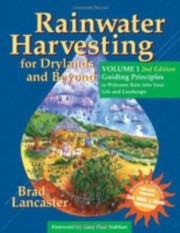
Water is the limiting factor in most landscapes; this book teaches you to read the land and design earthworks and catchments that passively hydrate your whole system — essential before planting at scale.
The definitive vision book for food forest design, covering ecology, plant relationships, and the seven-layer model — read the vision volume first to build the conceptual map before tackling the practice volume.
The companion practice volume delivers the actual design and implementation methodology for food forests, including species selection and guild assembly — it rewards the conceptual groundwork laid in Vol. 1.
Whole-Landscape Design: Putting It All Together
ExpertApply formal permaculture design methodology to plan, map, and implement a complete, self-sustaining landscape — integrating zones, sectors, patterns, and all prior knowledge into a coherent design.
▸ Study plan for this stage
Pace: 10–13 weeks total: Week 1–3 — "Introduction to Permaculture" by Mollison (~20–25 pages/day, including re-reading design diagrams and pattern overlays); Week 4–7 — "The Permaculture Handbook" by Bane (~25–30 pages/day, pausing to sketch zone maps and sector analyses as directed); Week 8–13 — "Restora
- Zone & sector analysis as a formal design tool — Mollison's concentric-zone model (Zones 0–5) mapped against energy-flow sectors (sun, wind, water, fire, wildlife) to locate every element optimally
- Pattern language in landscape design — Mollison's use of natural patterns (branching, spiraling, wave, net) as templates for paths, water systems, and plant guilds rather than aesthetic choices
- The SADIE / design-by-observation methodology — systematic site reading (Survey, Analyse, Design, Implement, Evaluate) as presented across Mollison and elaborated practically by Bane
- Stacking functions & element interconnection — every element serves multiple functions; every function is supported by multiple elements; Bane's household-to-farm scale examples ground this principle in real design decisions
- Broadscale water harvesting & earthworks — Bane's treatment of swales, ponds, and keyline principles as the structural skeleton of a whole-landscape design before any planting occurs
- STUN (Sheer Total Utter Neglect) and succession-based agriculture — Shepard's methodology of selecting for the most resilient species and systems by withdrawing inputs, revealing what truly self-sustains at landscape scale
- Perennial polyculture systems & savanna-model agriculture — Shepard's oak-apple-hazel-cattle-hog-chicken stacking as a real-world, income-generating permaculture whole-farm design
- Integration of prior knowledge into a coherent master plan — synthesizing soil biology, water cycles, plant guilds, animals, and human needs (from earlier curriculum stages) into a single, mapped, phased design document
- Using Mollison's zone-and-sector framework, how would you determine the correct placement of a food forest, a market garden, a water storage pond, and a woodlot on a 2-acre suburban lot versus a 200-acre farm — and what changes between the two scales?
- Bane argues that water is the first design decision in any landscape. Drawing on 'The Permaculture Handbook,' explain why earthworks and water harvesting must precede planting plans, and describe the sequence of decisions Bane recommends.
- How does Mollison's concept of 'pattern application' differ from simply copying a natural shape, and how would you use at least two specific patterns from 'Introduction to Permaculture' to design a productive edge between a pond and a vegetable garden?
- Shepard's STUN method seems to contradict the careful, hands-on management described by Mollison and Bane. How do you reconcile these approaches, and at what scale or successional stage does each become most appropriate?
- Describe Shepard's New Forest Farm model as a complete whole-landscape design: what are its structural layers, its economic outputs, its animal integrations, and how does it achieve self-sustaining function over time?
- After reading all three books, outline the phases of a complete permaculture design process — from initial site survey to a 10-year implementation timeline — citing specific tools or frameworks from Mollison, Bane, and Shepard respectively.
- Draw your own zone-and-sector map: Choose a real site (your garden, a friend's property, or a local park). Using Mollison's methodology, overlay a zone map (0–5) with at minimum four sector analyses (sun angles by season, prevailing wind, water flow, and wildlife corridors). Annotate every proposed element with its zone rationale.
- Complete a full SADIE design document for a chosen site: Write a formal survey (soil, water, climate, existing vegetation, human needs), a written analysis, a hand-drawn or digital design map with a legend, a phased implementation plan (Year 1 / Years 2–3 / Years 4–10), and an evaluation checklist — following Bane's handbook structure as your template.
- Design a broadscale water system on paper before any planting: Using Bane's earthworks sequencing, sketch the placement of at least one primary pond, two swale lines, and a greywater or roof-catchment system for your chosen site. Calculate rough storage volumes and identify which zones each water feature serves.
- Run a 'stacking functions' audit: List every element you've placed in your design (tree, path, fence, animal, structure). For each, list at least three functions it performs and at least two other elements that back up each critical function — directly applying Mollison's design principle. Redesign any element that serves fewer than two functions.
- Model a perennial polyculture system inspired by Shepard's New Forest Farm: Select a minimum of five species (at least two tree crops, one shrub, one vine or ground cover, and one animal) suited to your climate. Map their spatial relationships, describe their functional interactions (nitrogen fixation, pest suppression, fodder, harvest timing), and project a rough 20-year yield and income timeline
- Peer-review design charrette: Share your completed design document with at least one other person (a gardening group, online permaculture forum, or study partner). Present your zone map, water system, and polyculture plan. Collect structured feedback on: (a) unmet human needs, (b) single-function elements, and (c) missing connections between elements. Revise and document changes.
Next up: By producing a complete, mapped, and phased whole-landscape design that integrates zones, water, perennial systems, and animal elements, the reader has moved from learning permaculture principles to practicing permaculture design — establishing the hands-on, site-specific foundation needed for the next stage, which focuses on long-term land stewardship, community-scale implementation, and the soci
Written by permaculture's co-founder, this is the most practical of Mollison's works — now that you have soil, water, and plant knowledge, his zone-and-sector design framework clicks into place and ties everything together.
A thorough, modern synthesis of permaculture design for North American contexts that walks you through a complete design process from site assessment to implementation, serving as the capstone reference for your own landscape plan.
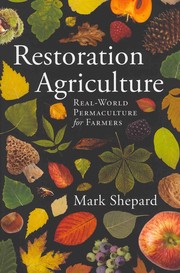
Expands your vision beyond the home garden to farm-scale regenerative systems, showing how perennial polycultures and keyline design can make landscapes truly self-sustaining and productive over the long term.
Discussion
Keep reading
Paths that share books, cover the same subject, or open a related topic.