Best Books on Nuclear Engineering, in Reading Order
Nuclear engineering is a technical subject that cannot be separated from its history, so this path opens with three works of reporting — the making of the bomb, a catalogue of accidents, and the definitive account of Chernobyl — before any cross-section is defined. It then works through a standard first course, moves to reactor physics proper, and ends with the thermal-hydraulics, detection and health physics that determine whether a design is safe to operate. The reactor physics books are the heart of it; the accident literature at the start exists so that the safety analysis later reads as consequential rather than procedural.
The history, and the failures
IntermediateUnderstand how nuclear technology was developed, how the major accidents actually happened, and why the field's safety culture takes the form it does.
▸ Study plan for this stage
Pace: Ten to twelve weeks for about 1,890 pages, all of it narrative and none of it requiring a pencil. The Making of the Atomic Bomb (886 pages) is the largest and takes five to six weeks; it is worth every one of them and teaches more physics than its reputation as history suggests. Atomic Accidents (44
- The physics as it was actually discovered: Chadwick's neutron in 1932, Szilard's chain reaction, and the Hahn-Strassmann experiment that Meitner and Frisch interpreted as fission at the end of 1938
- Chicago Pile-1 in December 1942 as the first controlled chain reaction, and the fact that its control was achieved by hand with cadmium rods on the strength of the delayed neutron fraction
- Criticality accidents as a class: Mahaffey's laboratory cases, including the demon core incidents and Tokaimura in 1999, show that criticality is a geometry-and-moderation problem before it is a reactor problem
- SL-1 in 1961 — a single control rod withdrawn too far, a prompt excursion, three deaths — as the clearest demonstration of why reactivity worth per rod is a design constraint
- Windscale in 1957 and the release of stored Wigner energy in irradiated graphite, a failure mode with no analogue in water reactors
- Three Mile Island in 1979 as an instrumentation and human-factors failure rather than a physics one, and the origin of much of the industry's operator-interface practice
- The RBMK's specific vulnerabilities in Higginbotham: a positive void coefficient, and control rods with graphite displacer tips that momentarily added reactivity when inserted — so the scram itself contributed to the excursion
- Xenon poisoning and the operational trap it set at Chernobyl, which connects directly to the depletion and poison chapters you will meet two stages later
- Trace the physics from the discovery of the neutron to a self-sustaining chain reaction. What was the key insight at each step?
- Why does a chain reaction with prompt neutrons alone become uncontrollable, and what do delayed neutrons change?
- What went wrong at SL-1, and what design rule followed from it?
- Explain the positive void coefficient of the RBMK in plain language. Why is a positive void coefficient dangerous in a water-cooled, graphite-moderated reactor?
- What did the graphite tips on the RBMK control rods do at the moment of insertion, and why is that the single most notorious design detail in reactor history?
- Across Mahaffey's cases, how many accidents were caused by physics that was not understood, and how many by procedures, instrumentation or organisation?
- Build a timeline from 1932 to 2011 marking every event in these three books, with a one-line cause for each accident. Keep it; you will annotate it in every later stage.
- Write 500 words explaining the Chernobyl accident sequence to someone with no physics background, without using the word meltdown. If you cannot, reread the reactor chapters of Higginbotham.
- Classify every accident in Mahaffey by primary cause — criticality geometry, reactivity insertion, loss of cooling, materials, or organisation. The distribution of that list is the field's actual risk profile.
- After Rhodes, write one page on what the delayed neutron fraction made possible. It is a single small number and the entire practicability of reactor control rests on it.
Next up: Every accident above turns on a quantity — reactivity worth, void coefficient, decay heat — that the next stage defines properly, which is why the history came first.
The best single book on nuclear anything: the physics from radioactivity to fission explained properly, inside a history of the people and the politics. Start here — it teaches more nuclear physics than its reputation as a history suggests, and it gives the whole field its context.
A working nuclear engineer's tour of what has gone wrong, from criticality excursions in laboratories to SL-1, Windscale and Fukushima. Mahaffey is technical, unsentimental and clear about causes, which makes this far more useful than either advocacy or alarm.
The definitive account of the accident, built on archives opened after the Soviet collapse, and precise about the reactor physics — the positive void coefficient, the graphite tips on the control rods — that made the RBMK design vulnerable. Read it last in this stage: it is the case study every later chapter on reactivity control is written against.
A first course
IntermediateHandle nuclear reactions, cross-sections, neutron interactions and the elementary reactor equations, and describe the main reactor types and fuel cycles.
▸ Study plan for this stage
Pace: Six to eight months for about 1,830 pages, worked rather than read. Lamarsh's Introduction to Nuclear Engineering (764 pages) is the spine and needs three to four months with the problems done; do not skip the cross-section and diffusion chapters. Murray's Nuclear Energy (450 pages) is less mathemat
- Binding energy per nucleon and the curve that explains both fission and fusion, plus Q-values computed from mass differences
- Microscopic and macroscopic cross-sections, and the mean free path as the physically meaningful quantity — the distinction between sigma and capital sigma trips up more beginners than anything else in the subject
- The 1/v region, resonances, and Doppler broadening of resonance absorption, which is the physical origin of the negative fuel temperature coefficient that makes a reactor stable
- The four-factor and six-factor formulas, and the assembly of k-effective from its physical components rather than as a number produced by a code
- One-speed neutron diffusion: Fick's law for neutrons, the diffusion equation, extrapolated boundaries, and the critical equation relating geometric to material buckling
- The fuel cycle end to end — mining, conversion, enrichment, fabrication, irradiation, storage, reprocessing or disposal — and where the proliferation-sensitive steps sit
- Decay heat as a quantity that does not switch off, which is the entire reason Fukushima happened and the reason a shut-down core still needs cooling
- Radiation interaction mechanisms in Shultis and Faw: photoelectric, Compton and pair production for photons, and stopping power for charged particles, which is the foundation for shielding and dosimetry
- Given atomic masses, compute the Q-value of a fission reaction and account for where the energy goes.
- What is the difference between a microscopic and a macroscopic cross-section, and what are the units of each?
- Explain Doppler broadening and why it produces a prompt negative reactivity feedback.
- Write the one-group diffusion equation for a bare homogeneous reactor and derive the critical condition for a slab, a sphere and a cylinder.
- Why can CANDU run on natural uranium when a PWR cannot? Identify the specific term in the six-factor formula that differs.
- Roughly what fraction of full power is decay heat one second after shutdown, one hour after, and one day after?
- Compute k-infinity for a simple homogeneous uranium-water mixture using the four-factor formula, then vary the moderator-to-fuel ratio and plot the result. The under- and over-moderated regions and the sign of the void coefficient fall straight out of that curve.
- Solve the bare critical reactor problem in all three standard geometries and tabulate the geometric buckling for each. Twenty minutes, and it is the most reused result in the subject.
- Draw the fuel cycle as a flow diagram with mass flows for a 1,000 MWe PWR over one year. The numbers are in Murray and the diagram makes the waste question concrete.
- Work five shielding problems from Shultis and Faw using exponential attenuation with a buildup factor, and note how much the buildup factor changes the answer. That ratio is why point-kernel shielding is not just exponential attenuation.
- Return to your accident timeline and annotate each event with the quantity it turned on, now that you can name them.
Next up: The one-group diffusion equation gets you a critical size for an idealised bare core; real reactors are reflected, heterogeneous, energy-dependent and time-varying, which is what reactor physics proper is for.
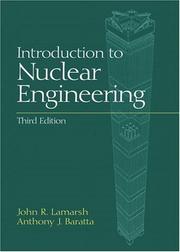
The standard undergraduate text of the field, covering atomic and nuclear physics, interactions, diffusion, the one-group reactor equation, heat removal, radiation protection and reactor systems. Work it thoroughly; almost everything else assumes it.

Broader and less mathematical than Lamarsh, and much stronger on applications beyond power reactors — isotopes, medicine, propulsion, waste and weapons policy. Read it alongside Lamarsh for the map of what nuclear engineering encompasses.
Shultis and Faw is the strongest of the three on radiation interaction, shielding and dosimetry, and it is the natural bridge to the health physics material in the final stage. Its treatment of radiation transport is more careful than either of the others.
Reactor physics
BeginnerDerive and solve the neutron diffusion and transport equations, analyse criticality, reactivity feedback and burnup, and understand reactor kinetics.
▸ Study plan for this stage
Pace: Eight to twelve months for about 2,000 pages, and this is the intellectual core of the path. Lamarsh's Introduction to Nuclear Reactor Theory (585 pages) continues his own notation and takes two to three months. Duderstadt and Hamilton (650 pages) is the central book of the whole path and deserves f
- The neutron transport equation in full, and the sequence of approximations — angular expansion, P1, diffusion — that gets you to the equation you already solved, so you finally know what you assumed
- Multigroup theory: energy group structures, group constants obtained by flux-weighted collapsing, and the two-group treatment of a thermal reactor as the first genuinely useful model
- Heterogeneity: the lattice cell, self-shielding, the disadvantage factor, and cell homogenisation — the reason a fuel pin surrounded by moderator behaves unlike the same materials smeared together
- Point kinetics with delayed neutron precursors, the inhour equation, prompt jump, and reactivity measured in dollars against the delayed neutron fraction
- Prompt criticality as the boundary that separates a controllable transient from an excursion, which is the quantitative statement of what happened at SL-1 and Chernobyl
- Reactivity feedback and coefficients: fuel temperature via Doppler, moderator temperature, and void — and the design requirement that the sum be negative in every operating state
- Xenon-135 and samarium-149: production, decay, the post-shutdown xenon peak and the dead time it imposes, plus spatial xenon oscillations in large cores
- Fuel depletion and burnup: conversion, plutonium buildup, the changing isotopic composition over a cycle, and the reactivity letdown that control systems must compensate
- Write the transport equation and state, term by term, what each approximation discards on the way to diffusion theory.
- How are two-group constants generated, and what is the weighting spectrum used for the collapse?
- Derive the point kinetics equations from the time-dependent diffusion equation with one delayed group. What does the prompt jump approximation assume?
- What is a dollar of reactivity, and why is that the natural unit? What happens above one dollar?
- Explain the post-shutdown xenon transient. Why does xenon concentration rise after shutdown, and how long is the dead time?
- Why must the overall temperature coefficient be negative, and which specific coefficient was positive at Chernobyl?
- Solve the two-group reflected slab reactor by hand. It is long, it is standard, and it is the problem that converts multigroup theory from notation into understanding.
- Integrate the point kinetics equations numerically for a step reactivity insertion of 0.5 dollars, then 0.9, then 1.1. Plot all three on one set of axes. That single figure is the quantitative content of the first stage's accident history.
- Compute a fuel temperature coefficient from Doppler broadening for a simple lattice and check its sign and order of magnitude against published PWR values.
- Model the xenon transient after a shutdown from equilibrium full power and find the peak and the dead time. Then reread the relevant chapter of Midnight in Chernobyl.
- Do a simple burnup calculation over one cycle tracking uranium-235 depletion and plutonium-239 buildup, and plot the reactivity letdown. Then work out how much control absorber is needed to hold the core critical at beginning of life.
Next up: Neutronics tells you where the power is produced; the final stage covers getting that power out of the fuel without melting it, measuring the radiation involved, and computing what it does to people.

Lamarsh's dedicated reactor theory volume, and the gentlest serious treatment of diffusion theory, multigroup methods, reflectors and kinetics. Read it immediately after his introductory text, whose notation it continues.
Duderstadt and Hamilton is the classic graduate text and still the best single explanation of how a reactor is actually analysed — transport to diffusion, multigroup constants, thermal spectra, feedback, fuel depletion. The core book of this path.
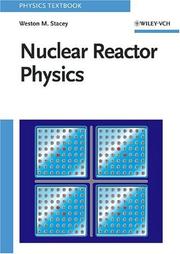
The most current of the three and the most rigorous on numerical methods and on reactor dynamics and stability. Read it after Duderstadt if you intend to do computational reactor physics rather than to understand it in principle.
Thermal-hydraulics, detection and dose
BeginnerAnalyse heat removal and two-phase flow in a core, make real radiation measurements, and compute doses and shielding to professional standards.
▸ Study plan for this stage
Pace: Eight to ten months for about 2,300 pages. Nuclear Systems Volume I (980 pages) is the largest and takes four months worked properly, with the two-phase flow and critical heat flux chapters done rather than skimmed. Knoll (802 pages) is a reference to work through selectively over two to three month
- Power distribution and hot channel factors: the core average is not what constrains the design, the worst channel is, and the peaking factors are what convert one to the other
- The boiling curve applied to a reactor: nucleate boiling as the desired regime, and departure from nucleate boiling as the thermal limit that actually bounds reactor power
- Critical heat flux correlations, the minimum DNB ratio as a licensing criterion in a PWR, and dryout as the corresponding limit in a BWR
- Decay heat removal and loss-of-coolant analysis, which is where the physics of the first stage's accidents lives — Fukushima was a decay heat removal failure and nothing else
- Gas-filled detectors across their operating regions — ionisation chamber, proportional counter, Geiger-Müller — and why the same tube behaves as three instruments at three voltages
- Counting statistics done properly: Poisson behaviour, propagation of error, minimum detectable activity, and dead time corrections — the part of Knoll that everyone needs regardless of instrument
- Dosimetric quantities kept straight: absorbed dose, equivalent dose, effective dose, and the weighting factors that separate them, with their SI and legacy units
- Shielding design in practice — attenuation with buildup, source term estimation, ALARA — and internal dosimetry via intake, biokinetics and committed dose
- What is the minimum DNB ratio, and why is a thermal limit rather than a neutronic one the constraint on reactor power?
- Why does decay heat removal fail in a station blackout, and what is the timescale to fuel damage?
- Explain why the same gas-filled tube acts as an ionisation chamber, a proportional counter or a GM tube depending on applied voltage.
- Given a count rate and a counting time, compute the uncertainty and the minimum detectable activity. What assumptions did you make?
- Distinguish absorbed dose, equivalent dose and effective dose, with the units and weighting factors for each.
- What is the linear no-threshold model, what is it used for, and what is the honest state of the evidence at low doses?
- Perform a full single-channel thermal analysis for a PWR hot channel: axial power shape, coolant enthalpy rise, cladding and fuel centreline temperatures, and the DNB ratio. This is the standard exercise of the subject and it uses everything above it.
- Compute the decay heat curve for a core after shutdown and integrate it to find how much water would boil off in the first day with no active cooling. The number is the physical content of Fukushima.
- Work through a gamma spectrum from Knoll and identify the photopeak, the Compton edge, the backscatter peak and any escape peaks. Doing this once makes every subsequent spectrum readable.
- Take a real counting measurement, or a worked example, and propagate the uncertainty end to end including dead time. Then state the result correctly with its uncertainty.
- Design a shield for a specified gamma source to a target dose rate, using attenuation with a buildup factor, and state your assumptions explicitly. Then compute the committed effective dose from a specified intake of one radionuclide.
- Finish by returning to your accident timeline from the first stage and writing, for each event, the specific quantity from this path that was exceeded or misunderstood. The completed timeline is the summary of the whole path.
Next up: This is the end of the path — history and failures, a first course, reactor physics, and the thermal, detection and dose engineering that makes a design operable — and the natural next step is a production code and a real design basis document, read with everything above behind them.

Todreas and Kazimi is the reference on reactor thermal-hydraulics: power distribution, single and two-phase flow, boiling, critical heat flux and the thermal limits that actually constrain reactor power. Heat removal, not neutronics, is what fails in most severe accidents.
The universal reference on detectors — gas-filled, scintillator, semiconductor — and on counting statistics and spectroscopy. Anyone who will handle real instruments needs this rather than the detector chapter of a survey text.

Closes the path with radiation protection as a profession: dosimetry, biological effects, regulatory limits, shielding design and internal dose. Cember is the standard preparation for certification and the practical counterpart to everything theoretical above it.
Discussion
Keep reading
Paths that share books, cover the same subject, or open a related topic.