The Best Books to Learn Mathematical Logic, In Order
This curriculum is designed for an expert-level learner who wants to achieve deep mastery of mathematical logic across its three core pillars: proof theory, model theory, and computability. Starting from rigorous foundational texts that unify these areas, the path moves through the canonical graduate-level treatments and culminates in research-frontier monographs that demand full mathematical maturity.
Rigorous Foundations & Unification
BeginnerEstablish a precise, unified picture of first-order logic — syntax, semantics, completeness, compactness, and the interplay between proof systems and models — as the shared language for everything that follows.
▸ Study plan for this stage
Pace: 8–10 weeks, ~25–30 pages/day (with 2–3 days per week for problem-solving and review)
- Propositional logic syntax: well-formed formulas, truth tables, and logical connectives as the foundation for reasoning
- First-order logic syntax: predicates, quantifiers, variables, and the distinction between free and bound variables
- Semantics and interpretation: models, truth under an interpretation, and the relationship between syntax and meaning
- Proof systems: natural deduction and/or Hilbert-style axioms as formal methods to derive theorems
- Completeness theorem: the equivalence between semantic entailment (⊨) and syntactic derivability (⊢)
- Compactness theorem: finite satisfiability implies satisfiability, with implications for model theory
- Soundness: every provable formula is logically valid; the reliability of proof systems
- Unification: recognizing first-order logic as the canonical framework unifying syntax, semantics, and proof
- What is the difference between a formula being true in a model versus being logically valid, and why does this distinction matter?
- State and explain the completeness theorem. Why is it significant that semantic entailment and syntactic derivability coincide?
- How do quantifiers (∀ and ∃) interact with free and bound variables, and what does it mean for a formula to be closed?
- Prove or construct a simple example showing that the compactness theorem holds: if every finite subset of a set of formulas is satisfiable, the entire set is satisfiable.
- Compare two proof systems (e.g., natural deduction vs. Hilbert-style) presented in Enderton. What are the trade-offs in expressiveness and usability?
- Given a first-order sentence, determine whether it is satisfiable, valid, or neither, and justify your answer using semantic or proof-theoretic reasoning.
- Work through Enderton's exercises on propositional logic truth tables and tautologies (Chapters 1–2). Build fluency in recognizing valid and invalid inferences.
- Translate informal mathematical statements into first-order logic notation (e.g., 'every natural number has a successor' or 'there exists a prime larger than any given prime'). Verify your translations by checking models.
- Prove 5–10 simple theorems using the proof system Enderton presents (natural deduction or Hilbert-style). Start with basic tautologies and move to quantifier rules.
- Construct explicit models (interpretations) for given first-order sentences and verify whether specific formulas are true or false in those models.
- Work through compactness applications: show that certain infinite sets of formulas are satisfiable by proving every finite subset is satisfiable.
- Solve Enderton's exercises on completeness and soundness (typically in Chapters 2–3). These cement the relationship between ⊨ and ⊢.
Next up: Mastering first-order logic as a unified framework—where syntax, semantics, and proof coincide—equips you with the precise language and reasoning tools needed to explore advanced topics such as computability, decidability, and the limits of formal systems (e.g., Gödel's incompleteness theorems).
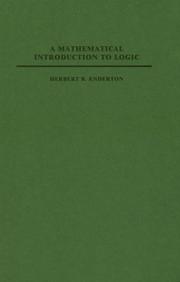
The single clearest entry point into first-order logic at a serious mathematical level; its careful treatment of syntax, semantics, and the completeness theorem builds exactly the vocabulary needed for all three pillars.
Proof Theory & Computability — Core Graduate Level
IntermediateMaster the classical results of computability theory (Turing machines, undecidability, recursion theorem) and the proof-theoretic backbone (Gödel's incompleteness theorems, formal arithmetic), understanding why and how the limits of formal systems arise.
▸ Study plan for this stage
Pace: 8–10 weeks, ~40–50 pages/day (with proof work and exercises interspersed)
- Turing machines as a formalization of effective computability and the Church–Turing thesis
- Undecidability: the halting problem and reduction techniques to prove problems uncomputable
- Recursive and recursively enumerable sets; the hierarchy of computational complexity
- Kleene's recursion theorem and its role in self-reference and fixed points
- Formal arithmetic (Peano Arithmetic) and its expressiveness for representing computable functions
- Gödel's incompleteness theorems: the first theorem (unprovability of true sentences) and the second (unprovability of consistency)
- The interplay between computability and provability: Gödel numbering, diagonalization, and self-reference
- Limits of formal systems: what cannot be proven within a system, and why this matters for mathematics and computation
- What is the Church–Turing thesis, and why is it considered a thesis rather than a theorem?
- Explain the halting problem: what does it mean to say it is undecidable, and how does the proof work?
- How do reduction techniques allow us to prove that other problems are undecidable?
- What is the difference between recursive and recursively enumerable sets, and why does this distinction matter?
- State Gödel's first incompleteness theorem precisely: what does it say about formal arithmetic, and what is the role of Gödel numbering?
- How does Kleene's recursion theorem establish the existence of self-referential programs, and what is its significance?
- Explain how Gödel's incompleteness theorems relate to computability theory and the limits of formal systems.
- Why can Peano Arithmetic represent all computable functions, and what are the implications for what PA can and cannot prove?
- Work through Boolos's construction of a Turing machine for a simple function (e.g., addition or multiplication); trace its execution on a concrete input to internalize the model.
- Prove that a specific problem (e.g., the Post correspondence problem or a variant of tiling) is undecidable by reduction from the halting problem; write out the reduction carefully.
- Construct a Gödel numbering for a fragment of formal arithmetic; encode a simple formula and verify the encoding is injective and computable.
- Implement (in pseudocode or a real language) a Turing machine simulator and use it to verify that a given machine halts or loops on test inputs.
- Work through Smith's detailed proof of Gödel's first incompleteness theorem step-by-step; identify each use of diagonalization and self-reference.
- Prove that a specific set (e.g., the set of theorems of PA) is recursively enumerable but not recursive; explain why this reflects the incompleteness phenomenon.
- Construct an explicit self-referential sentence in formal arithmetic (or a simplified version) that asserts its own unprovability; verify it is true but unprovable.
- Compare the proof strategies in Boolos and Smith: identify how computability-theoretic arguments (from Boolos) underpin the logical arguments in Gödel's theorems (from Smith).
Next up: This stage equips you with the foundational results on what formal systems cannot do—the bedrock of mathematical logic—preparing you to explore advanced topics such as proof complexity, modal logic of provability, or the semantics of formal theories in the next stage.
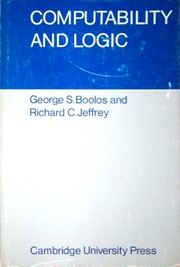
The gold-standard graduate text uniting computability and incompleteness; its logical progression from Turing computability through Gödel's theorems makes it the ideal bridge between foundations and advanced specialization.
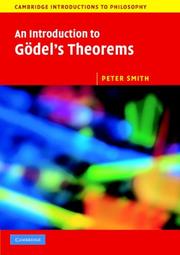
Provides an unusually thorough and philosophically careful proof of both incompleteness theorems, filling gaps that more terse treatments skip — essential before tackling proof theory proper.
Model Theory — Deep Dive
IntermediateDevelop a thorough command of model theory: elementary equivalence, types, saturated models, ultraproducts, categoricity, and stability — the tools that connect logic to algebra, geometry, and combinatorics.
▸ Study plan for this stage
Pace: 8–10 weeks, ~40–50 pages/day (Marker first 4–5 weeks; Hodges for refinement and breadth 3–4 weeks; overlap final week for synthesis)
- Elementary equivalence and the Löwenheim–Skolem theorems: when two structures satisfy the same first-order sentences
- Types and type spaces: how to classify elements and realize/omit types in models
- Saturated models: models rich enough to realize all types, and their role as universal objects
- Ultraproducts and ultrafilters: constructing new models from families of existing ones, and their preservation of first-order properties
- Categoricity and completeness: when a theory has a unique model up to isomorphism, and connections to decidability
- Stability theory: classifying theories by their complexity (stable, unstable, simple), and the role of indiscernible sequences
- Quantifier elimination and model completeness: when formulas simplify and what this reveals about definable sets
- Applications to algebra and geometry: how model theory explains algebraic closure, algebraically closed fields, and geometric structure
- What is elementary equivalence, and how do the Löwenheim–Skolem theorems constrain the models of a first-order theory?
- Define a type over a set A and explain the difference between realizing and omitting a type; why does saturation matter?
- What is an ultraproduct, and why does it preserve first-order sentences? Give a concrete example (e.g., ultrapower of ℕ).
- Explain categoricity: when is a theory κ-categorical, and what does this tell us about the theory's completeness and decidability?
- What is stability, and how do indiscernible sequences and VC-dimension relate to classifying theories as stable or unstable?
- How does quantifier elimination simplify model theory, and what does it reveal about definable subsets of a model?
- Work through Marker's proof of the downward Löwenheim–Skolem theorem (Ch. 1–2); construct a countable model of a given theory and verify it satisfies the same sentences as a larger model.
- Compute the type space S_n(A) for a simple theory (e.g., dense linear orders, or ACF); identify which types are realized in specific models and which are omitted.
- Build an ultraproduct: take a sequence of finite structures (e.g., cyclic groups Z/nZ) and an ultrafilter on ℕ; verify that the ultraproduct is infinite and compute its first-order properties.
- Prove that ACF (algebraically closed fields) is ω-categorical in each characteristic (following Marker Ch. 3 or Hodges); explain why this implies completeness.
- Analyze a stable theory (e.g., vector spaces over a fixed field) using Hodges' treatment: identify indiscernible sequences and show why the theory has few types.
- Apply quantifier elimination to a concrete theory (e.g., real closed fields or Presburger arithmetic); simplify a complex formula and describe the definable sets it defines.
- Compare two theories (e.g., DLO vs. ACF) using Marker and Hodges: determine which is categorical, which is stable, and what this means for their model-theoretic complexity.
- Work Marker's exercises on saturated models (Ch. 4): construct a saturated model of a theory, verify saturation, and show how it realizes all types over finite sets.
Next up: Mastery of model theory's core tools—types, saturation, ultraproducts, stability, and categoricity—equips you to apply these frameworks to specific mathematical structures (algebraic geometry, combinatorics, and o-minimality) and to understand how logic constrains and explains algebraic and geometric phenomena.
The most accessible rigorous graduate text on modern model theory; its concrete examples from algebra make abstract concepts like types and quantifier elimination tangible before moving to harder texts.
The comprehensive reference for classical model theory; after Marker, Hodges provides the full technical depth — omitting types, ultraproducts, or saturation at nothing — and is the standard citation in research papers.
Advanced Computability & Degree Theory
ExpertReach research depth in computability theory: Turing degrees, the arithmetical hierarchy, priority arguments, and the structure of relative computability — the machinery of modern recursion theory.
▸ Study plan for this stage
Pace: 12–16 weeks, ~40–50 pages/day with 2–3 days/week for problem sets and proof exercises
- Turing degrees and the partial order structure of relative computability: how degrees are defined, compared, and organized
- The arithmetical hierarchy (Σ⁰ₙ and Π⁰ₙ classes): classification of decision problems by their logical complexity and quantifier depth
- Priority arguments and finite injury methods: the core proof technique for constructing sets with specific degree-theoretic properties
- The jump operator and Turing jump: how to move up the arithmetical hierarchy and understand post's theorem
- Undecidability and incompleteness: connections between halting problem, Gödel's theorems, and the limits of computation
- Relative computability and oracle machines: how computation changes when you have access to an oracle for a harder problem
- Minimal pairs and the density of the Turing degrees: structural results about the landscape of degrees between 0 and 0'
- Recursively enumerable (r.e.) sets and their role in degree theory: characterization via Σ⁰₁ formulas and the r.e. degrees
- What is a Turing degree, and how does the partial order of degrees relate to the notion of relative computability?
- Explain the arithmetical hierarchy: what do Σ⁰ₙ and Π⁰ₙ classes represent, and why is this hierarchy strict (non-collapsing)?
- Describe the finite injury priority method: how does it work conceptually, and what is an example of a result proved using it?
- What is the Turing jump operator, and how does it relate to Post's theorem and the arithmetical hierarchy?
- How do oracle machines formalize relative computability, and what does it mean for a set A to be Turing-reducible to a set B?
- What are minimal pairs in degree theory, and what do they tell us about the structure of the Turing degrees?
- Explain the connection between recursively enumerable sets, the halting problem, and the degree 0' (zero-jump)
- How do the results in computability theory relate to Gödel's incompleteness theorems and the limits of formal systems?
- Work through Weber's exercises on Turing degrees and degree comparisons; prove that the degree ordering is indeed a partial order
- Classify specific decision problems (e.g., Post's correspondence problem, the word problem for groups) into the arithmetical hierarchy; justify each classification
- Implement or trace through a finite injury priority argument construction (e.g., building a minimal pair or a set of intermediate degree); identify injury stages and why they preserve the construction
- Prove key results about the Turing jump: that 0' is the degree of the halting problem, and that the jump is strictly increasing
- Construct oracle machines for specific problems and verify their correctness; compare the complexity of problems with and without oracles
- Work Soare's exercises on r.e. sets, degrees, and their properties; prove results about the structure of the r.e. degrees
- Analyze proofs of density results (e.g., between any two degrees there exists a third) and understand how they use priority arguments or other techniques
- Write up a detailed proof of one major theorem from each book (e.g., Post's theorem from Weber, or a structural result from Soare); explain the proof strategy and key lemmas
Next up: Mastery of Turing degrees, priority arguments, and the arithmetical hierarchy provides the foundational machinery for exploring advanced topics such as the structure of higher-order degrees, forcing in recursion theory, and applications to mathematical logic and set theory.

A focused, modern graduate treatment of Turing degrees and the arithmetical hierarchy that bridges the gap between Boolos-level introductions and the formidable Soare monograph.

The definitive expert-level monograph on computability theory; Soare's reorganization around Turing's original ideas and his coverage of priority arguments represents the current research standard.
Proof Theory & Stability Theory — Research Frontier
ExpertAchieve frontier-level understanding of structural proof theory (cut elimination, ordinal analysis) and Shelah's stability-theoretic classification program — the deepest results in each pillar of mathematical logic.
▸ Study plan for this stage
Pace: 8–10 weeks, ~40–50 pages/day (with 2–3 days/week for deep problem work and review cycles)
- Stability and instability: the fundamental dichotomy between stable and unstable theories, and how stability constrains model-theoretic behavior
- Forking independence and non-forking extensions: the core notion of independence in stable theories and its role in building models
- Shelah's classification program: how stability, superstability, and the spectrum function organize theories into a hierarchy
- Rank and dimension in stable theories: ordinal-valued measures (Lascar rank, Shelah rank) that quantify complexity and determine categorical spectra
- Types and definable sets: the structure of type spaces in stable theories and how definability constrains their geometry
- Saturated and homogeneous models: how to construct and use models that realize all types to study stability properties
- Applications to algebraic structures: how stability theory applies to algebraically closed fields, differentially closed fields, and other classical structures
- What is the definition of a stable theory, and why does stability imply that the number of types over a finite set is bounded by a function of the set's cardinality?
- Explain the notion of forking independence in a stable theory: what does it mean for a type to fork over a set, and why is non-forking extension a key property?
- How does Shelah's spectrum function T(κ) classify theories, and what does it mean for a theory to be categorical in some cardinality?
- What are Lascar rank and Shelah rank, and how do they measure the complexity of definable sets and types in a stable theory?
- Describe the structure of a saturated model of a stable theory: what types does it realize, and how does saturation relate to stability?
- How does stability theory apply to algebraically closed fields and differentially closed fields? What does it tell us about their model-theoretic properties?
- Work through Shelah's definition of stability: verify that the theory of algebraically closed fields is stable by showing that the number of types over a finite set is bounded, and contrast this with an unstable theory (e.g., dense linear order)
- Construct explicit examples of forking and non-forking extensions in ACF: given a type p over a finite set A, find an extension that forks over A and one that does not, and explain the geometric meaning
- Compute the spectrum function T(κ) for a superstable theory of rank ω: determine the number of models in each cardinality and verify that the theory is categorical in some cardinality
- Prove that a stable theory has the finite cover property: show that any definable set can be covered by finitely many definable sets of smaller rank, and use this to bound the number of types
- Analyze the type space S_n(A) of a stable theory over a finite set A: describe its structure as a Boolean algebra of definable sets, and compute its cardinality in terms of |A| and the language
- Study a concrete application: prove that the theory of differentially closed fields is stable, and determine its spectrum function and categorical cardinalities
Next up: Mastery of Shelah's stability-theoretic classification program provides the model-theoretic foundation for understanding how syntactic proof-theoretic complexity (cut elimination, ordinal analysis) relates to semantic stability properties, enabling the final synthesis of proof theory and model theory at the research frontier.

Shelah's own monograph on stability and classification theory is the ultimate destination in model theory; demanding but irreplaceable for anyone who wants to understand the architecture of modern pure model theory.
Discussion
Keep reading
Paths that share books, cover the same subject, or open a related topic.