Differential geometry is notorious for its abstraction, but the abstraction is earned, not arbitrary. The modern language of manifolds and tensors exists to generalize things you can first meet concretely on curves and surfaces in space. Jump straight to smooth manifolds and the definitions feel unmotivated; meet curvature on a surface first and the general theory lands as a natural extension.
The path below moves from concrete curves and surfaces, to the machinery of smooth manifolds, to Riemannian geometry and the deeper structures built on it.
Curves and surfaces
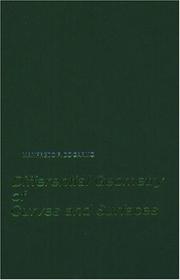
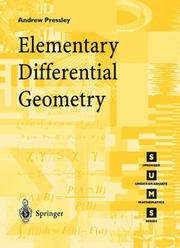
Start with Elementary Differential Geometry by Pressley, a gentle, well-motivated introduction that keeps everything visualizable. Then Differential geometry of curves and surfaces by do Carmo, the beloved classic that develops curvature, geodesics, and the Gauss-Bonnet theorem with a perfect balance of rigor and geometric feel. These two give you the concrete intuition that every later abstraction refers back to.
The manifold machinery
Now build the modern framework. Calculus on manifolds by Spivak is the compact, demanding bridge from multivariable calculus to differential forms and Stokes' theorem. Introduction to Smooth Manifolds by John Lee is the definitive, patient text that develops the full theory of smooth manifolds, vector fields, and forms — the reference most students learn from. Together they turn the earlier surface geometry into coordinate-free tools that generalize to any dimension.
Riemannian geometry and beyond
The final arc is where the subject flowers. Riemannian geometry by do Carmo and Riemannian manifolds by John Lee introduce metrics, connections, and curvature on manifolds, the setting for general relativity and much of modern geometry. A comprehensive introduction of differential geometry by Spivak is the encyclopedic multi-volume reference for going deep. Comparison theorems in riemannian geometry by Cheeger and Ebin, Differential forms in algebraic topology by Bott and Tu, Foundations of differential geometry by Kobayashi and Nomizu, Geometry of Differential Forms by Morita, and Spin geometry by Lawson and Michelsohn each open a specialized frontier — curvature bounds, topology, connections, and spinors.
Read in this order and the abstraction becomes inevitable rather than intimidating. Follow the full path from a curve in the plane to the geometry of manifolds.
Follow the full reading path →
Ready to learn something deeply?
Build a reading path — free