The Best Books on Conservatism
This curriculum traces conservative political thought from its 18th-century origins through its modern intellectual and policy expressions, building conceptual fluency before tackling primary texts and contemporary debates. Starting at the intermediate level, each stage deepens the reader's grasp of conservatism's core tensions — tradition vs. liberty, order vs. reform, nationalism vs. globalism — so that by the final stage they can engage the living arguments that define conservatism today.
The Founding Tradition
IntermediateUnderstand the philosophical origins of conservatism through its two most essential founding texts, grasping the core concepts of tradition, order, and organic society that all later conservative thought presupposes.
▸ Study plan for this stage
Pace: 8–10 weeks, ~40–50 pages/day. Start with Burke's Reflections (approx. 300 pages, 2–3 weeks), then move to Kirk's The Conservative Mind (approx. 500+ pages, 5–7 weeks). Allow 1 week for review and synthesis.
- Tradition as accumulated wisdom: Burke's argument that society is a contract between the living, the dead, and the unborn, embodying centuries of tested experience
- Organic society and gradual change: The conservative rejection of abstract rationalism and revolutionary rupture in favor of evolutionary, piecemeal reform rooted in existing institutions
- The dangers of ideology and first principles: Burke's critique of the French Revolution as an attempt to rebuild society from pure reason, severed from historical continuity
- Prescription and prejudice as guides: Burke's rehabilitation of 'prejudice' as inherited wisdom and 'prescription' as the legitimacy conferred by long use and custom
- The conservative intellectual lineage: Kirk's tracing of conservative thought from Burke through the 19th and early 20th centuries, showing how core Burkean principles persist across thinkers and contexts
- The defense of property, family, and local community: How both Burke and Kirk identify these institutions as the bulwarks against centralized power and the dissolution of social bonds
- Skepticism toward utopian schemes: The conservative suspicion of grand designs for human perfectibility and the preference for modest, incremental improvement within existing frameworks
- What does Burke mean by the 'contract' between the living, the dead, and the unborn, and why is this metaphor central to his defense of tradition?
- How does Burke distinguish between 'prejudice' and mere irrationality, and what role does he assign to inherited customs in political judgment?
- What are Burke's main criticisms of the French Revolution, and how do they reflect his broader philosophy of organic social change?
- According to Kirk, what are the six or seven canons of conservative thought, and how do they derive from or extend Burke's foundational ideas?
- How do Burke and Kirk defend the institutions of property, family, and local community as essential to a healthy social order?
- What does it mean to say that conservatism is skeptical of 'first principles' and abstract rationalism, and how does this skepticism play out in both texts?
- Close-read Burke's famous passage on the 'partnership' between generations (Part II of Reflections); annotate it to extract his core claims about tradition, then write a 500-word essay explaining why he uses the language of contract rather than, say, inheritance or authority.
- Create a two-column chart: in one column, list Burke's specific critiques of the French Revolution (e.g., abolition of feudalism, confiscation of church property, rationalist constitution-making); in the other, identify the conservative principle each critique rests on.
- Read Kirk's opening chapters on Burke and write a 750-word analysis of how Kirk interprets Burke's legacy—what does Kirk emphasize as most essential, and what might he downplay or reframe?
- Select one 19th-century conservative thinker discussed in Kirk (e.g., Coleridge, Newman, Disraeli) and trace one key Burkean concept (e.g., organic society, prescription, skepticism of rationalism) through their work; write a 600-word comparison showing continuity and evolution.
- Debate exercise: Argue both sides—first, defend Burke's position that the French Revolution was a catastrophic break with wisdom; second, articulate a counter-argument that might come from a progressive or revolutionary perspective. This clarifies what Burke is actually claiming.
- Create a concept map or visual diagram showing how Kirk's 'canons of conservatism' relate to and expand upon Burke's core ideas in Reflections. Use arrows and labels to show dependencies and developments.
Next up: This stage establishes the philosophical bedrock—Burke's defense of tradition, order, and organic society—that all subsequent conservative thought presupposes, preparing you to examine how these principles were applied, contested, and refined in specific historical and political contexts in the next stage.

The indispensable origin point of modern conservatism — Burke's critique of abstract rationalism and defense of inherited institutions sets the vocabulary every subsequent conservative thinker responds to. Read first to establish the foundational framework.
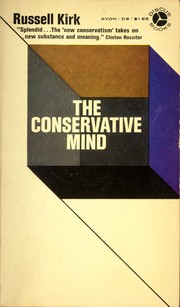
Kirk's 1953 masterwork traces the Anglo-American conservative tradition from Burke through the mid-20th century, synthesizing its 'six canons' into a coherent philosophy. Reading it immediately after Burke shows how the tradition was consciously constructed and transmitted.
Liberty, Order, and the Market
IntermediateDistinguish the major strands within conservatism — traditionalism, classical liberalism, and anti-totalitarianism — and understand the intellectual tensions between them that shaped 20th-century conservative politics.
▸ Study plan for this stage
Pace: 6–7 weeks, ~25–30 pages/day. Week 1–3: "The Road to Serfdom" (~320 pages); Week 4–5: "Up from Liberalism" (~200 pages); Week 6–7: Review, synthesis, and comparative analysis.
- The knowledge problem and why centralized economic planning fails (Hayek's core argument in The Road to Serfdom)
- The distinction between the rule of law and arbitrary power, and how socialism erodes this distinction
- Classical liberalism as a defense of individual liberty through market mechanisms and limited government
- Traditionalism and the role of inherited institutions, custom, and organic social order (Buckley's emphasis)
- The tension between libertarian economics (Hayek) and conservative social values (Buckley)
- Anti-totalitarianism as a unifying concern across conservative strands in the 20th century
- The critique of rationalist social engineering and the value of evolved, decentralized solutions
- How conservatism reconciles individual liberty with social order and moral authority
- What is Hayek's 'knowledge problem,' and why does he argue it makes centralized economic planning impossible?
- How does Hayek distinguish between the rule of law and the rule of arbitrary power, and what role does this play in his critique of socialism?
- What does Buckley mean by 'liberalism' in 'Up from Liberalism,' and what does he propose conservatism should conserve?
- Where do Hayek and Buckley agree on the dangers of totalitarianism, and where do they diverge on how to prevent it?
- How do classical liberalism (Hayek) and traditionalism (Buckley) offer different answers to the question of social order?
- What is the relationship between economic freedom and political freedom in Hayek's argument, and does Buckley accept this relationship?
- Outline Hayek's argument in Part I of The Road to Serfdom: trace how he moves from the claim that 'the curious task of economics is to demonstrate to men how little they really know' to his warning about the road to serfdom.
- Create a two-column chart: list Hayek's main critiques of socialism on one side and Buckley's main critiques of liberalism on the other. Identify overlaps and tensions.
- Write a 500-word response to this prompt: 'Can a society be both economically free (Hayek's priority) and morally traditional (Buckley's priority)? Use examples from both books.'
- Analyze Hayek's Chapter 5 ('Planning and Democracy') and Buckley's discussion of 'the problem of power' in Up from Liberalism. How do they each argue that democracy alone cannot prevent tyranny?
- Identify three specific historical examples Hayek or Buckley reference (e.g., Nazi Germany, Soviet planning, American progressivism). For each, explain what aspect of their argument it illustrates.
- Debate exercise: Prepare arguments for both Hayek and Buckley on this question: 'Should conservatism prioritize economic liberty or social/moral order?' Present both sides, then write a synthesis.
Next up: This stage establishes the foundational intellectual tensions within mid-20th-century conservatism (liberty vs. order, market vs. tradition, individual vs. community), preparing you to examine how these tensions played out in concrete political movements, policy debates, and the evolution of conservative thought in later stages.

Hayek's landmark argument against central planning introduced the classical-liberal strand into modern conservatism and became a touchstone for the postwar right. Reading it here reveals the tension between Burkean tradition and free-market individualism.
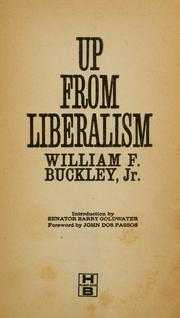
Buckley was the great synthesizer who fused traditionalism, anti-communism, and libertarianism into a workable American conservatism. This book captures that fusion and bridges the philosophical stage to the political movement that followed.
The Neoconservative and Social Turn
IntermediateUnderstand how conservatism absorbed and responded to the upheavals of the 1960s–1980s, producing neoconservatism, social conservatism, and the Reagan-era synthesis that dominated late-20th-century politics.
▸ Study plan for this stage
Pace: 8–10 weeks, ~40–50 pages/day, with 1–2 weeks per book for deep engagement and reflection
- Goldwater's libertarian-conservative fusion: limited government, individual liberty, and anti-communism as the foundation for 1960s conservative revival
- The neoconservative break from liberalism: how former liberals embraced anti-communism abroad and cultural conservatism at home in response to 1960s upheaval
- Irving Kristol's two-culture thesis: the distinction between the 'business civilization' and the 'adversary culture' of intellectuals, and neoconservatism's role mediating between them
- The social conservative turn: how cultural anxieties about family, education, and moral decline became central to conservative politics alongside economic and foreign-policy concerns
- Bloom's critique of American relativism and educational decline: the argument that universities abandoned great books and objective standards, producing a morally adrift generation
- The Reagan synthesis: how neoconservative foreign policy, social conservatism, and supply-side economics merged into a dominant political coalition
- The role of intellectuals in conservative movement-building: how Kristol, Bloom, and others used ideas to reshape political coalitions and institutions
- What are the core principles of Goldwater's conservatism, and how did he position them as a response to the post-war liberal consensus?
- How did Irving Kristol define neoconservatism, and what specific historical events or intellectual shifts caused liberals to become neoconservatives?
- What is Kristol's critique of the 'adversary culture,' and what role does he assign to neoconservatives in defending bourgeois civilization?
- According to Bloom, what went wrong in American universities and education, and how does he connect this decline to broader moral and political problems?
- How did social conservatism (concerns about family, sexuality, education, and cultural values) become integrated into the broader conservative movement during this period?
- What is the relationship between neoconservative foreign policy (particularly anti-communism) and social conservatism in the Reagan-era coalition?
- Annotated reading of Goldwater's key chapters: mark passages where he defines conservatism, and create a one-page summary of his core platform; compare it to post-war liberal positions to see the contrast
- Trace Kristol's intellectual biography: write a 2–3 page narrative of how and why Kristol moved from liberalism to neoconservatism, citing specific arguments from his essays
- Create a Venn diagram comparing Goldwater's conservatism, Kristol's neoconservatism, and traditional social conservatism; identify overlaps and tensions
- Close reading exercise on Bloom's diagnosis of American education: select 3–4 key passages from 'The Closing of the American Mind' and write a 1-page analysis of his argument about relativism and the loss of great books
- Debate preparation: argue both for and against Bloom's claim that American universities have abandoned objective standards and moral seriousness; use specific examples from the book
- Synthesis essay: write a 4–5 page essay explaining how the three authors collectively describe the conservative response to 1960s–1980s upheaval, and identify points of agreement and disagreement among them
Next up: This stage establishes how conservatism transformed from a marginal, defensive posture in the 1950s into a dominant political force by the 1980s through intellectual synthesis and coalition-building; the next stage will examine how this Reagan-era synthesis fractured and evolved in response to post–Cold War realities, globalization, and new cultural conflicts.

Goldwater's slim manifesto electrified grassroots American conservatism and launched the movement that culminated in Reagan. It is essential for understanding how philosophical ideas became a mass political program.
Kristol, the 'godfather of neoconservatism,' explains in his own essays how former liberals remade the right around democratic capitalism and moral seriousness. Reading him here shows the decisive mid-century shift in conservative intellectual life.

Bloom's cultural critique of relativism and the collapse of liberal education became a defining text of 1980s conservatism. It deepens the reader's understanding of how conservatives engaged the culture wars that followed the 1960s.
Conservatism in Crisis and Renewal
ExpertEngage the serious contemporary debates — nationalism, populism, fusionism's collapse, and the search for a post-liberal conservatism — that define the right in the 21st century.
▸ Study plan for this stage
Pace: 8–10 weeks, ~40–50 pages/day (with 2–3 days per week for reflection and note-taking). Allocate roughly 3 weeks to Levin, 3 weeks to Deneen, and 2–3 weeks to Hazony, with a final week for synthesis and debate preparation.
- Levin's concept of 'fractured republic': how mid-century institutional consensus has fragmented into competing moral visions and tribal identities
- Deneen's critique of liberalism's internal contradictions: how the liberal promise of freedom paradoxically produces conformity, dependence, and the erosion of mediating institutions
- The role of subsidiarity and localism as conservative alternatives to both centralized liberalism and populist nationalism
- Hazony's defense of nationalism as a legitimate political form grounded in national traditions and particular communities, contra cosmopolitan liberalism
- The tension between fusionism (the Cold War alliance of social conservatives and free-market advocates) and its contemporary collapse
- Post-liberal conservatism as an emerging framework that rejects both progressive liberalism and populist authoritarianism
- The relationship between cultural/moral decline and political instability in contemporary democracies
- How competing conservative visions (nationalist, traditionalist, classical liberal) struggle to cohere in the 21st century
- What does Levin mean by a 'fractured republic,' and how does he trace the breakdown of mid-century institutional consensus to contemporary polarization?
- According to Deneen, what are the core internal contradictions of liberalism, and why does he argue that liberal freedom produces conformity rather than genuine liberty?
- How do Levin and Deneen differ in their diagnosis of contemporary conservatism's crisis, and where might they agree?
- What is Hazony's case for nationalism as a legitimate conservative principle, and how does he distinguish it from both cosmopolitan liberalism and ethnic authoritarianism?
- Why has fusionism—the alliance between social conservatives and free-market libertarians—become unstable, and what does this instability reveal about conservative ideology?
- What are the key features of 'post-liberal conservatism' as it emerges across these three texts, and what practical political agenda might it entail?
- Create a three-column comparison chart: map Levin's, Deneen's, and Hazony's diagnoses of what went wrong in modern conservatism. Note points of convergence and irreducible disagreement.
- Write a 500-word position paper: 'Is Deneen's critique of liberalism persuasive?' Use specific examples from his text and test his claims against Levin's more moderate institutional analysis.
- Identify 3–4 contemporary political movements or figures (from the last 5 years) and classify them according to the frameworks in these books: Are they fusionist, post-liberal, nationalist, or something else? Justify your classification.
- Debate exercise (solo or with a partner): Construct the strongest case for Hazony's nationalism, then construct the strongest liberal rebuttal. Which position holds up better under scrutiny?
- Annotated timeline: Plot the key historical moments each author cites (institutional breakdown, cultural shifts, political realignments) on a single timeline. Where do their narratives align or diverge?
- Close-reading exercise: Select one chapter from each book that directly engages the others' arguments (implicit or explicit). Analyze how each author would respond to the other two.
Next up: By mapping the contemporary conservative crisis and exploring post-liberal alternatives, this stage equips readers to evaluate whether conservatism can articulate a coherent positive vision—preparing them to examine specific policy domains (economics, family, education, law) where these philosophical tensions play out in practice.

Levin diagnoses how both left and right became trapped in nostalgia for mid-20th-century America and argues for a conservatism rooted in mediating institutions. It is the best entry point into the current internal debate about conservatism's future.
Deneen's provocative post-liberal critique argues that classical liberalism itself — not just its progressive variant — is the problem, challenging the Hayek-Buckley synthesis and sparking the defining debate on the contemporary right.

Hazony provides the most rigorous philosophical defense of nationalist conservatism, directly challenging both neoconservative internationalism and libertarian globalism. Reading it last places the reader at the cutting edge of where conservatism stands today.
Discussion
Keep reading
Paths that share books, cover the same subject, or open a related topic.