Acoustics is unusually broad: it reaches from the wave equation to how the ear encodes pitch to why a concert hall sounds warm or harsh. Start with the heavy mathematical physics and you lose the connection to sound itself; start with audio gear and you never understand why anything works. The subject rewards an order that keeps physics and perception in view together.
The path below opens with an accessible survey, builds the physical and perceptual theory, and ends in applied acoustics and audio engineering, where the ideas turn into rooms, instruments, and code.
The big picture
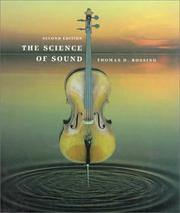
Begin with The science of sound by Rossing, a rich and approachable tour of vibration, waves, hearing, instruments, and rooms that maps the whole territory. Musical acoustics by Donald Hall covers similar ground with a musician's focus, making the math concrete through instruments you already know. Together they give you a working vocabulary before any equations get demanding.
The physics and the ear
Now go deeper on both halves of the subject. Fundamentals of acoustics by Kinsler is the standard engineering-physics text, developing the wave equation and its consequences carefully. The physics of musical instruments by Fletcher and Rossing is the definitive account of how strings, pipes, and membranes actually make sound. On the perception side, Psychoacoustics: Facts and Models is the reference on how loudness, pitch, and masking are measured and modeled, and An introduction to the psychology of hearing by Moore explains how the auditory system turns pressure waves into experience.
Applied acoustics
The final arc is putting it to work. Architectural acoustics by Marshall Long is the professional text on designing rooms and controlling noise. Master Handbook of Acoustics by Everest is the practical companion for studios and listening spaces, readable and full of usable guidance. Acoustics by Allan Pierce is the rigorous graduate reference for when you need the full theory, and Designing Audio Effect Plug-Ins in C++ by Pirkle turns the science into working digital audio code, closing the loop from physics to software.
Read in this order and sound stops being either abstract math or mysterious gear and becomes one connected science. Follow the full path to move from hearing to designing.
Follow the full reading path →
Ready to learn something deeply?
Build a reading path — free