Econometrics is what happens when you point statistics at economic questions, where you cannot run clean experiments and the data is observational, endogenous, and messy. The central challenge is not computing a regression; it is arguing that the regression means what you claim, that you have identified a real effect rather than a spurious correlation. Beginners who focus on the formulas and skip the reasoning about identification end up confidently wrong. Order matters here as much as content.
The path starts with an intuitive introduction, builds toward the modern causal toolkit, and then branches into the specialized areas of panel and time-series data. Along the way the emphasis stays on identification: knowing when your estimate can be believed.
Get the intuition, then the rigor
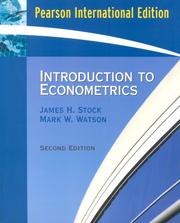
Start with Introduction to econometrics by Stock and Watson, the standard undergraduate text that teaches regression and inference with a strong emphasis on real data and causal interpretation. It builds the intuition the right way. When you need the fuller, more mathematical treatment, Econometric analysis by Greene is the comprehensive graduate reference covering the theory in depth, best used as you deepen rather than as a first read.
Learn to identify causal effects
The heart of modern applied econometrics is credible identification. Mostly harmless econometrics by Angrist and Pischke is the celebrated, readable guide to the quasi-experimental methods, instrumental variables, difference-in-differences, and regression discontinuity, that let you draw causal conclusions from observational data. Pair it with Causal Inference by Scott Cunningham, which covers the same toolkit with code and clear worked examples, and The Effect by Nick Huntington-Klein, a newer and exceptionally clear book that ties research design and estimation together. These three are where econometrics becomes genuinely useful.
Handle panel and time-series data
Real data often has structure that demands specialized methods. Econometric analysis of cross section and panel data by Wooldridge is the authoritative treatment of data that tracks many units over time, and Microeconometrics by Cameron and Trivedi goes deep on methods for individual-level data. For data indexed by time, Time Series Analysis by Hamilton is the definitive, demanding reference, and Analysis of Financial Time Series by Tsay applies these tools to finance, where volatility and returns have their own well-studied patterns.
Follow the full path and econometrics stops being a blur of Greek letters and becomes a disciplined way to extract believable answers from imperfect data. You end able to choose a research design, defend your identifying assumptions, and handle panel and time-series structure with confidence. Remember that every estimate rests on assumptions: the craft is stating them honestly, not hiding them behind the math.
Follow the full reading path →
Ready to learn something deeply?
Build a reading path — free