Yoko Ogawa Reading Order: Where to Start
Yoko Ogawa is two writers sharing a name. One writes quiet, tender books about care and mathematics and memory; the other writes some of the coldest cruelty in contemporary fiction, in exactly the same unhurried, polite prose. Picking the wrong one first is how readers bounce off her, so this path starts with the warm books, moves through the dystopia she is now best known for, and only then hands over the genuinely disturbing work — by which point you can see that the gentleness and the cruelty were always the same technique.
Start Here: The Gentle Ogawa
BeginnerMeet Ogawa at her warmest and learn her method — flat, patient, unemphatic sentences that let enormous feeling accumulate without ever announcing it.
▸ Study plan for this stage
Pace: Four to five weeks. The Housekeeper and the Professor is short — around 180 pages in English — and can be read in a week, but it is better taken over ten days, because its effect is cumulative and quiet. Mina's Matchbox is 317 pages and more leisurely still; two to three weeks at 25 pages a sitting.
- Ogawa reads like two writers sharing a name. One writes tender, patient books about care, mathematics and memory; the other writes some of the coldest cruelty in contemporary fiction — in exactly the same unhurried, polite prose. Meeting the wrong one first is how readers bounce off her.
- The full published title of the first book is The Housekeeper and the Professor, published in Japanese in 2003 and in English in 2009. Our catalogue lists it without the leading article, so ask for the full title in a bookshop.
- Its premise: a mathematician whose memory lasts only eighty minutes after a head injury, the housekeeper who is hired to look after him, and her ten-year-old son, whom the professor names Root because his flat head resembles a square-root sign.
- The mathematics is not decoration. Amicable numbers, perfect numbers and Euler's formula are used as the vocabulary of affection — the professor can only express care through numbers because he cannot retain anything else, and the book makes that genuinely moving rather than whimsical.
- The technique to notice from the first page: flat, patient, unemphatic sentences with almost no adverbs of feeling. Ogawa never tells you a scene is sad. The emotion accumulates in what is described and never once named, and that restraint is exactly the same instrument she later uses for horror.
- Mina's Matchbox, published in Japanese in 2006 and in English in 2024, is her other genuinely warm book: a girl sent in 1972 to live with wealthy relatives near Kobe, her asthmatic cousin Mina, and the pygmy hippopotamus Mina rides to school.
- Read it second while the gentle register is still fresh, because nothing after this stage is safe. It is also the best demonstration that Ogawa's strangeness is not the same thing as her cruelty — a hippopotamus in the garden is odd, and the book is kind.
- Repetition and routine are her structural signature in both books: the same meal, the same walk, the same eighty minutes beginning again. She builds feeling by returning rather than by escalating.
- How does the professor express affection, and why does his condition make mathematics the only available medium?
- Find a passage that moved you and check it for emotional vocabulary. How many words in it name a feeling?
- What does the eighty-minute limit do to the structure of the novel? What is the housekeeper required to do again each day?
- In Mina's Matchbox, what is the function of the hippopotamus — comic relief, symbol, or something the book refuses to convert into meaning?
- What do both books have to say about people who are looked after and people who do the looking after?
- What is already unsettling in these two warm books? There is something in each, and locating it now makes the next stage much easier to read.
- Look up amicable numbers before or during The Housekeeper and the Professor. Two minutes of arithmetic and the novel's central gesture of affection becomes concrete rather than abstract.
- Copy out one paragraph you found affecting and delete every adjective. Almost nothing will change, which tells you where Ogawa's emotion actually lives.
- Keep a list of the physical details she lingers on — food, hands, hair, illness, the body. She is an intensely bodily writer even here, and noticing that in the gentle books means the later ones do not seem to come from nowhere.
- After Mina's Matchbox, write one sentence on what makes an Ogawa sentence recognisable. You will want that sentence when the tone flips completely in stage three.
Next up: You now have her method in the register where it reads as tenderness, which is exactly what the next stage needs, because The Memory Police uses the identical prose for loss.

The right first Ogawa for almost everyone: a housekeeper, her son, and a mathematician whose memory lasts eighty minutes. It is kind, it is about prime numbers, and it teaches you her restraint in a form where restraint is simply tenderness.
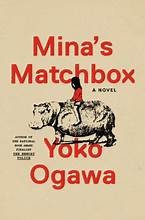
A late novel and her other genuinely warm book — a girl sent to live with wealthy relatives in 1972, and the cousin who rides a pygmy hippopotamus to school. Read it second while the gentle register is still fresh, because nothing after this is safe.
The Famous One: Memory and Disappearance
BeginnerRead the novel that made her name in English and see the same calm prose used for loss rather than affection.
▸ Study plan for this stage
Pace: Three to four weeks for about 450 pages. The Memory Police is 274 pages and moves slowly on purpose — two weeks, 20 pages a sitting, and expect the pace to feel becalmed in the middle third, which is the book working rather than failing. The Diving Pool is 176 pages holding three novellas and is sho
- The Memory Police is the accessible entry to Ogawa and the book most English-language readers meet her through, but it belongs second rather than first — it is far easier to read once you have seen the same prose used for kindness.
- The premise: on an unnamed island, things disappear. Ribbons, birds, roses, photographs, novels. When something disappears the islanders forget it existed, and a secret police force ensures the forgetting is complete by removing anyone who cannot forget.
- It was written in Japanese in 1994 and only translated into English in 2019, which matters: it is not a response to any recent politics, and its reception as a book about contemporary authoritarianism is a reading the text permits rather than an intention.
- The horror works precisely because the narrator refuses to raise her voice. She loses things and reports the loss in the same tone she uses for the weather, and the flatness is the most frightening thing in the book.
- The narrator is a novelist, and the novel she is writing appears inside the book in fragments — a woman losing her voice, held in a clock tower by her typing teacher. The inner story runs a parallel and more explicitly bodily version of the outer one.
- Her editor, R, cannot forget, and she hides him in a concealed room. That arrangement — one person preserved by another, in a small space, indefinitely — is the emotional core, and it is a variation on the caretaking relationships from stage one.
- Loss in this book is finally physical rather than abstract, and the last movement makes that literal in a way it would be unfair to spoil. Ogawa's subject is always the body; the disappearances are only the mechanism.
- The Diving Pool collects three novellas from 1990 and 1991 and is the correct bridge into her darker mode. Each begins as a domestic sketch and turns quietly malignant: a girl in an orphanage watching a boy dive, a woman recording her sister's pregnancy, a student visiting a strange dormitory. The m
- What is the mechanism of a disappearance on the island? What do people do on the morning something goes, and who decides?
- Why does the narrator's flat tone make the book more disturbing than an anguished one would be? Point to a specific sentence.
- How does the novel-within-the-novel comment on the outer story? What does it make explicit that the frame keeps implicit?
- What is R's position, and how does the relationship between him and the narrator resemble the caretaking in The Housekeeper and the Professor?
- In each of the three novellas in The Diving Pool, at what precise point does the domestic surface break? Name the sentence or scene.
- What is Pregnancy Diary actually about, and how does Ogawa make food and the body carry all of it?
- Keep a list of what disappears from the island, in order. The escalation is precisely designed and the list makes the shape of the book visible.
- Read the inner-novel sections of The Memory Police consecutively, skipping the frame, once you have finished. They form a coherent short story and reading them that way clarifies what Ogawa is doing with the double structure.
- Read the three novellas of The Diving Pool a day apart, and after each write one sentence on what the narrator wanted. Ogawa's narrators want things they do not admit to, and that is the mechanism of the dread.
- Note every food description in this stage. Ogawa uses eating, spoiling and rot more than any other image, and the pattern becomes overwhelming in the next stage.
- Before moving on, decide how much unease you actually want. This is the honest stopping point for a reader who liked the first stage — stage three is a different proposition and choosing it deliberately is better than being ambushed.
Next up: You have now seen the same unhurried prose used for tenderness and for loss, which is precisely the range you need to recognise that the two cruellest books use no new technique at all.

An island where objects — ribbons, birds, novels — vanish from the world and from memory, enforced by a secret police. Written in 1994 and read now as a book about authoritarianism; the horror works precisely because the narrator refuses to raise her voice.
Three novellas, and the correct bridge into her darker mode: each one starts as a domestic sketch and turns quietly malignant. Short enough to read in an evening, and it shows how early the cruelty was there.
The Cruel Ogawa
IntermediateRead the two books that put her closer to horror than to literary realism, with enough of her range behind you to see what she is actually doing.
▸ Study plan for this stage
Pace: Three to four weeks for two short books of roughly 160 pages each. Revenge is eleven linked stories — read one or two a sitting over a fortnight, never straight through, because the links only register with a gap. Hotel Iris is 164 pages and can be read in two or three sittings, but leave a clear we
- Say this plainly before you begin: these two books are genuinely disturbing, and Hotel Iris in particular is a book some readers will not want. Nothing in them is gratuitous and both are the work of a major writer, but knowing what they are is better than discovering it at page forty.
- Revenge is eleven linked stories in which a detail from one becomes the centre of the next — a bakery selling strawberry shortcake to a woman whose son is dead, a woman whose heart grows on the outside of her body, a bagmaker asked to make a bag for it, a tiger, a museum of torture.
- The linking is the achievement. Objects and minor figures migrate between stories and change status, so a background detail in one becomes a protagonist's obsession in the next, and the collection closes into a loop rather than a sequence.
- It is the best demonstration in her whole catalogue that the sweetness and the menace are one technique. The bakery story could sit unaltered in a book about grief; placed here, the same sentences are horror.
- Her bodily preoccupation is fully exposed in Revenge — organs, decay, produce, surgery, the inside of things. Ogawa consistently treats the body as an object that can be examined, opened and stored, and the flat prose makes that examination clinical rather than lurid.
- Hotel Iris is her hardest book: a seventeen-year-old girl working at her mother's seaside hotel, and a translator in his sixties, in a sadomasochistic relationship narrated without a shred of authorial comment.
- The absence of comment is the point and the difficulty. Ogawa neither condemns nor endorses; she reports, in the same voice that described the professor's mathematics, and the reader is left with nowhere to stand.
- Save it for last deliberately. It is only fully legible once you can hear that the narrator of Hotel Iris and the narrator of The Housekeeper and the Professor are the same instrument — that is the argument this entire path has been constructing, and Hotel Iris is where it lands.
- Trace three objects or characters across the stories in Revenge. What changes about each as it moves between them?
- Why does the first story in Revenge work as an opening? What does it establish about the tone that the later, stranger stories depend on?
- What does Ogawa gain by never commenting on the relationship in Hotel Iris? What would a single judging sentence destroy?
- How does Mari narrate her own situation, and where can you see her account and the reader's understanding come apart?
- Compare a paragraph from Hotel Iris with a paragraph from The Housekeeper and the Professor. What is technically different — and is anything?
- Having read across the range, what is Yoko Ogawa's actual subject? Neither tenderness nor cruelty is the right answer on its own.
- Draw the links in Revenge as a diagram as you read — each story a node, each shared object an edge. It is genuinely the best way to see the structure and it takes one sheet of paper.
- After finishing Revenge, reread the first story. It is different once you know where everything in it goes, and the collection is built to be reread this way.
- Read Hotel Iris only when you have time to stop. Deciding in advance that you may put it down permanently is a reasonable precaution and does not mean failing the book.
- Take one sentence from Hotel Iris and one from stage one, write them side by side, and mark what distinguishes them. Most readers find they cannot tell which is which without context, which is the whole point.
- Write a final page on the relationship between her gentleness and her cruelty. Six books is enough evidence, and articulating it is what converts having read Ogawa into understanding her.
Next up: This closes the path with her full range in view — the gentle books, the famous dystopia and the genuinely cruel work — leaving you able to pick up any of her other translated titles knowing which register you are walking into.

Eleven linked stories in which a detail from one becomes the centre of the next — a bakery, a heart on the outside of a body, a hand-shaped bag. The most formally ingenious thing she has written, and the best demonstration that her sweetness and her menace are one technique.

Her hardest book: a seventeen-year-old and a much older translator, told without a shred of authorial comment. Save it for last deliberately — it is genuinely disturbing, and only worth reading once you can recognise the same voice that narrated The Housekeeper and the Professor.
Discussion
Keep reading
Paths that share books, cover the same subject, or open a related topic.