Start with Housekeeper and the Professor, published as The Housekeeper and the Professor and listed in our catalogue without the leading article, so ask for the full title in a shop. The obvious alternative is The Memory Police, which is the book most English-language readers meet her through — and it belongs second, not first.
The reason is that Ogawa reads like two writers sharing a name. One writes tender, patient books about care, mathematics and memory; the other writes some of the coldest cruelty in contemporary fiction, in exactly the same unhurried, polite prose. Meeting the wrong one first is how readers bounce off her. Establish the warm register and everything after it becomes legible.
The gentle Ogawa
Housekeeper and the Professor concerns a mathematician whose memory lasts only eighty minutes after a head injury, the housekeeper hired to look after him, and her ten-year-old son, whom the professor names Root because his flat head resembles a square-root sign. The mathematics is not decoration: amicable numbers, perfect numbers and Euler's formula are the vocabulary of affection, because the professor cannot retain anything else.
Notice the technique from the first page — flat, patient, unemphatic sentences with almost no adverbs of feeling. Ogawa never tells you a scene is sad; the emotion accumulates in what is described and never once named, and that restraint is exactly the instrument she later uses for horror.
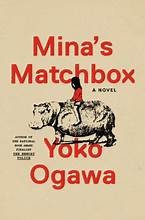
Read Mina's Matchbox second, while the register is fresh. A girl is sent in 1972 to live with wealthy relatives near Kobe, with her asthmatic cousin Mina and the pygmy hippopotamus Mina rides to school. It is the best demonstration that Ogawa's strangeness and her cruelty are separate things: a hippopotamus in the garden is odd, and the book is kind.
The famous one
The Memory Police is set on an unnamed island where things disappear — ribbons, birds, roses, photographs, novels — and when something disappears the islanders forget it existed, while a secret police force removes anyone who cannot forget. It was written in Japanese in 1994 and translated into English only in 2019, which is worth knowing: its reception as a book about contemporary authoritarianism is a reading the text permits rather than an intention.
The horror works because the narrator refuses to raise her voice. She reports loss in the same tone she uses for the weather. Expect the middle third to feel becalmed; that is the book working rather than failing. The narrator is a novelist, and the novel she is writing appears inside the book in fragments, running a parallel and more explicitly bodily version of the outer story.
The Diving Pool collects three novellas and is the correct bridge into her darker mode. Each begins as a domestic sketch and turns quietly malignant. The middle one, Pregnancy Diary, won the Akutagawa Prize in 1991, and its casual sustained menace shows how early the cruelty was fully formed.
The cruel Ogawa
Say this plainly before you begin: these two books are genuinely disturbing, and Hotel Iris in particular is one some readers will not want. Nothing in them is gratuitous and both are the work of a major writer, but knowing what they are beats discovering it at page forty.
Revenge is eleven linked stories in which a detail from one becomes the centre of the next — a bakery selling strawberry shortcake to a woman whose son is dead, a woman whose heart grows on the outside of her body, a bagmaker asked to make a bag for it. The linking is the achievement: objects and minor figures migrate between stories and change status, and the collection closes into a loop rather than a sequence. Read one or two stories a sitting; the links only register with a gap.
Hotel Iris is her hardest book: a seventeen-year-old girl working at her mother's seaside hotel, and a translator in his sixties, in a sadomasochistic relationship narrated without a shred of authorial comment. The absence of comment is both the point and the difficulty — Ogawa neither condemns nor endorses, and the reader is left with nowhere to stand.
Where to stop
Stopping after The Memory Police is entirely reasonable, and many readers do. The last stage is only fully legible once you can hear that the narrator of Hotel Iris and the narrator of Housekeeper and the Professor are the same instrument, which is the argument this order is built to make. Ogawa has other translated titles; once you know the two registers, you can choose which one you are walking into. More translated fiction is on Discover.
Follow the full ordered path here: Yoko Ogawa Reading Order: Where to Start.