Witold Gombrowicz Reading Order: Where to Start
Gombrowicz's body of work in English is small — four novels, one enormous diary, a book of early stories and a few memoirs — and that is the honest shape of this path rather than a gap in it. Start with Ferdydurke, which is the book everything else answers to, then take the novels in publication order, then the Diary, which many readers end up rating above the fiction. The final stage is the margins: the early stories, the memoirs and the philosophy lectures. Insist on the Danuta Borchardt translations where they exist; the older English versions were made from the French and are noticeably flatter.
Start Here: Ferdydurke
BeginnerMeet Gombrowicz's central obsession — immaturity, and the forms other people force on us — in the book that states it first and most violently.
▸ Study plan for this stage
Pace: 4–6 weeks for 272 pages, which is very slow for a book that short — and it should be. Set expectations honestly before you start. Gombrowicz wrote in Polish and everything you will read is a translation; he is deliberately difficult, deliberately absurd, and satirical to the point of hostility towar
- The premise: a thirty-year-old writer is abducted back into a schoolboy's body and life by his former teacher, and is thereafter treated as an adolescent by everyone he meets
- Immaturity — Gombrowicz's word for the unfinished, undignified, unformed condition he thinks is the actual human state — is the central idea of his entire body of work and it is stated here first and most violently
- The Form: the shapes other people force us into by looking at us, and the faces we pull at each other, which Gombrowicz treats as the fundamental social mechanism
- The 'gęba' and the 'pupa' — roughly the mug or grimace imposed on someone, and the infantilising bottom — are untranslatable coinages that carry the argument; whichever English words your translator chose, watch how they recur
- The interpolated stories, Philidor and Philibert, interrupt the novel with unrelated absurdist farce and are prefaced by mock-critical essays; they are structurally necessary rather than digressive
- The satire's targets are Polish national culture, literary reputation, progressive schoolmasters, the landed gentry and modern youth — no group in the book escapes
- Published in 1937, before the war and before his exile, which makes it prophetic about his own life rather than a response to it
- What does Gombrowicz mean by Form, and where in the novel does a character visibly acquire one against their will?
- Why is immaturity presented as the true condition rather than as a stage to be outgrown?
- What are the Philidor and Philibert chapters doing, and what would the novel lose without them?
- Which Polish social types does the novel attack, and what does it hold against each?
- How does the narrator's own writing — his self-conscious, digressive, self-mocking manner — participate in the satire rather than standing outside it?
- What happens at the end, and is escape from Form possible in this book's terms?
- Check the translator before you buy. Borchardt for Ferdydurke, Cosmos, Pornografia and Trans-Atlantyk; anything relayed through a third language is a meaningfully worse book.
- Read the two interpolated stories and their prefaces in single sittings rather than across days. They are farces and they die when interrupted.
- Keep a note of every scene in which one character imposes an identity on another. Written out, the list is the whole novel and it makes the apparently random plot cohere.
- Read one page aloud when you stall. Gombrowicz's sentences accumulate absurdity by rhythm, and hearing it converts confusion into comedy.
- Write down what you take Form to mean after fifty pages, and again at the end. Watching your own definition change is the most reliable sign you are reading him correctly.
Next up: With the argument about Form and immaturity in place, the remaining novels can be read as three variations on it — which is what they are, and what makes them legible where they would otherwise seem merely strange.
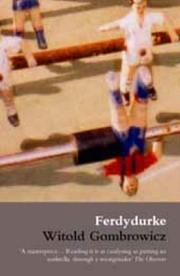
A thirty-year-old man is kidnapped back into a schoolboy's body by his former teacher. Published in 1937, and the only correct starting point: every later book is a variation on its argument that we are made by the faces others pull at us. Read the Borchardt translation, which is the first into English from the Polish.
The Other Novels
BeginnerFollow the same argument through exile, wartime Poland and a country house, and see Gombrowicz's forms get tighter as his subject gets stranger.
▸ Study plan for this stage
Pace: 10–14 weeks for 210, 160 and 202 pages. All three are short and none is quick. Trans-Atlantyk is the hardest sentence by sentence and needs the most patience; Pornografia is the most conventionally readable; Cosmos is the hardest to hold in the mind. Fifteen pages a sitting, and read them in this or
- Trans-Atlantyk is about a Polish writer stranded in Buenos Aires when the war breaks out, which is exactly what happened to Gombrowicz in 1939 — he arrived on a ship two weeks before the invasion and stayed twenty-four years
- It is written as a pastiche of the gawęda, an archaic Polish gentry storytelling mode, which makes it famously hard to translate and gives the English a deliberately antique, buttonholing manner
- Its argument is against patriotic duty: the novel sets Poland — the fatherland — against what Gombrowicz calls the sonland, and treats national obligation as the largest Form of all
- Pornografia puts two middle-aged men in occupied Poland manipulating two teenagers toward each other, and is his most controlled and most disturbing novel
- Pornografia dramatises directly what Ferdydurke satirised: the adult hunger for youth, and the way older people stage the young to feel something themselves
- Cosmos is his last novel and won the International Prize for Literature: a hanged sparrow, an arrow scratched on a ceiling, a mouth, and two men constructing an entire system of meaning out of coincidence
- Cosmos turns the method on interpretation itself — the reader is doing exactly what the characters are doing, which is why it is the correct final novel
- What is the sonland in Trans-Atlantyk, and what is Gombrowicz proposing in place of patriotic obligation?
- How does the archaic narrative manner of Trans-Atlantyk work as an argument rather than as a style?
- In Pornografia, what do Fryderyk and the narrator actually want, and does the novel condemn them?
- How does the wartime occupation setting change the stakes of the Form argument in Pornografia?
- In Cosmos, which of the connections the characters find are real, and how would you know?
- Across all four novels, is Gombrowicz's position consistent, or does it change between 1937 and 1965?
- Read the translator's introduction to Trans-Atlantyk before the novel. It is the one book in this path where knowing the formal problem in advance materially helps.
- In Cosmos, keep your own list of the objects and coincidences as they accumulate. You will find yourself building the same system the characters build, which is the experiment the novel is running on you.
- After Pornografia, reread the schoolboy chapters of Ferdydurke. The same material handled as satire and then as something much colder is the clearest evidence of his development.
- Note where each novel is set and when it was written. Argentina, occupied Poland, a Polish boarding house — the geography of exile is doing real work.
- Write one sentence stating what each novel adds to the argument of Ferdydurke. If a novel adds nothing, say so; that is a defensible reading of at least one of them.
Next up: Having read the fiction, you can take on the Diary — which is Gombrowicz's own running commentary on exactly these books and is, for many readers, the more important half of his work.
Written in Buenos Aires about a Polish writer stranded there when the war breaks out — which is exactly what happened to him. It is a pastiche of an archaic Polish gentry narrative and famously hard to translate, so it earns its place second: read it once you know what he is arguing against.

Two middle-aged men in occupied Poland manipulating two teenagers toward each other. His most controlled novel and the most direct dramatisation of the adult hunger for youth that Ferdydurke satirised.

His last novel and the one that won the International Prize for Literature: a hanged sparrow, an arrow scratched on a ceiling, and two men constructing meaning out of nothing. The hardest of the four, and the right final novel because it turns the method on the act of interpretation itself.
The Diary
BeginnerRead the work many consider his masterpiece, and get his own commentary on everything in the previous stages.
▸ Study plan for this stage
Pace: 3–5 months for 239 pages, read a few entries at a time. This is not a book to be finished; it is a book to be lived alongside, and Gombrowicz wrote it that way — in instalments for an émigré magazine over twenty years. An edition note first: the Diary is one continuous work, and in English it has ap
- The Diary is criticism, autobiography, provocation and philosophy at once, and many readers end up rating it above the novels — it is his major work by that reckoning
- It famously opens with four consecutive entries reading Monday, Me. Tuesday, Me. — a joke, a manifesto and an accurate summary of the method
- It was written from Argentina for Kultura, the Paris-based Polish émigré magazine, and its immediate audience is a Polish exile community he is deliberately provoking
- Gombrowicz uses it to attack Polish literary piety, national self-congratulation, poetry as a genre, and the reputations of writers his readers revered
- It explains the novels better than any critic has, because he is arguing about the same things in his own voice and without the fiction's protective absurdity
- The self-construction is the point: the Diary invents 'Gombrowicz' as a public figure, which is itself an instance of the Form argument being applied by its author to himself
- Its tone shifts constantly between the comic, the vain, the philosophically serious and the openly manipulative, and following those shifts is most of the reading skill it requires
- What does the opening 'Monday. Me.' sequence announce, and how seriously should it be taken?
- Who is Gombrowicz arguing with in the Diary, and what does he want from the Polish émigré readership?
- How does the Diary's account of Form differ from the version dramatised in the novels?
- Where does he defend one of his own books, and is the defence convincing?
- How much of the 'Gombrowicz' of the Diary is a constructed persona, and does the book admit it?
- Do you find the Diary better than the fiction? Many readers do; say what specifically supports your answer.
- Check which edition you are buying — one of the three volumes, or the single-volume collected Diary. The one-volume edition gives the whole twenty-year sequence and is worth seeking out.
- Read three or four entries at a sitting and stop. The Diary was written in instalments and consumed in blocks it becomes shrill.
- When he discusses one of his own novels, go back to your notes on that novel before reading further. The pairing is the strongest reason to read the Diary after the fiction.
- Mark the passages where he is obviously performing versus obviously sincere, and then reconsider whether you can tell. That uncertainty is the book's chief effect.
- Keep a list of the writers he attacks. It doubles as a map of the Polish canon as it stood, and it explains how much of what he says was aimed at readers who could not answer back.
Next up: With the fiction and its author's commentary both in hand, the remaining books fill in the margins — the early stories, the Poland he left, and the philosophy he dictated at the end of his life.

Written from Argentina over twenty years and opening with four consecutive entries that read Monday, Me. Tuesday, Me. It is criticism, autobiography, provocation and philosophy at once, and it explains the novels better than any critic has. Read it after the fiction so the arguments have objects.
The Margins
BeginnerReach the early stories, the memoir and the late lectures, and finish with essentially everything Gombrowicz wrote that exists in English.
▸ Study plan for this stage
Pace: 10–14 weeks for 275, 202, 119 and 221 pages, and none of it is compulsory. Bacacay and A Guide to Philosophy are the two most worth your time and are the easiest reading in the entire path; Polish Memories is straightforward memoir; Possessed is a curiosity. Read them in the order given, which runs
- Bacacay collects the early stories written before and around Ferdydurke — grotesque, funny and considerably more accessible than the novels
- The stories are a useful check on whether you have understood the method: the same manoeuvres appear at short length where they are much easier to see
- Polish Memories is a memoir of the Poland he left in 1939, written for Radio Free Europe, and is the most conventional prose he produced
- It is also the best source on the world that Ferdydurke and Pornografia are satirising — the gentry, the Warsaw literary cafés, the schools
- A Guide to Philosophy in Six Hours and Fifteen Minutes collects lectures on Kant, Hegel, Marx, Sartre and existentialism, dictated to his wife in the last weeks of his life
- It is very short, genuinely funny and the clearest statement anywhere of the philosophical position the novels dramatise — existentialism handled by someone impatient with it
- Possessed is a gothic serial written under a pseudonym in 1939 for a Warsaw newspaper and not acknowledged until the end of his life; it is minor, included for completeness, and is the last thing left to read
- Which of the stories in Bacacay contains the Ferdydurke method in miniature, and how does the short form change it?
- What does Polish Memories show about interwar Polish literary life that makes the satire of Ferdydurke sharper?
- In the philosophy lectures, what is his objection to Sartre, and how does it relate to his own idea of Form?
- Why would a dying man dictate an introduction to Western philosophy, and what does the choice of philosophers tell you?
- Does Possessed contain anything recognisably Gombrowicz, or is it genuinely just a serial? Answer from the text rather than from his own later dismissal.
- Having read essentially everything of his available in English, what is his actual achievement — and would you recommend him, and to whom?
- Read Bacacay first in this stage and use it as a diagnostic: if the stories now seem clear rather than baffling, you have learned to read him.
- Read the philosophy lectures in two sittings. At 119 pages they are the shortest and most enjoyable thing here and make an excellent recovery after Cosmos.
- Use Polish Memories to annotate Ferdydurke retroactively — pick three satirical targets in the novel and find the real originals in the memoir.
- Treat Possessed as optional and abandon it without guilt if it does not hold you. Completeness is the only argument for it and it is a weak one.
- Write a paragraph on what Gombrowicz would have said about being turned into a reading path. The joke is entirely in the spirit of his work and it is a good test of whether you have his voice.
Next up: This is the end of the path: four novels, the Diary, the stories, the memoir and the lectures — very nearly everything of his that exists in English — so the natural next move is outward to the writers he argued with and against, or back to Ferdydurke, which reads completely differently with the Diary behind it.
The collected early stories, written before and around Ferdydurke. Grotesque, funny and much easier than the novels, which makes them a useful check on whether you have understood what he is doing.

A memoir of the Poland he left in 1939, written for Radio Free Europe. The most conventional prose he produced and the best source on the world Ferdydurke and Pornografia are set against.
Lectures on Kant, Hegel, Marx, Sartre and existentialism, dictated to his wife in the last weeks of his life. Very short, very funny, and the clearest statement of the philosophical position the novels dramatise.
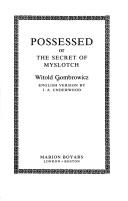
A gothic serial he wrote under a pseudonym in 1939 for a Warsaw newspaper and never claimed until the end of his life. Minor, and included only for completeness — it is the last thing left to read.
Discussion
Keep reading
Paths that share books, cover the same subject, or open a related topic.