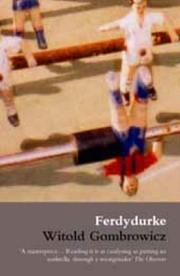
Start with Ferdydurke. It is the book that made him, it is only 272 pages, and it contains in miniature everything he spent the rest of his life doing — a thirty-year-old writer is abducted back into a schoolroom and forced into immaturity, and the novel proceeds to argue that everyone is always being forced into a form by everyone else. The obvious alternative is the Diary, which many readers and quite a few critics consider his major work, and it is better approached after the fiction so that its arguments have objects to attach to.
Set expectations honestly before you begin. Gombrowicz wrote in Polish and everything you will read is a translation. He is deliberately difficult, deliberately absurd, and satirical to the point of hostility toward the reader. Ferdydurke has a plot that abandons itself twice, two interpolated stories that appear to have nothing to do with anything, and a vocabulary of invented body-part abstractions that a translator has to reinvent in English. It is also funny, and it is not a book you can read on autopilot. Twenty pages a sitting is plenty; four to six weeks for 272 pages is not excessive. If the first fifty pages bewilder you, that is the intended effect and it does resolve into a method.
One purchasing note that makes a real difference: insist on the Danuta Borchardt translation where one exists. Hers were made directly from the Polish, whereas the older English versions were relayed through French or Spanish and are noticeably flatter.
The other novels
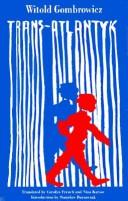
Trans-Atlantyk, Pornografia and Cosmos, in that order, at 210, 160 and 202 pages. All three are short and none is quick — ten to fourteen weeks for the set, fifteen pages a sitting.
Trans-Atlantyk is the hardest sentence by sentence: a mock-archaic narrative written in an old Polish gentry style, about a writer stranded in Argentina when the war breaks out, which is exactly what happened to Gombrowicz. Pornografia is the most conventionally readable of the three, and readers who find Ferdydurke too abstract sometimes get on better here. Cosmos is the hardest to hold in the mind — two men in the countryside constructing an investigation out of meaningless signs — and it is the most complete statement of the method. This is publication order and also the order in which that method tightens.
The Diary
Three to five months, read a few entries at a time. This is not a book to be finished; it is a book to be lived alongside, and Gombrowicz wrote it that way, in instalments for an émigré magazine over twenty years. It is where he is funniest, most quarrelsome and most direct about what the novels are doing, and it is the reason many readers end up rating him as an essayist and self-mythologiser rather than a novelist.
An edition note. The Diary is one continuous work, and in English it has appeared both as three separate volumes and as a single collected edition. The record on this path, Diary Volume 2 (Diary), is the second of the three-volume translation and covers the middle stretch. It reads perfectly well entered at that point — the Diary has no plot to lose — but if you can find the one-volume collected edition, that is the fuller experience and the better purchase.
The margins
None of this is compulsory. Bacacay is the early short fiction and A Guide to Philosophy in Six Hours and Fifteen Minutes is a set of lectures on Kant, Hegel, Schopenhauer, Nietzsche, Husserl, Heidegger and Sartre delivered near the end of his life — these two are the easiest reading in the entire path and the most worth your time. Polish Memories is straightforward memoir of his early years. Possessed, or, The secret of Myslotch is a gothic serial he published pseudonymously for money and is a curiosity rather than a discovery. Read them in that order, which runs from most to least essential.
Where to stop
Ferdydurke, Cosmos and the Diary is the case for Gombrowicz made properly. If Ferdydurke alone does not persuade you, the rest will not, and stopping there is entirely reasonable.
More author reading orders are on Discover.
Follow the full ordered path here: Witold Gombrowicz Reading Order: Where to Start.