Hitchhiker's Guide Reading Order and Guide
Hitchhiker's is famously a trilogy in five parts, and the order is simply publication order — but the five books are not equal, and the arc bends sharply downward in mood. Books one and two are the radio series turned into prose and are the funniest; books three to five get progressively darker until Adams ends the whole thing on a note he later said he regretted. There is a sixth novel, written by Eoin Colfer after Adams's death, which is a real book and not part of the core reading. This path takes the five, then the Colfer and the original radio scripts as optional extras, then the rest of Adams — which is where his best sentences arguably live.
Start Here
BeginnerRead the two books adapted directly from the radio series — the funniest, densest and most quotable of the five.
▸ Study plan for this stage
Pace: One week for 440 pages. These are short, fast and constantly funny, and most readers do both in three or four sittings. Resist reading them in one go — the jokes are dense enough that fatigue sets in, and a chapter or two a night keeps every gag landing.
- The order is simply publication order and there is no controversy. What is worth knowing is that the five books are not equal and the mood bends sharply downward across them, so the first two are the funniest and the last is the bleakest
- The Hitchhiker's Guide to the Galaxy and The Restaurant at the End of the Universe were adapted from the 1978 BBC radio series rather than written as novels. That is why they read as a run of superb set pieces rather than as plotted books
- Because they were written for radio, the prose is built for the ear. The rhythm of the famous passages — the Vogon poetry, the whale, the Babel fish — is comic timing transcribed, and reading a few paragraphs aloud makes this obvious
- The Guide entries are the best invention. They interrupt the story to deliver a joke in the voice of an encyclopedia written by people who could not be bothered, and Adams uses them to do exposition and comedy in the same breath
- Arthur Dent is a deliberately inert protagonist. He wants tea and to go home, and everything happens to him. This is a structural choice, not a failure of characterisation
- The answer to life, the universe and everything is famous enough to have escaped the books entirely, but the actual joke is what it implies about the question. Notice which one the books are more interested in
- The Restaurant at the End of the Universe is where Adams's real subject shows up: bureaucracy, time as an administrative problem, and the total indifference of the universe to individual intent
- One reading-order note peculiar to Hitchhiker's: the radio series, the novels, the television series and the film all diverge in plot. If you have met the story in another medium, expect the books to contradict it, and do not try to reconcile them
- What does the Guide-entry device let Adams do that ordinary narration would not?
- Arthur never drives events. What holds the book together in the absence of a protagonist with goals?
- Which passages are funniest read aloud, and what does that tell you about how they were written?
- The Restaurant at the End of the Universe has more structure than book one. Is it funnier or just better organised?
- Adams's jokes are usually about a system rather than a person. Name three systems he attacks in these two books
- Read the Vogon poetry passage and the Babel fish entry aloud. The timing only exists when spoken
- Note every Guide entry and read them together at the end as a single text. They form a rough philosophy
- Track what Arthur actually decides to do across both books. The list is very short
- If you know the story from the radio or film, write down three things the books do differently and then stop trying to reconcile the versions
Next up: You have the two radio-derived books at their funniest, which is the necessary baseline for noticing how deliberately the next three cool down.
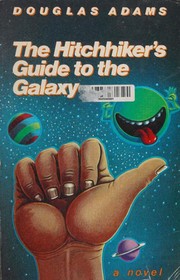
Earth is demolished on a Thursday and Arthur Dent never gets his cup of tea. Start here and nowhere else — the joke density in the first hundred pages is the highest Adams ever managed.

The second half of the original radio run, and the payoff to book one's cliffhanger. Read it immediately after: the two were one story before a publisher split them, and the Golgafrinchan ending is the real conclusion of the opening movement.
The Rest of the Trilogy
BeginnerContinue into the three novels Adams wrote as novels rather than adaptations, and watch the comedy get colder as the books get better structured.
▸ Study plan for this stage
Pace: 2 weeks for about 670 pages. Life, the Universe and Everything and So long, and thanks for all the fish are quick. Mostly Harmless is short but should be read slowly and not late at night — it is the bleakest thing Adams wrote and readers regularly report being genuinely upset by the ending.
- These three were written as novels rather than adapted from radio, and it shows. They are better structured, more plotted, and progressively less funny — that trade is the actual story of the trilogy in five parts
- Life, the Universe and Everything was reworked from an unused Doctor Who storyline, which explains why it has a proper plot, an actual villain and a threat to the universe. It is the most conventional science fiction novel of the five
- So long, and thanks for all the fish is the odd one: a love story, set mostly on Earth, quiet and rather tender, with far fewer jokes per page. Some readers find it the best of the five and others feel cheated
- Mostly Harmless is dark, angry and structurally cruel. Adams wrote it during a difficult period and later said as much, and the ending closes the sequence in a way that satisfies almost nobody. He said publicly that he wanted to write a sixth book with a more cheerful ending
- Adams died in 2001 at the age of forty-nine, so that sixth book was never written by him. Knowing this changes how the end of Mostly Harmless sits
- Across the five books, watch the ratio of jokes to plot invert. The first book is almost all gags with a thread through them; the fifth is a plotted novel with jokes deployed defensively
- Fenchurch in book four and Random in book five are the only two characters Adams gives genuine emotional weight to, and what happens to each of them is the clearest evidence that the series stopped being a comedy
- You can legitimately stop after book four. A number of longstanding readers do, and if you want the sequence to end warmly that is the place
- Life, the Universe and Everything has a real plot. Does the comedy survive the structure?
- Book four has far fewer jokes and a love story. Is that a failure of nerve or a writer trying something?
- Where exactly does Mostly Harmless turn cruel, and is it aimed at the characters or at the reader?
- Adams said he wanted a more upbeat ending. On the evidence of book five, what would that have required him to undo?
- Track the joke-to-plot ratio across the five. What does the trend suggest about what Adams found difficult?
- Would you tell a new reader to stop after book four? Defend it
- Count the Guide entries per book. The decline across the five is a measurable version of the tonal shift
- Read the last chapter of Mostly Harmless in daylight and not at the end of a bad week
- Decide deliberately whether you are stopping at four or continuing. Drifting into book five unprepared is how it ambushes people
- Write two sentences on what the sequence loses when Adams starts caring about his characters, and two on what it gains
Next up: The canonical five are done, which is the right moment to decide about the two books that sit just outside them — a continuation by another writer, and the scripts everything grew from.

The first genuinely original novel of the run, built from a rejected Doctor Who script about the Krikkit wars. More plot, fewer digressions — an honest change of gear rather than a decline.

Arthur comes home and falls in love, and the book is barely science fiction at all. The most divisive volume: slight if you came for the jokes, quietly the most human thing he wrote if you did not.
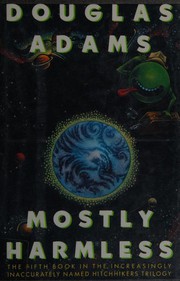
Written during a miserable period and it shows — bleak, angry, and ending the series with a door slammed. Read it to complete the set, but be told in advance that it is not funny in the way the first two are.
The Sixth Book and the Scripts
IntermediateDecide about the two things that sit outside the canon — a continuation by another writer, and the original radio scripts the whole thing grew from.
▸ Study plan for this stage
Pace: 2 to 3 weeks for about 585 pages. And Another Thing… over a week to ten days. The Original Hitchhiker Radio Scripts are not read like a novel — take one episode per sitting across a week or two, ideally alongside the audio if you can find it. Both are optional.
- And Another Thing… was written by Eoin Colfer, at the invitation of Adams's estate and with the agreement of his widow, and published in 2009 to mark thirty years of the series. It is a real, authorised book and it is not by Douglas Adams
- Colfer's job was to give the series the less bleak ending Adams had said he wanted, which means it is explicitly designed to undo the effect of Mostly Harmless. Whether you want that undone is the entire question
- The prose is recognisably Colfer's rather than Adams's — faster, broader, more plot-driven. Readers who go in expecting a pastiche are disappointed; readers who go in expecting a fond sequel by a different writer generally enjoy it
- The Original Hitchhiker Radio Scripts are the 1978 and 1980 series as broadcast, with Adams's own introductions and notes about what was cut and why
- The radio version came first and differs substantially in plot from the novels, particularly in the second series. Reading the scripts after the books shows you which jokes were built for sound and which Adams invented for the page
- Adams's introductions are the best short account of how the whole thing was made, including how much was written at the last possible minute. He was famously and comprehensively late
- Neither book is part of the core reading. Take the scripts if you are interested in how comedy is constructed; take the Colfer if you finished Mostly Harmless wanting a different ending
- Should a series be continued by another writer after the author's death? Answer with reference to this specific book rather than in the abstract
- What does Colfer get right about the voice, and where can you hear the seam?
- Comparing the scripts with the novels, which jokes only work in sound?
- Adams's notes describe writing under extreme deadline pressure. Where can you see that in the finished work, and does it help?
- Does And Another Thing… successfully undo the ending of Mostly Harmless, and did you want it to?
- Read one radio episode per sitting, ideally listening to the corresponding broadcast
- Pick one scene that exists in both the scripts and the novels and compare them line by line
- Read the first thirty pages of And Another Thing… and decide there whether to continue. It is a fair sample of the whole
- Write half a page on what makes a joke Adams-shaped, using an example from each side of the comparison
Next up: Having exhausted the Hitchhiker's material proper, the last stage is the non-Hitchhiker Adams, which is where a good many readers think his best writing actually is.
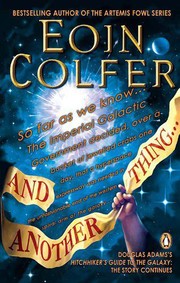
Commissioned by Adams's estate to give the series a warmer ending than Mostly Harmless. A competent pastiche by a good writer and not Adams; treat it as optional, and only read it if the fifth book's ending genuinely bothered you.

The 1978 and 1980 BBC scripts with Adams's production notes. Read them after the novels and you can see exactly what was rewritten, cut and reused — the single most interesting document about how the thing was actually made.
The Rest of Douglas Adams
IntermediateRead the non-Hitchhiker books, including the detective novels and the one work of non-fiction that most people end up calling his best.
▸ Study plan for this stage
Pace: 4 to 5 weeks for about 1,080 pages. Dirk Gently's Holistic Detective Agency and The Long Dark Tea-Time of the Soul over a week each. Last Chance to See over a week and a half, unhurried. The Salmon of Doubt in two or three sittings, dipping rather than reading straight through.
- Dirk Gently's Holistic Detective Agency is the most intricately plotted thing Adams wrote. It braids a ghost, a time machine, a Coleridge poem and an Electric Monk into a structure where every apparent digression turns out to be load-bearing. It is also partly reworked from Doctor Who material
- It is much less immediately funny than Hitchhiker's and considerably cleverer. Readers who find the later Hitchhiker books thin often prefer this
- Dirk's principle — the fundamental interconnectedness of all things — is a joke that doubles as a plotting method. Watch him use it to justify billing clients for a beach holiday and to solve the case
- The Long Dark Tea-Time of the Soul puts Norse gods into contemporary London and is looser, stranger and less well constructed than the first Dirk Gently, with a superb opening set piece at an airport check-in desk
- Last Chance to See is non-fiction, co-written with the zoologist Mark Carwardine, about travelling to see endangered species. Adams himself considered it his favourite of his books and a great many readers agree it is his best
- It is funny in exactly the Adams way and then, without warning, entirely serious. The kakapo and the Yangtze river dolphin chapters are the finest sustained writing he produced, and the dolphin is now extinct, which the book does not know
- The Salmon of Doubt was assembled after his death from the files on his computers: essays, journalism, interviews and about eleven chapters of an unfinished Dirk Gently novel. It is a posthumous miscellany rather than a book he wrote
- Read it last and read it as what it is — offcuts and occasional pieces from a writer who is not there to finish them. The unfinished novel stops mid-thought and there is no ending
- Dirk Gently is tightly plotted where Hitchhiker's is episodic. Which mode suits Adams's comedy better?
- What does the interconnectedness gag let Adams get away with structurally?
- Last Chance to See moves between comedy and grief without a gear change. How does he manage the transition?
- Adams thought Last Chance to See was his best book. Having read it, do you agree, and what is your criterion?
- The Salmon of Doubt is assembled rather than written. Should unfinished work be published, and does this particular collection justify itself?
- Across everything in this path, what was Adams consistently interested in? It is not spaceships
- Read Dirk Gently once for the jokes and skim it a second time for the plot. The construction only becomes visible on the second pass
- Read the kakapo chapter of Last Chance to See on its own and note where the comedy stops
- Look up the current status of the species in Last Chance to See after finishing. The book becomes a different object
- Read only the essays in The Salmon of Doubt first and treat the unfinished novel as optional
- Rank everything in this path and defend your top two. A surprising number of people end up with a non-Hitchhiker book at number one
Next up: That is the complete Douglas Adams, and the natural continuations are Terry Pratchett's Discworld for comic fantasy with its own reading-order question, or more science and nature writing in the vein of Last Chance to See.
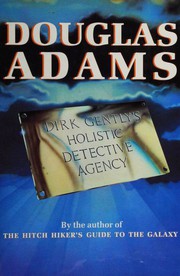
A ghost, an Electric Monk, a sofa stuck on a staircase and Coleridge, all resolving into one absurdly tight plot. The most impressively constructed thing Adams wrote — read it first outside Hitchhiker's.
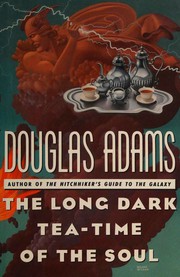
Norse gods in a decaying London, and Dirk being paid in almost nothing. Looser than the first Dirk novel and funnier line by line.

Adams and zoologist Mark Carwardine travelling to see endangered species before they go. Non-fiction, genuinely moving, and the book most Adams readers name as his best once they have read it.

The posthumous collection of essays, interviews and the unfinished final novel. Read it last — as a first Adams book it is scraps, and as a final one it is a proper farewell.
Discussion
Keep reading
Paths that share books, cover the same subject, or open a related topic.