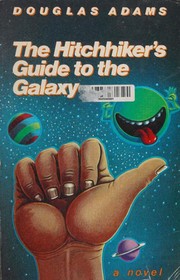
Start with The Hitchhiker's Guide to the Galaxy and read the five books in publication order. There is no controversy about the order at all. What is worth knowing before you start is that the five books are not equal, and the mood bends sharply downward across them: the first two are the funniest and the last is the bleakest.
One other thing peculiar to this series. The radio series, the novels, the television series and the film all diverge in plot. If you have met the story in another medium, expect the books to contradict it, and do not try to reconcile them.
The two radio books
The Hitchhiker's Guide to the Galaxy and The Restaurant at the End of the Universe were adapted from the 1978 BBC radio series rather than written as novels. That is why they read as a run of superb set pieces rather than as plotted books, and it is also why the prose is built for the ear — the rhythm of the famous passages is comic timing transcribed. Read the Vogon poetry and the Babel fish entry aloud and this becomes obvious immediately.
The Guide entries are the best invention. They interrupt the story to deliver a joke in the voice of an encyclopedia written by people who could not be bothered, and Adams uses them to do exposition and comedy in the same breath. Arthur Dent, meanwhile, is a deliberately inert protagonist: he wants tea and to go home, and everything happens to him. That is a structural choice rather than a failure of characterisation.
Do not read both in one go. The jokes are dense enough that fatigue sets in; a chapter or two a night keeps every gag landing.
The rest of the trilogy in five parts
Life, the Universe and Everything was reworked from an unused Doctor Who storyline, which explains why it has a proper plot, an actual villain and a threat to the universe. It is the most conventional science fiction novel of the five.
So long, and thanks for all the fish is the odd one: a love story, set mostly on Earth, quiet and rather tender, with far fewer jokes per page. Some readers find it the best of the five and others feel cheated.
Mostly Harmless is dark, angry and structurally cruel. Adams wrote it during a difficult period and later said as much, and the ending closes the sequence in a way that satisfies almost nobody. He said publicly that he wanted to write a sixth book with a more cheerful ending. He died in 2001 at the age of forty-nine, so he never did, and knowing that changes how the ending sits.
Where to stop
After book four, if you want the sequence to end warmly. A number of longstanding readers do exactly that, and it is a genuinely defensible choice rather than a cop-out. Read Mostly Harmless slowly, not late at night, and not at the end of a bad week — readers regularly report being genuinely upset by the last chapter. Decide deliberately which you are doing, because drifting into book five unprepared is how it ambushes people.
The sixth book and the scripts
And Another Thing… was written by Eoin Colfer at the invitation of Adams's estate and with the agreement of his widow, and published in 2009. It is a real, authorised book and it is not by Douglas Adams. Colfer's job was to give the series the less bleak ending Adams had said he wanted, which means it is explicitly designed to undo the effect of Mostly Harmless. Whether you want that undone is the entire question. The prose is recognisably Colfer's — faster, broader, more plot-driven — and readers who expect a pastiche are disappointed.
The Original Hitchhiker Radio Scripts is the 1978 and 1980 series as broadcast, with Adams's own introductions and notes about what was cut and why. Read after the books, it shows you which jokes were built for sound. His introductions are also the best short account of how the whole thing was made, including how much was written at the last possible minute.
The rest of Douglas Adams
Dirk Gently’s Holistic Detective Agency and The Long Dark Tea-Time of the Soul are the other novels, and the first is the better constructed thing Adams ever wrote — a comic detective novel that is also a time-travel plot and a ghost story, with every element paying off.
Last Chance to See is the non-fiction: a travel book about endangered species, written with the zoologist Mark Carwardine, and it is the warmest and best-written book on this list. The Salmon of Doubt is the posthumous collection of essays, interviews and the unfinished novel he was writing when he died.
Browse more science fiction reading paths on Discover.
Follow the full ordered path here: Hitchhiker's Guide Reading Order and Guide.