This page is a history, not a reform argument. The aim is to be able to say what the institution was built to do, on the evidence, and the books are ordered archivally and chronologically: English origins, then the two separate American lineages, then the reform movements of 1900 to 1970, then the construction of the link between race and crime, and finally two theoretical frames.
If what you want is the contemporary argument — abolition, militarisation, the misdemeanour system, what departments should do now — that is a different reading list, and it is on our policing and police reform page. The two overlap by exactly two books, Slave patrols and The condemnation of blackness, which are foundational to either.
Before the police, and the English invention
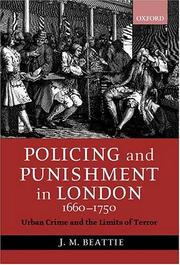
Start with Policing and Punishment in London, 1660-1750. J. M. Beattie's archival study covers parish constables, the night watch, the reward system that produced professional thief-takers, and the courts all of it fed. Its point is that London had policing long before it had police — which is the fact that makes 1829 interpretable rather than miraculous. Then The English police, Clive Emsley's standard political and social history from Peel onward, sceptical of both the official story of consent freely given and the radical story of a force imposed to suppress the working class.
The two American lineages
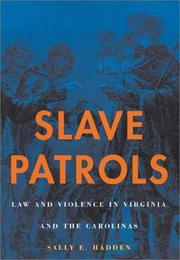
The southern slave patrols and the northern municipal departments were genuinely separate origins, and the relationship between the first and modern policing is the most asserted and least sourced claim in the subject. Slave patrols is where to settle it: Sally Hadden's archival history of the patrols in Virginia and the Carolinas — who served, under what law, and what happened to the institution after emancipation. Hadden is considerably more careful about the lines of continuity than the slogan version of her argument, which is exactly why reading her rather than a summary of her is the point.
Policing the city is the northern origin story in its earliest documented form: Roger Lane on Boston between 1822 and 1885, showing the force emerging from the older watch system in response to riot, immigration and vice rather than to crime as such. It is a 1967 book, we hold no ISBN for it, and it is still the model the later case studies follow — expect to find it through a library.
Police in urban America, 1860-1920 is the comparative quantitative study. Eric Monkkonen's finding, that police spent most of their early decades on order maintenance, poor relief and lodging the homeless rather than on crime, reframes what the institution was originally for. Rise of the Chicago Police Department is the strongest available statement of the class-formation account, grounded in one city's records: Sam Mitrani argues Chicago's department was built between 1850 and 1894 by a business elite that needed a reliable instrument against strikes.
Professionalisation, and what it achieved
Big-City Police is the classic account of American police reform from the 1890s to the 1970s, in two waves — the Progressive attack on machine politics, then the postwar professional model. Robert Fogelson's organising insight is that each reform solved the previous generation's problem while creating the next one.
Read it against Samuel Walker's study of professionalism as an idea, and of how much of it was self-presentation by police leaders rather than change in practice. Our catalogue record for that book has a missing space in its display title, rendering it as A critical history of policereform; it is the right book. Then Black police in America, W. Marvin Dulaney on Black officers from Reconstruction onward — the towns that hired them, the departments that would not, the restrictions on arresting white citizens — which is the part of the professionalisation story the standard accounts omit.
Race, statistics, and the twentieth-century turn
The condemnation of blackness is the intellectual history underneath all of this: Khalil Gibran Muhammad on how post-emancipation crime statistics were assembled and read so that Blackness itself became evidence of criminality, while identical statistics about immigrant populations were read as evidence of poverty. It changes how you read every subsequent number.
Street Justice is Marilynn Johnson's history of police violence in New York from the 1840s to the 1990s, and the best long-run case study of accountability as a historical rather than a contemporary problem. From the war on poverty to the war on crime is Elizabeth Hinton's archival history of federal crime policy from Johnson through Reagan, arguing that the punitive turn began inside the Great Society rather than as a reaction against it. It is the last strictly historical book here.
Two frames worth having
Policing the crisis is the 1978 Birmingham study of the British mugging panic, by Stuart Hall with Chas Critcher, Tony Jefferson, John Clarke and Brian Roberts: how a crime wave was manufactured in the press, and how policing became the answer to a political crisis that was not about crime. Dense and theoretically committed. Violence Work is Micol Seigel's recent and contested argument that police are best understood as state violence work whose domestic and imperial forms were never really separate. Michel Foucault's Discipline and Punish is the other frame often applied here, though it is about the prison and the wider disciplinary order rather than about police.
Fourteen books, about 4,690 pages. The stage order and each book's length are on the history of policing path.