The Best Seismology Books on Earthquakes
This curriculum takes an intermediate learner from a solid conceptual grounding in seismology through to rigorous, research-level mastery. Each stage builds on the last: first establishing the physical intuition and vocabulary of earthquakes and seismic waves, then diving into the mathematics of wave propagation and Earth structure, and finally reaching the frontier of seismic data analysis and source physics.
Foundations & Physical Intuition
BeginnerBuild a clear mental model of what earthquakes are, how seismic waves travel through the Earth, and how seismographs record ground motion — with enough vocabulary to tackle technical texts.
▸ Study plan for this stage
Pace: 4–5 weeks, ~25–30 pages/day. Start with Bolt's "Earthquakes" (weeks 1–2, ~80 pages), then move to Tarbuck's "The Earth" sections on seismology and plate tectonics (weeks 3–5, ~100–120 pages). Allow 1–2 days per week for review and exercises.
- Earthquake mechanics: stress accumulation, elastic rebound theory, and the rupture process along faults
- Seismic wave types and propagation: P-waves, S-waves, and surface waves (Rayleigh and Love waves), and how they travel through different Earth layers
- Earth's internal structure: crust, mantle, outer core, and inner core, and how seismic waves reveal this layering
- Seismograph design and operation: how instruments detect, record, and measure ground motion to quantify earthquake magnitude and location
- Plate tectonics framework: how plate boundaries generate earthquakes and the relationship between plate motion and seismic activity
- Earthquake location and magnitude: triangulation using seismic stations, magnitude scales (local, body-wave, surface-wave), and moment magnitude
- Hazards and energy release: understanding earthquake intensity, damage patterns, and the exponential energy scale
- What is elastic rebound theory, and how does it explain the buildup and release of energy in earthquakes?
- Describe the three main types of seismic waves, their speeds, and the different types of ground motion they produce.
- How do seismographs work, and what information can they provide about an earthquake (location, magnitude, depth)?
- What are the major layers of the Earth, and how did seismic waves help scientists discover and characterize them?
- How do plate boundaries relate to earthquake occurrence, and what types of faults are associated with different plate motions?
- Explain the difference between earthquake magnitude and intensity, and why moment magnitude is preferred by modern seismologists.
- Sketch and label a fault diagram showing stress accumulation, rupture initiation, and elastic rebound; annotate with energy release mechanisms.
- Draw a seismogram and identify P-wave and S-wave arrivals; use the time difference to estimate epicentral distance using standard travel-time curves.
- Locate an earthquake epicenter using arrival times from three or more simulated seismic stations (triangulation exercise with provided data).
- Create a cross-section of the Earth showing crust, mantle, outer core, and inner core; mark how P and S waves behave at each boundary.
- Compare two earthquake records (e.g., from Bolt's examples): identify which is larger, deeper, or closer based on wave characteristics and arrival patterns.
- Research a historical earthquake from Bolt's case studies; calculate its magnitude using provided seismograph data and explain the damage pattern in terms of intensity and local geology.
Next up: This stage equips you with the vocabulary, physical intuition, and observational skills needed to move into quantitative seismology—where you'll learn to model wave propagation mathematically, interpret complex seismic networks, and apply seismology to earthquake forecasting and hazard assessment.

Bolt's classic primer covers fault mechanics, seismic waves, magnitude scales, and hazard in an accessible but rigorous way — the ideal starting point for an intermediate learner who needs to consolidate fundamentals before going deeper.

Provides the broader geological context — plate tectonics, rock mechanics, and Earth's layered interior — that seismology sits within, ensuring the learner is not reading wave equations in a vacuum.
Earth's Interior & Seismic Wave Theory
IntermediateUnderstand how body waves and surface waves propagate, how travel-time curves are used to image Earth's interior, and the physical basis of reflection and refraction seismology.
▸ Study plan for this stage
Pace: 4–5 weeks, ~40–50 pages/day, focusing on Chapters 2–5 of Shearer's "Introduction to Seismology"
- Body waves (P and S waves): definitions, particle motion, and propagation characteristics in elastic media
- Surface waves (Rayleigh and Love waves): mode theory, dispersion, and depth sensitivity
- Snell's law and ray theory: refraction at boundaries and critical angles in layered Earth models
- Travel-time curves: construction, interpretation, and use in determining Earth's velocity structure
- Reflection and refraction seismology: physical basis, Fresnel zones, and amplitude variations with offset (AVO)
- Velocity gradients and ray paths: how velocity increases with depth affects wave propagation and ray bending
- Seismic imaging: using travel times and waveforms to constrain Earth's internal structure
- What are the fundamental differences between P-wave and S-wave particle motion, and why can S-waves not propagate through liquids?
- How do Rayleigh and Love waves differ in their particle motion and depth sensitivity, and why are they dispersive?
- Explain Snell's law in the context of seismic waves and describe what happens at the critical angle.
- How are travel-time curves constructed from seismic data, and what information about Earth's interior can they reveal?
- What is the physical basis of reflection and refraction in seismic surveys, and how does impedance contrast affect reflection coefficients?
- How does velocity increase with depth in Earth's interior affect ray paths, and what role does ray theory play in seismic imaging?
- Sketch particle motion diagrams for P, S, Rayleigh, and Love waves; label amplitude, wavelength, and direction of propagation
- Work through Snell's law calculations for rays crossing velocity boundaries at various angles; identify critical angles for a simple two-layer model
- Construct a travel-time curve from synthetic seismic data (provided or generated) and interpret it to infer a velocity model
- Analyze a real seismogram: identify P and S arrivals, measure travel times, and estimate distance to the epicenter using a travel-time table
- Calculate reflection coefficients for normal incidence using impedance contrasts at different Earth boundaries (crust-mantle, mantle-core)
- Use ray-tracing software or hand calculations to model how ray paths bend in a velocity gradient; compare results to straight-ray approximations
Next up: Mastery of wave propagation and travel-time interpretation provides the foundation for advanced seismic tomography, earthquake location, and moment-tensor inversion, where these principles are applied to real three-dimensional Earth models and complex source mechanisms.
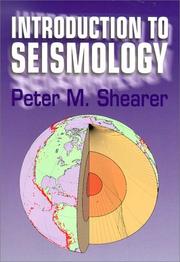
Shearer's concise text is the perfect companion, sharpening the mathematical treatment of P, S, and surface waves and introducing spectral analysis of seismograms — read after Stein to reinforce and extend the theory.
Earthquake Source Physics & Seismic Hazard
IntermediateMaster the mechanics of fault rupture, the seismic moment tensor, stress drop, and scaling relations, and understand how source parameters translate into ground-motion prediction and hazard assessment.
▸ Study plan for this stage
Pace: 8–10 weeks, ~40–50 pages/day (Scholz first: 4–5 weeks; Aki second: 4–5 weeks)
- Fault mechanics: stress, strain, friction, and the Coulomb failure criterion as the foundation for understanding when and how faults rupture
- Seismic moment tensor: definition, physical interpretation, and how it encodes the geometry and kinematics of fault slip
- Earthquake scaling relations: moment-magnitude relationships, stress drop, rigidity, and how source parameters scale with earthquake size
- Rupture dynamics and propagation: how ruptures initiate, propagate, and arrest on faults, and the role of fracture mechanics
- Seismic radiation and moment tensor inversion: how to extract source parameters from seismic waves and interpret them physically
- Stress transfer and Coulomb stress change: how earthquakes alter stress on nearby faults and influence aftershock and triggered seismicity
- Ground-motion prediction from source parameters: linking fault rupture characteristics to radiated seismic energy and peak ground motion
- Seismic hazard assessment: translating source physics into probabilistic and deterministic hazard models
- What is the Coulomb failure criterion, and how does it explain fault instability and the conditions for earthquake rupture?
- Define seismic moment (M₀) and the moment tensor. What do the six independent components of the moment tensor tell us about fault geometry and slip direction?
- How do earthquake magnitude and seismic moment relate, and what is the physical meaning of stress drop in terms of energy release and fault slip?
- Explain the scaling relations between seismic moment, fault area, average slip, and stress drop. Why do larger earthquakes not simply scale linearly?
- How is the moment tensor inverted from seismic waveforms, and what assumptions underlie this inversion?
- Describe how Coulomb stress transfer works and why it is important for understanding earthquake clustering and aftershock patterns.
- How do source parameters (moment, stress drop, rupture velocity) constrain ground-motion prediction models and seismic hazard estimates?
- Work through Scholz's derivations of the Coulomb failure criterion and stress-strain relationships for a simple fault geometry; sketch stress states on a Mohr circle and identify the critical angle for failure.
- Calculate seismic moment (M₀) from given fault parameters (area, rigidity, average slip) using M₀ = μAD, then convert to moment magnitude (Mw) and compare with observed magnitudes.
- Construct and interpret a moment tensor from synthetic seismic waveforms (or use provided data); identify the nodal planes and determine the fault plane and auxiliary plane.
- Plot and analyze earthquake scaling relations (e.g., moment vs. magnitude, stress drop vs. magnitude) using real earthquake catalogs or provided datasets; discuss deviations from simple linear scaling.
- Perform a Coulomb stress change calculation for a mainshock on a mapped fault, then predict which nearby faults are brought closer to failure; compare predictions with observed aftershock locations.
- Use Aki's formulas to estimate ground-motion amplitude (e.g., peak velocity or acceleration) from source parameters and distance; validate against observed strong-motion records.
Next up: This stage equips you with the physical understanding of how faults rupture and radiate seismic energy, setting the foundation for the next stage on wave propagation and seismic imaging, where you will learn how to extract and interpret these source parameters from real seismic data.

The definitive text on fault mechanics and earthquake physics — it connects rock friction, fault geometry, and rupture dynamics to the seismological observables introduced in the previous stage.
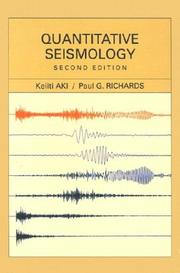
Aki & Richards is the canonical advanced reference for source theory, moment tensors, and wave propagation; reading it after Scholz means the physical intuition is already in place for its demanding mathematics.
Seismic Data Analysis & Imaging
ExpertLearn how raw seismograms are processed, how tomographic images of the Earth are constructed, and how modern computational methods extract structure and source information from seismic data.
▸ Study plan for this stage
Pace: 8–10 weeks, ~40–50 pages/day (with weekly review sessions for dense technical sections)
- Seismic trace processing: filtering, denoising, and amplitude recovery from raw field data
- Velocity analysis and stacking: how velocity models are built and used to collapse seismic reflections
- Prestack and poststack migration: principles and algorithms for imaging subsurface reflectors in their true spatial positions
- Seismic resolution, bandwidth, and wavelet theory: understanding frequency content and its effect on image quality
- 3D seismic data acquisition and processing workflows: how modern surveys are designed and processed at scale
- Tomographic inversion and velocity model building: iterative refinement of Earth structure from seismic data
- Noise and artifact removal: identifying and mitigating multiples, ghosts, and other coherent noise in processing
- Computational efficiency and modern algorithms: FFT, Kirchhoff migration, and reverse-time migration fundamentals
- What are the main steps in a typical seismic data processing workflow, and why is each step necessary?
- How do velocity analysis and normal moveout (NMO) correction work together to prepare data for stacking?
- Explain the difference between poststack and prestack migration, and when you would use each approach.
- What is the relationship between seismic resolution, frequency bandwidth, and wavelet shape?
- How does 3D seismic data processing differ fundamentally from 2D processing, and what additional challenges does it introduce?
- Describe the role of velocity model building in iterative tomographic inversion and how it improves image quality.
- Work through a synthetic 2D seismic dataset: apply filtering, NMO correction, and stacking to produce a final stack section; document how each step changes the data quality
- Perform velocity analysis on a real or synthetic CMP gather: pick velocity trends, apply NMO, and evaluate the quality of the stack
- Implement or use a standard migration algorithm (Kirchhoff or finite-difference) on a simple velocity model; compare prestack and poststack results
- Analyze a real seismic section and identify coherent noise (multiples, ghosts, ground roll); propose and test removal strategies
- Build a simple 1D or 2D velocity model using tomographic principles: start with a rough initial model and iteratively refine it using synthetic seismograms and misfit reduction
- Extract and analyze the wavelet from a seismic dataset; assess its frequency content and implications for resolution
- Process a small 3D seismic cube (or subset) through a complete workflow: trace editing, velocity analysis, migration, and final interpretation
Next up: This stage equips you with the technical foundation to understand how seismic images are created and refined; the next stage will apply these processing and imaging skills to interpret crustal and mantle structure, source mechanisms, and dynamic Earth processes.

The industry and research standard for understanding seismic processing — filtering, migration, velocity analysis, and imaging — giving the learner the practical signal-processing toolkit that complements the theoretical foundation.
Discussion
Keep reading
Paths that share books, cover the same subject, or open a related topic.