Runaways Reading Order: Where to Start Brian K. Vaughan's Marvel Series
Runaways has the best premise in twenty-first-century Marvel: six teenagers discover that their parents are the supervillain cabal that has quietly run Los Angeles for decades, and run. Brian K. Vaughan wrote it for two volumes of issues; Joss Whedon, Terry Moore and Kathryn Immonen each took a turn after him, and Rainbow Rowell relaunched it in 2017. That succession is the reason the series is confusing to buy, because Marvel renumbered it, collected it in digests, re-collected it in hardcovers, and used the same trade titles across editions. This path follows the digest numbering, which is the one that resolves cleanly here: volumes one through six are Vaughan's complete run, volume seven closes it out, and the two post-Vaughan volumes follow under their story titles rather than numbers. A caution up front: the Rowell relaunch does not resolve in our catalogue under any form we tried, and neither do the volumes after Terry Moore's, so this path covers the original series and stops where the catalogue does.
The Original Run
BeginnerRead Vaughan's first eighteen issues, the self-contained story most people mean when they say Runaways. You should finish able to name all six kids and their parents' specialities, and to explain the twist about who among them was not what they seemed.
▸ Study plan for this stage
Pace: Three books recorded at 1,116 pages between them, and the numbers deserve a look before you buy: volume one and volume two are held here at 448 pages each while volume three is 220 and every later volume in this path is 144. Our first two records are plainly larger collected editions rather than the
- The premise in one line: six teenagers discover their parents are the cabal that has quietly run Los Angeles, and run
- Each kid's inheritance — what the parents were, and what the children took with them
- The Pride as an organisation with a purpose, not just a villain group; the annual meeting is a job
- The mole plot, and the clues Brian K. Vaughan plants across the first eighteen issues
- Superheroes as a genre the book borrows from without joining — nobody here wants a costume
- Los Angeles as a setting chosen against Marvel's default New York
- Why the eighteen issues work as a closed story with a real ending
- Name all six kids and each set of parents' speciality within the Pride.
- Who among the six was not what they seemed, and at what point does the comic first make that available to a careful reader?
- What does the Pride actually want? Give their aim in their own terms rather than as villainy.
- Why does the book refuse the costume-and-codename apparatus its characters keep reaching for?
- If the series had stopped at the end of volume three, what would be unresolved — and would it matter?
- Make a two-column table as you read volume one: kid on the left, parent's speciality on the right. Fill the right column only when the comic confirms it, not when you guess it.
- After finishing volume three, go back through volume one and mark every panel that the twist retroactively changes. Vaughan plays fair; the exercise is to prove it.
- Write down, before starting volume two, which of the six you expect to leave the group. Check it at the end of volume three and work out what the book led you to think.
- Compare the opening pages of volume one with the closing pages of volume three and describe what has changed about how the six talk to each other.
Next up: Volume three is the ending the premise was built to reach, which is exactly what makes the next stage worth understanding as a deliberate restart rather than a continuation.
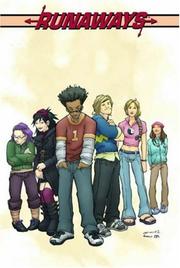
The opening: the annual charity meeting, the thing the kids see through the vent, and the decision to run. Also sold as Pride and Joy, which is a separate catalogue record for the same collection, so buy one of the two and not both.

The kids on the street, learning what they inherited and starting to use it. Also catalogued as Teenage Wasteland. Read straight on from volume one; the two are halves of one arc.
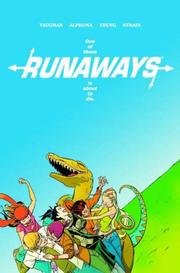
The end of the first eighteen-issue story and the volume the whole premise was built to reach. If you read only three books from this path, read these three. Also filed as The Good Die Young.
Vaughan's Second Volume
BeginnerFollow the series past its natural ending into the relaunch Vaughan wrote himself, and understand what changes — the cast reshuffles, the scope widens beyond Los Angeles, and the book starts touching the wider Marvel universe.
▸ Study plan for this stage
Pace: Four volumes at 144 pages each, 576 in total — noticeably slimmer sittings than the first stage, so a week is comfortable and four evenings is realistic. Read four, five, six and seven in order and do not shuffle them: volume six lands the series' second-best twist and almost every part of it depend
- A relaunch by the same writer: what carries over from the first eighteen issues and what is deliberately reset
- The reshuffled lineup, and what a new member costs a cast that was defined by shared history
- The widening from Los Angeles to New York and the wider Marvel universe
- Consequence as the engine — the unresolved business of volume three drives volume four
- The volume-six twist and the setup laid for it across four and five
- Volume seven as an ending written on purpose, not a cancellation
- What is different about the group after the relaunch, beyond who is in it?
- The book starts touching the rest of the Marvel universe in volume five. What does it gain, and what does it dilute?
- Reconstruct the volume-six twist from the evidence in volumes four and five. Was it available to you?
- Volume seven ends Vaughan's run. What does he close, and what does he leave open for whoever came next?
- Is the second volume a continuation or a second series wearing the same name? Argue it from the text.
- Before reading volume six, write down what you think the twist will be. Then check which specific panels in four and five you were reading, and which you had ignored.
- Track one character across volumes four to seven and note every scene where the widening Marvel setting changes what they can do.
- At the end of volume seven, list the open threads. Keep the list — the next stage is other writers picking some of them up and dropping others.
- Re-read the last page of volume three immediately after the first page of volume four and describe what the gap between them assumes you have accepted.
Next up: With Vaughan's complete run behind you and an explicit list of what he left open, you can judge the successor volumes on what they did with an inherited cast rather than on whether they felt the same.

The relaunch, with a new lineup and the consequences of volume three still unresolved. The tone shifts noticeably; this is the volume that decides whether you stay.

The New York story, and the first sustained contact with the rest of the Marvel universe. Also catalogued under its story title, Escape to New York, as a separate record of the same book.

Parental Guidance, and the volume where the series lands its second-best twist. Do not read it out of order — almost everything in it depends on volumes four and five.
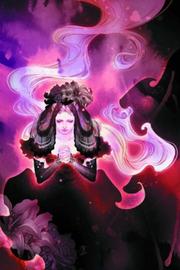
Vaughan's last volume and the end of his run. Read it before any of the successor volumes; the handover is abrupt and this is the last book with a single authorial plan behind it.
After Vaughan
IntermediateRead the two successor runs that resolve here, and be able to say what each writer did with an inherited cast — and why the series never regained its footing after the handover. This is also where the catalogue runs out, so you should know what remains unread.
▸ Study plan for this stage
Pace: Two volumes, and our records carry no page count for either — Dead End Kids Digest and Dead Wrong Digest are both digest collections of six issues, so plan a sitting each rather than a number of pages we cannot supply. A weekend covers the stage. Read Whedon's Dead End Kids first: six issues drawn b
- Inherited characters: a writer working with a cast whose rules someone else set
- Whedon's period displacement — 1907 New York as a way to isolate the team from its own continuity
- Michael Ryan's art against the house style the series had settled into
- Terry Moore arriving from creator-owned work and what he brings to work-for-hire
- Why a series can survive a change of writer more easily than a change of premise
- The boundary of this path: what remains unread and where to look for it
- What does Dead End Kids do with the cast that Vaughan never did, and is it a use the characters support?
- Which of the threads you listed at the end of volume seven do these two volumes take up, and which are quietly abandoned?
- Whedon's volume is the most self-contained in the series. Is that a strength here or an admission?
- How does Terry Moore's handling of the group's dialogue differ from Vaughan's?
- State plainly why the series never regained its footing after the handover — and separate the writing from the publishing decisions where you can.
- Take your volume-seven list of open threads and mark each one resolved, advanced or dropped across these two books.
- Pick one character and compare a page of their dialogue in volume six with a page in Dead End Kids. Read both aloud; the difference is easier to hear than to see.
- Write a one-paragraph description of what you would need to find, and under what titles, to read past Dead Wrong. Search for those titles outside this list and note which are even in print.
- Decide which of the two successor volumes you would keep if the series were being reprinted in one collection, and defend it.
Next up: Having watched Runaways change hands, the last stage returns to the writer and shows what those same instincts do when nobody else owns the characters.
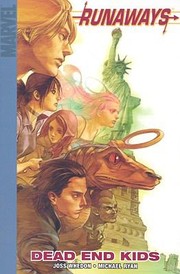
Whedon's six issues, drawn by Michael Ryan, which send the team to 1907 New York. Catalogued as Dead End Kids Digest. Divisive — it is the most self-contained thing in the series and the least connected to what came before.
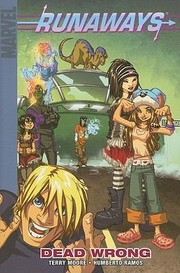
Terry Moore's run, filed here as Dead Wrong Digest, and the last volume of the original series that resolves in our catalogue. The volumes after it, including Kathryn Immonen's, and the whole of Rainbow Rowell's 2017 relaunch, return nothing under any query we tried — so if you want those, look for them by story title outside this list.
The Rest of Brian K. Vaughan
IntermediateMove on to Vaughan's creator-owned work, which is where the qualities that made Runaways good — fast dialogue, a premise stated in one sentence, plots that actually end — are least constrained.
▸ Study plan for this stage
Pace: Three books, 408 pages: Y The Last Man, Vol. 1 at 128, Pride of Baghdad at 136, and Paper girls, Vol. 1 at 144. Three sittings, a week at an unhurried pace. Take Y first — every mammal with a Y chromosome dies except one man and his monkey, and it ran sixty issues to a real ending; volume one is the
- A premise stated in one sentence, which is the constant across everything Vaughan writes
- Serial construction with an ending planned in advance — Y is the demonstration
- Dialogue speed as a signature: how much characterisation he gets from how fast people talk
- Allegory in Pride of Baghdad, and the cost of putting a political argument in the mouths of animals
- Creator-owned versus work-for-hire, and what the constraint of Marvel's universe removed from Runaways
- Chiang's colour and design in Paper girls against Henrichon's painted pages — the same writer, opposite visual strategies
- The teenage-ensemble structure recurring, and what Vaughan changes the second time
- What does Y The Last Man's first volume establish that a reader must accept before sixty issues can work?
- Pride of Baghdad is about an invasion. Does the animal allegory clarify the argument or protect it from scrutiny?
- Where is Paper girls recognisably Runaways again, and where has Vaughan deliberately changed the formula?
- Compare a page of dialogue from any of these with a page from Runaways volume two. What is the same?
- Which of these three would you hand to a Runaways reader first, and what are you assuming about them?
- Write the one-sentence premise of all four Vaughan works you have now read. Any that takes two sentences is the outlier — work out why.
- Read Pride of Baghdad twice in one evening, the second time watching only Henrichon's colour. Note where the palette does the work the script does not.
- Take the first ten pages of Paper girls and the first ten of Runaways volume one and compare how each introduces its ensemble — how many named characters, how much power exposition, how fast the plot starts.
- List what you would need to know before committing to the remaining volumes of Y and Paper girls, then check whether volume one of each told you.
Next up: This is the end of the path: you have the original series, its successors, and the writer's own work, which together are enough to say what Runaways was and why nothing after it quite replaced it.

Every mammal with a Y chromosome dies except one man and his monkey. Sixty issues with a real ending, written in parallel with Runaways and the most direct next read.
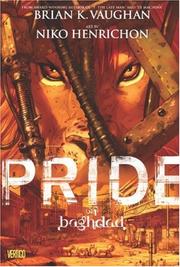
A single-volume story about four lions loose in Baghdad after the 2003 bombing, painted by Niko Henrichon. Short and completely unlike the rest; read it when you want to see what he does without a serial format.

Four newspaper delivery girls in 1988 Cleveland and a time war, drawn by Cliff Chiang. The closest he has come to writing Runaways again, and the best place to end this path.
Discussion
Keep reading
Paths that share books, cover the same subject, or open a related topic.