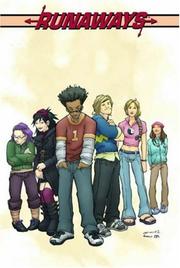
Start with Runaways Vol. 1 and read straight through to Runaways, Vol. 3. Those three books are Brian K. Vaughan's first eighteen issues, and together they are a complete story with a real ending: six Los Angeles teenagers work out at the annual family charity gathering that their parents are the supervillain cabal that has quietly run the city for decades, and they run. If you read only three books from this list, read those three.
The obvious alternative is to pick up whichever Runaways collection is nearest to hand, and that is exactly the trap this series sets. Marvel published it as digests, then as larger collected editions, then again in hardcover, and reused the same story titles across formats. Volumes one, two and three also sit in our catalogue under the story titles Pride and Joy, Teenage Wasteland and The Good Die Young — the same comics under a different record, so buy one form and not both. The page counts give the formats away: the records for Runaways Vol. 1 and Runaways, Vol. 2 both read 448 pages, against 220 for Runaways, Vol. 3 and 144 for everything after it. Those first two are collected editions, not the single digests the rest of this path follows.
The first run: volumes one to three
Runaways Vol. 1 is the charity meeting, the thing the children see through the vent, and the decision to run. Runaways, Vol. 2 has them on the street, working out what they inherited from their parents and starting to use it; it is the second half of one arc rather than a fresh start, so read it immediately. Runaways, Vol. 3 ends the eighteen-issue story and delivers the twist the whole premise was built to reach.
Vaughan's second volume: four to seven
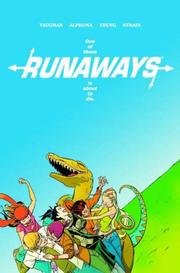
Runaways Vol. 4 is the relaunch Vaughan wrote himself, with a reshuffled lineup and the consequences of volume three still open. The tone shifts noticeably here, and this is the volume that decides whether you continue. Runaways Vol. 5 takes the team to New York and makes the first sustained contact with the wider Marvel universe; it is also filed separately under the story title Escape to New York, which is the same book again. Runaways, Vol. 6 lands the series' second-best twist and depends almost entirely on the two volumes before it, so do not read it out of sequence. Runaways Vol. 7 is Vaughan's last, and the final book with one authorial plan behind it.
After Vaughan, and where the catalogue stops
Dead End Kids Digest is Joss Whedon's six issues, drawn by Michael Ryan, which send the team to 1907 New York. It is the most self-contained thing in the series and the least connected to what came before, which is why readers split on it. Dead Wrong Digest is Terry Moore's run, and it is the last volume of the original series our catalogue holds.
Be clear about the gap: Kathryn Immonen's volume and the whole of Rainbow Rowell's 2017 relaunch return nothing in our catalogue under any form we tried. This path covers the original series and stops where the catalogue does, not where the comics do. If you want the Rowell run, search for it separately by its own story titles.
Where to stop
Two honest stopping points. After volume three you have a complete, self-contained story, and many readers are happy to leave it there. After volume seven you have all of Vaughan, which is the version of the series people are recommending when they recommend Runaways. The post-Vaughan volumes are worth reading if you liked the cast; they are not the reason the book has a reputation.
The rest of Brian K. Vaughan
The natural next read is Y The Last Man, Vol. 1 (128 pages), in which every mammal with a Y chromosome dies except one man and his monkey — sixty issues, written alongside Runaways, with an ending. Pride of Baghdad (136 pages) is a single painted volume about four lions loose in Baghdad after the 2003 bombing, unlike anything else here. Paper girls, Vol. 1 (144 pages) puts four newspaper delivery girls in 1988 Cleveland into a time war, and is the closest he has come to writing Runaways again.
The complete order, with each volume's place in the run, is at /paths/pt_ai_runaways.