Pediatrics: The Best Books on Children's Medicine, in Order
Children are not small adults, and pediatrics exists because that turned out to be a physiological fact rather than a slogan. This path is an overview of the field for students and interested readers: first what the work is like from inside, then how the specialty was built and why it became bound up with public health, and finally the clinical texts a trainee actually uses. It is not guidance for treating a child — for that, see a clinician.
What the work is
BeginnerGet an accurate picture of paediatric training and practice, including the parts of it that are surgical and neonatal, before opening a textbook.
▸ Study plan for this stage
Pace: Four to five weeks for around 1,190 pages of narrative nonfiction, all of it readable at a normal pace. Klass's A Not Entirely Benign Procedure is 270 pages, Baby Doctor 339, Musemeche's Small 244 and Humes's Baby ER 336. Read them in the order given: two memoirs of training, then paediatric surgery
- The founding premise of the specialty, which every book here assumes: children are not small adults. Their physiology, drug handling, presentation of illness and capacity to compensate all differ, and the differences are large enough to make a separate discipline necessary rather than convenient.
- Klass's subject in the first book is the acquisition of clinical detachment — the moment a person learns to see a sick child as a problem to be solved — and her ambivalence about that transformation is the reason the book has lasted.
- What Baby Doctor adds is specificity: the paediatric residency has a different structure of difficulty from general training, because the patient may not be able to give a history and the person in the room giving it is a frightened parent.
- The three-party consultation. In adult medicine the patient reports and consents; in paediatrics the history comes from a parent, the assent from the child where possible, and the consent from the guardian, and managing those three relationships is a core clinical skill rather than a soft one.
- Musemeche's argument in Small: operating on a neonate is a different discipline, not a scaled-down version of adult surgery. Fluid volumes, thermoregulation, anaesthetic tolerance and the sheer size of the structures all change what is possible.
- The neonatal intensive care unit as Humes reports it: prematurity and its complications, the technology, and the fact that the unit's capabilities have moved the boundary of viability and thereby created the ethical questions it now faces.
- The moral weight the field carries. All four books circle the same set of decisions — how aggressively to treat, who decides, what counts as a good outcome — and none of them resolve it, which is an accurate representation of the field.
- The catalogue record for Musemeche's book displays the bare title Small; it is the paediatric surgery book described here.
- What specifically does Klass describe herself losing as she acquires clinical competence, and does she conclude the trade is worth making?
- Name three ways taking a history from a child differs from taking one from an adult, and what the clinician does in each case.
- According to Musemeche, what makes neonatal surgery a distinct discipline? Give physiological reasons rather than the observation that the patient is small.
- How has the capability of the modern NICU changed the questions the unit has to answer? Use a case from Baby ER.
- Across all four books, who is described as making the decision when the right course is genuinely unclear, and does the answer differ between them?
- What did you expect paediatric practice to be like before this stage, and which specific passage corrected you?
- Keep a running list of every clinical term the four books use without defining it. That list is your vocabulary target for the clinical stage and it is more useful than any glossary because it is what these authors assume.
- Take one case from Baby ER and write it up in the structure a clinician would use: presentation, findings, differential, course. You will not get it right; the exercise is finding out what you cannot yet supply.
- Write a paragraph on a decision in any of the four books where you disagree with what was done, stating the competing considerations fairly before giving your view.
- List the questions you would want answered before opening a textbook. Keep the list and check it at the end of stage four to see which the path answered and which it did not.
Next up: You have the culture of the field from inside; the next stage explains why it exists as a separate field at all, which the practitioners in these books take entirely for granted.
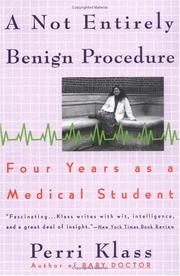
Klass wrote this as a medical student and it remains one of the best accounts of the moment a person learns to look at a sick child as a clinical problem. Read it first; everything later in the path is easier once you have the culture.

The sequel, covering her paediatric residency. Where the first book is about becoming a doctor, this one is specifically about becoming a paediatrician — the different questions, the parents in the room, the children who do not get better.

Paediatric surgery from a surgeon, and the clearest lay explanation of why operating on a neonate is a different discipline rather than a smaller version of the same one. The catalogue record displays the bare title 'Small'.
A year inside a neonatal intensive care unit, reported rather than remembered. It gives you the NICU as a place before the clinical stage gives you it as a body of knowledge.
How the specialty was built
IntermediateExplain why paediatrics separated from general medicine, and what that separation was for professionally as well as clinically.
▸ Study plan for this stage
Pace: Three to four weeks for 475 pages of academic history. Halpern's American Pediatrics, subtitled The Social Dynamics of Professionalism, is 228 pages; Baker's The Machine in the Nursery is 247. Both are university-press monographs with argument and apparatus rather than narrative drive, so read them
- Halpern's central argument: paediatricians constructed a specialty, and the claim that children are physiologically distinctive was both clinically true and professionally useful. Holding both halves of that at once is the intellectual work of this stage.
- Professionalisation as a process with visible components — boards, certification, journals, training requirements, control over who may claim the title — and the ability to identify each of those in a specialty's history.
- Why paediatrics separated from general practice when it did, and what the early specialty actually did for a living, which was substantially well-child care and prevention rather than the management of serious disease.
- The tension inside the field between prevention and acute care, which Halpern traces and which explains the shape of the next stage of this path.
- Baker's history of the incubator: technology moving from sideshow exhibits of premature infants to hospital equipment to the organising centre of a subspecialty. The route is not the one a linear progress account would predict.
- Technology creating a specialty rather than serving one. Neonatology exists in its modern form because the equipment made a previously untreatable population treatable, and the specialty organised itself around that capability.
- The boundary of viability as a moving, technology-dependent line, and the ethical questions that follow from a boundary that moves. Baker gives the historical version of what Humes reported as present-tense practice.
- How to read an institutional history critically: both authors are arguing against a self-congratulatory internal account of the field, and you should be able to say what that account claims and where the evidence goes against it.
- State Halpern's thesis in one sentence, then state the strongest objection to it. Which does the evidence in the book support?
- What did early paediatricians actually spend their time doing, and how does that differ from what a lay reader assumes a children's doctor does?
- Trace the incubator from exhibit to standard equipment. At which step does it become medical rather than spectacle, and what makes that step the boundary?
- How does the availability of a technology change the ethical questions a specialty faces? Answer using Baker rather than in the abstract.
- Halpern says a professional claim can be simultaneously true and self-serving. Give an example from paediatrics and explain how you would tell the two components apart.
- How does Baker's history change your reading of the NICU as Humes described it in the previous stage?
- Build a timeline of paediatric professionalisation from Halpern, marking each institutional milestone — society, journal, board, training requirement — and what capability it secured for the profession.
- Take one claim about children's distinctiveness that early paediatricians made and assess it twice: as a clinical claim and as a professional one. Write both assessments out.
- Compare Baker's account of the NICU's origins with Humes's present-tense reporting and write a page on what has and has not changed.
- Find the current professional requirements to practise paediatrics in your country and map them onto Halpern's framework. Which components does he identify that are still there?
Next up: Halpern showed that prevention was central to what paediatrics claimed for itself; the next stage takes up the largest preventive programme the field runs and the controversy that has attached to it.

Subtitled 'The Social Dynamics of Professionalism'. Halpern's history of how paediatricians constructed a specialty — and how their claims about children's distinctiveness were both clinically true and professionally useful. The best single answer to 'why does this field exist separately'.
The history of the incubator and of neonatal intensive care, from sideshow exhibits to the modern NICU. It is the concrete case study that Halpern's argument needs, and it pairs directly with Baby ER.
Children's health as public health
IntermediateUnderstand why so much of paediatric practice is preventive, and be able to describe the vaccine controversies accurately enough to explain them to someone who is worried.
▸ Study plan for this stage
Pace: Two to three weeks for 552 pages, both books by the same author and both readable at pace. Offit's Vaccinated is 254 pages and is history; Autism's False Prophets is 298 and is argument. Read them in that order — the history is the necessary background to the dispute. Read both knowing what Offit is
- Why so much of paediatric practice is preventive rather than curative — the burden of childhood illness was historically dominated by infectious disease, and the interventions that moved the numbers were population-level.
- Vaccine development as Offit tells it through Maurice Hilleman: the actual laboratory work of attenuation, the scale of what was achieved, and how little of it is publicly known.
- Herd immunity as a threshold phenomenon, and why individual and collective decisions come apart: a coverage level high enough to protect a community can be reached while any given individual's decision looks free of consequence.
- The MMR-autism claim: the retracted 1998 paper, the mechanism it proposed, the epidemiological studies that followed, and the specific reasons the claim did not survive them.
- Why a retraction does not end a controversy. Offit's account of the aftermath is largely about media dynamics, litigation and trust rather than about evidence, and that is the durable lesson of the book.
- Distinguishing types of vaccine concern. A worry about schedule, a worry about a specific ingredient, a worry about a specific vaccine and a general opposition are different positions with different evidence bearing on them, and treating them as one thing is a failure of both accuracy and persuasion
- Offit is a participant in the dispute he is describing. He has been personally attacked in it, and that shows in the tone; the epidemiology he reports stands independently of how he characterises his opponents.
- How to explain risk to a worried parent, which is the practical skill this stage is for: absolute rather than relative risk, honest acknowledgement of genuine adverse effects and their rates, and no overstatement of certainty.
- Describe the development of one vaccine from Hilleman's work in the detail Offit gives. What was the technical problem and how was it solved?
- Explain herd immunity quantitatively enough to say why the threshold differs between diseases.
- What did the 1998 paper claim, what was wrong with it, and what evidence subsequently addressed the claim? Separate the misconduct from the epidemiology.
- Why did the controversy persist after retraction? Give at least three mechanisms Offit identifies.
- Where does Offit's status as a participant show in Autism's False Prophets, and does it affect the reliability of any specific claim he makes?
- Draft what you would actually say to a parent who is not opposed to vaccination but is worried about the schedule. Where does the honest answer include uncertainty?
- Take one vaccine and write a one-page factual summary: what it prevents, the pre-vaccine burden of that disease, the current schedule, and the known adverse effects with their rates. Cite the source of each number.
- Separate the strands of the MMR dispute into a table — the specific claim, the evidence for it, the evidence against, the outcome. Doing this on paper is what makes the case explainable later.
- Write the strongest version of a parental concern about vaccination that is not answered by simply citing the MMR studies, then write an honest response to it.
- Rewrite one passage of Autism's False Prophets where you think Offit's tone weakens his case, keeping every factual claim intact. The exercise is separating the evidence from the advocacy.
Next up: You have the preventive half of paediatrics and the public argument around it; the next stage moves to the clinical core, where the field is a body of knowledge rather than a policy.

Offit is a paediatric infectious-disease physician and vaccine developer. This is the history of vaccine development told through Maurice Hilleman, and the necessary background before the argument book that follows.

The account of the MMR-autism claim, from the retracted 1998 paper to its aftermath. Offit is a participant in this dispute, not a neutral historian, and the book is more useful when you read it knowing that.
The clinical core
IntermediateWork through the standard teaching texts until you can take a paediatric history, recognise the common presentations by system, and read a growth chart properly.
▸ Study plan for this stage
Pace: Six to nine months, and this is where the path becomes a course rather than a reading list. Lissauer and Carroll's Illustrated Textbook of Paediatrics is 600 pages, Marcdante's Nelson Essentials of Pediatrics 831, the Zitelli and Davis atlas 1,032 and Neonatology at a Glance 224 — around 2,690 pages
- The paediatric history and examination as a distinct skill: the history is usually from a parent, the examination is opportunistic and order-flexible with a small child, and the approach changes substantially between neonate, toddler, school-age child and adolescent.
- Growth and development as the field's continuous background measure. Reading a growth chart properly — plotting, centiles, velocity across time rather than a single point, and what crossing centiles does and does not indicate — is the single most transferable technical skill in this stage.
- Developmental milestones and the concept of red flags: what is normal variation, what warrants surveillance, and what warrants referral. Lissauer is unusually clear on this and it is worth learning from him specifically.
- The common presentations by system — respiratory, gastrointestinal, febrile illness, rashes, seizures — and the paediatric differential for each, which differs markedly from the adult differential for the same complaint.
- The sick child versus the unwell child. Recognising serious illness in a child who compensates well until they suddenly do not is the recurring theme of the whole clinical literature, and it is a pattern-recognition skill rather than a knowledge one.
- Why Zitelli is a different kind of book: photographic diagnosis trains the eye. Rashes, dysmorphic features and injury patterns are recognised visually, and no verbal description substitutes for having seen a hundred images.
- Weight-based dosing and the physiological reasons behind it — altered volume of distribution, immature hepatic and renal clearance in neonates — which is the concrete form of the claim that children are not small adults.
- Neonatal medicine as its own body of knowledge: prematurity and its complications, respiratory distress, jaundice and its assessment, and resuscitation at birth. This is the clinical counterpart to the history and the reportage you read in the first two stages.
- Marcdante is the condensed Nelson written for clerkships, and moving from Lissauer to Marcdante is the point at which the vocabulary of the field becomes yours rather than something you are translating.
- Describe how you would structure a paediatric history, and how the structure changes for a two-year-old versus a fifteen-year-old.
- Given a growth chart with a child crossing two centile lines downward over a year, what does that pattern suggest and what would you want to know next?
- For fever in a young child, give the differential by system and name the features that would move a presentation from routine to urgent.
- What are the physiological reasons paediatric drug dosing is weight-based, and where does that rule break down?
- Take three rashes from Zitelli and describe each in words precisely enough for someone else to recognise it. Where does verbal description fail?
- Name the major complications of prematurity by system, and say which are managed and which are prevented.
- Work one body system per week across all three main texts: read Lissauer, then the Marcdante chapter, then find every relevant image in Zitelli. Write a one-page summary per system from memory afterwards.
- Practise growth charts until it is automatic: plot twenty sets of made-up serial measurements, including at least five abnormal patterns, and state the interpretation for each.
- Build a personal image atlas from Zitelli — condition, distinguishing features, what it is confused with — for the presentations that are recognised rather than reasoned.
- Make a milestone reference table by age band, with red flags marked. Then test yourself on ages rather than reading it.
- Take Neonatology at a Glance as a block and write out the assessment and immediate management of the three commonest neonatal presentations it covers, then compare with what Humes described happening in Baby ER.
Next up: You now have a working command of the teaching texts, which is precisely the level at which the definitive references become useful — as things to search rather than to read.

The Lissauer and Carroll text is the friendliest genuine textbook in the field — heavily illustrated, systems-based, and the standard first book on many UK undergraduate courses. Start the clinical stage here rather than with Nelson.

The condensed Nelson, written for clerkships. It is the bridge between an illustrated undergraduate text and the full reference, and the point at which the vocabulary of the field becomes yours.

Photographic diagnosis — rashes, syndromes, injuries — and the book that trains the eye rather than the memory. Use it alongside Marcdante, not after.
Newborn medicine as its own body of knowledge: prematurity, respiratory distress, jaundice, resuscitation. Short, and the clinical counterpart to Baby ER and The Machine in the Nursery.
The reference shelf
IntermediateKnow what the definitive references contain and how to use them for a specific question rather than reading them through.
▸ Study plan for this stage
Pace: Ongoing rather than time-boxed, and the only stage on this path not meant to be read through. The Nelson Textbook of Pediatrics runs to 3,147 pages and nobody reads it cover to cover; The Harriet Lane Handbook is 775 pages of pocket-sized dosing, protocols and reference values, written and revised b
- The structure of Nelson: how it is organised, how the index and cross-references work, and how a specific condition is found in under a minute. This is the actual skill and it is learned by practising retrieval, not by reading.
- What a definitive reference is for. Nelson answers a specific question at depth — mechanism, presentation, evidence, management — and is the wrong tool for learning a field, which is why it sits after the teaching texts rather than before them.
- The difference in kind between Nelson and Harriet Lane: one is comprehensive and explanatory, the other is procedural and immediate. A trainee carries the second and consults the first.
- Reference values in children are age-dependent across the board — vital signs, laboratory ranges, developmental norms — and looking them up rather than trusting memory is correct practice rather than a weakness.
- That Harriet Lane is written and revised by residents is itself informative: it is a record of what the people doing the work need at hand, which is a fair description of the day-to-day content of the discipline.
- The currency problem with any reference: guidelines change, editions differ, and knowing which edition you are holding and what has been superseded is part of using these books competently.
- How this stage closes the path. The first stage gave you the culture, the second the institutional history, the third the public-health argument, the fourth the clinical knowledge, and this one shows you the tools that knowledge is actually deployed through.
- The limits of book learning in a clinical field, stated plainly: everything here is background for supervised practice, and no reading list produces the pattern recognition or the judgement that supervised clinical work does.
- How is Nelson organised, and what is your route from a symptom to the relevant section?
- For which kinds of question is Harriet Lane the right book and Nelson the wrong one, and vice versa?
- Why are paediatric reference values age-banded, and what goes wrong if adult ranges are applied?
- Pick a condition you met in Lissauer and find it in Nelson. What does Nelson add, and was any of it necessary at your level?
- Looking back across the whole path, which stage did most to change how you understand the field, and why that one?
- Run timed retrieval drills: write ten specific clinical questions, then answer each from Nelson while timing yourself. Repeat until the time stops falling. That plateau is the skill.
- Learn the layout of Harriet Lane by navigating to five different section types — a dosing table, a reference range, a protocol, a formulary entry, an appendix — without using the index.
- Take one condition and follow it across the whole path: how it appeared in the memoirs, how the teaching texts present it, and what Nelson adds. Write the three versions side by side.
- Check the edition of each reference you are using and identify one area where guidance has changed since. This is the habit that keeps a reference shelf honest.
- Write a final page on what this path has and has not given you. If the answer to the second half is not substantially longer, reread the framing at the top of stage one.
Next up: This is the end of the path: you have the field as a culture, as an institution, as a public-health programme, as a body of clinical knowledge and as a working reference shelf — an overview of the discipline, and not a licence to practise any part of it.
The reference standard of the field, and not a book anyone reads cover to cover. Learn its structure so you can find a condition in it quickly; that skill is the actual deliverable of this stage.

The pocket manual written and revised by Johns Hopkins residents — dosing, protocols, reference values. It is what is actually in a paediatric trainee's coat, and it shows you what the day-to-day of the discipline is made of.
Discussion
Keep reading
Paths that share books, cover the same subject, or open a related topic.