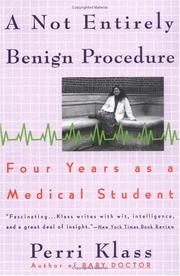
If you are a general reader, start with A Not Entirely Benign Procedure. Perri Klass wrote it as a medical student, and it is still one of the best accounts anywhere of the moment a person learns to look at a sick child as a clinical problem. If you are a clinical student, start instead with Illustrated Textbook of Paediatrics — the Lissauer and Carroll book is the friendliest genuine textbook in the field, heavily illustrated and systems-based, and it is the standard first text on many UK undergraduate courses.
One thing plainly, once. This is an overview of a discipline for students and interested readers, not guidance for treating a child. Even the clinical texts here are teaching material read under supervision; a sick child is a clinician's problem, and nothing on this list changes that. And a second warning specific to this subject: pediatric references date faster than almost any other medical literature, because dosing, immunisation schedules and resuscitation protocols are revised on a cycle of a few years.
What the work is
Baby doctor is Klass's sequel, covering her paediatric residency. Where the first book is about becoming a doctor, this one is about becoming a paediatrician specifically — different questions, parents in the room, and the children who do not get better. Small, filed under the bare title, is Catherine Musemeche on paediatric surgery, and the clearest lay explanation of why operating on a neonate is a different discipline rather than a scaled-down version of adult surgery. Baby ER is Edward Humes reporting a year inside a neonatal intensive care unit, and it gives you the NICU as a place before the clinical books give it to you as a body of knowledge.
How the specialty was built, and why it became public health
American pediatrics, subtitled The Social Dynamics of Professionalism, is Sydney Halpern's history of how paediatricians constructed a specialty, and of how their claims about children's distinctiveness were both clinically true and professionally useful. It is the best single answer to why this field exists separately at all. The machine in the nursery is Jeffrey Baker on the incubator and the origins of neonatal intensive care — from sideshow exhibits to the modern NICU — and it is the concrete case study Halpern's argument needs.
Then two by Paul Offit, who is a paediatric infectious-disease physician and a vaccine developer. Vaccinated is the history of vaccine development told through Maurice Hilleman, and the necessary background for what follows. Autism's false prophets is his account of the MMR-autism claim from the retracted 1998 paper onward. Offit is a participant in that dispute rather than a neutral historian, and he has been a target in it; the book is more useful when you read it knowing that.
The clinical core, and the edition problem
This is where the dates matter, so check them before you buy. Our catalogue record for Illustrated Textbook of Paediatrics is a 2007 printing, Nelson essentials of pediatrics is 2011, Zitelli and Davis' Atlas of Pediatric Physical Diagnosis is 2012, Neonatology at a glance is 2011, Nelson textbook of pediatrics is 2007 and The Harriet Lane Handbook is a 1996 printing. Every one of those titles has been through multiple editions since. Treat the records here as identifying the right book, then buy the newest edition you can — for the Harriet Lane in particular, which exists to give you current dosing, an old copy is worse than no copy.
With that said, the sequence is straightforward. Lissauer and Carroll first. Then Nelson essentials of pediatrics, the condensed Nelson written for clerkships, which is the bridge between an illustrated undergraduate text and the full reference and the point where the vocabulary becomes yours. Use Zitelli and Davis' Atlas of Pediatric Physical Diagnosis alongside it rather than after: photographic diagnosis of rashes, syndromes and injuries trains the eye, which no prose text does. Neonatology at a glance covers newborn medicine as its own body of knowledge — prematurity, respiratory distress, jaundice, resuscitation — and is short.
The reference shelf
Nelson textbook of pediatrics runs to several thousand pages and is not a book anyone reads through. Learn its structure so you can find a condition in it quickly; that navigational skill is the actual deliverable. The Harriet Lane Handbook is the pocket manual written and revised by Johns Hopkins residents — dosing, protocols, reference values — and it is what is genuinely in a trainee's coat pocket. Reading it tells you more about the day-to-day shape of the discipline than any memoir does. For the institutional side of all this, the hospital medicine hub covers the setting these books take for granted.
Follow the full path in order and the field will read as one subject rather than as a shelf.
Follow the full ordered path here: Pediatrics Books: A Reading Order for Students and Curious Readers.