Thermodynamics: a reading path from heat and energy to entropy
This curriculum builds thermodynamic mastery in four tightly sequenced stages, starting from physical intuition and classical laws, then advancing through formal thermodynamic theory, statistical mechanics, and finally the deep mathematical and conceptual frontiers of entropy and irreversibility. Because the learner starts at an intermediate level, the path skips purely introductory material and instead opens with books that sharpen physical intuition before demanding rigorous formalism.
Physical Intuition & Classical Foundations
IntermediateBuild a vivid, concrete understanding of the four laws of thermodynamics — temperature, heat, work, and entropy — through physical reasoning before encountering heavy formalism.
▸ Study plan for this stage
Pace: 4–5 weeks, ~40–50 pages/day. Start with "The Second Law" (3 weeks, ~30 pages/day) for conceptual grounding, then move to "Thermodynamics, An Engineering Approach" (2 weeks, ~50 pages/day) for applied reinforcement and problem-solving.
- The zeroth law of thermodynamics and the concept of thermal equilibrium as the foundation for defining temperature
- Heat as energy transfer due to temperature difference, distinct from internal energy and work
- Work as organized energy transfer through mechanical, electrical, or other macroscopic means
- The first law of thermodynamics as energy conservation: ΔU = Q - W, and its physical meaning in closed and open systems
- The second law of thermodynamics: entropy increases in isolated systems, and why spontaneous processes are irreversible
- Entropy as a measure of disorder and unavailable energy, not merely randomness
- The third law of thermodynamics and absolute zero as a limiting concept
- The four laws as a unified framework: zeroth (equilibrium), first (energy), second (direction), third (limits)
- Explain the zeroth law of thermodynamics and why it is necessary before defining temperature rigorously.
- What is the physical difference between heat and internal energy? Why is this distinction crucial?
- State the first law of thermodynamics in words and mathematical form. How does it apply differently to closed versus open systems?
- Why does the second law imply that some processes are irreversible? What role does entropy play in determining the direction of spontaneous change?
- How does Atkins' narrative explanation of entropy in 'The Second Law' differ from a purely mathematical treatment, and why is this intuition important?
- Given a real-world thermodynamic process (e.g., a gas expanding, a cup cooling), identify which laws apply and predict the direction of change.
- After reading Atkins' chapters on the second law, write a one-page explanation of entropy using only everyday language and a concrete analogy (e.g., a shuffled deck of cards, a room filling with perfume). Avoid equations.
- Work through 5–8 first-law problems from Çengel's textbook involving closed systems (rigid containers, pistons) and calculate ΔU, Q, and W for each. Verify energy balance.
- Sketch energy flow diagrams for three different processes: (1) a heat engine, (2) a refrigerator, and (3) a throttling process. Label Q, W, and ΔU for each.
- Conduct a simple home experiment: measure the temperature of hot water cooling in a room over 30 minutes. Plot T vs. time and explain why the cooling rate slows using the second law and entropy concepts.
- Solve 4–6 problems from Çengel involving entropy calculations for reversible and irreversible processes. Compare results and explain physical meaning.
- Create a concept map linking the four laws of thermodynamics, showing how each builds on or constrains the others. Include real-world examples for each law.
Next up: This stage equips you with intuitive mastery of the four laws and their physical meaning, preparing you to tackle the mathematical formalism (partial derivatives, Gibbs free energy, Maxwell relations) and advanced applications (phase transitions, chemical reactions, cycles) in the next stage.

Atkins presents entropy and the second law with remarkable clarity and visual intuition, making it the ideal first read to cement why energy has a direction and what entropy physically means.

Grounds the four laws in concrete cycles, devices, and worked examples, giving the intermediate learner a firm quantitative grip on heat, work, and efficiency before moving to abstract theory.
Rigorous Classical Thermodynamics
IntermediateMaster the formal mathematical structure of classical thermodynamics — potentials, Maxwell relations, phase equilibria, and the criteria for equilibrium — at the level of a physics or chemistry graduate student.
▸ Study plan for this stage
Pace: 8–10 weeks, ~40–50 pages/day (Fermi: 2–3 weeks; Callen: 5–7 weeks). Fermi is dense and foundational; Callen is longer and more comprehensive. Allocate extra time for Callen's chapters on thermodynamic potentials and stability conditions.
- The first and second laws as mathematical constraints: internal energy U(S,V,N) and entropy S(U,V,N) as fundamental equations of state
- Legendre transformations and thermodynamic potentials: H, F, G, and their natural variables and conjugate pairs
- Maxwell relations: deriving and applying cross-derivative identities to connect measurable quantities (Cp, Cv, α, κ)
- Conditions for equilibrium and stability: convexity of U, concavity of S, and second-order stability criteria (Callen's Chapter 8)
- Phase equilibria and phase transitions: Clausius-Clapeyron equation, coexistence curves, and the role of chemical potential
- Chemical potential and Gibbs-Duhem relation: understanding intensive-extensive relationships and constraints on independent variables
- Thermodynamic response functions: relating abstract potentials to laboratory measurements (heat capacities, compressibility, thermal expansion)
- Fermi's axiomatic approach vs. Callen's rigorous formalism: recognizing how different presentations unify the same underlying structure
- Starting from the fundamental equation U = U(S,V,N), derive the Helmholtz free energy F(T,V,N) via Legendre transformation and explain why it is the natural potential for isothermal processes.
- State the four Maxwell relations for H, F, and G, and use one to relate (∂Cp/∂P)_T to measurable properties of a substance.
- What are the conditions for thermodynamic stability in terms of second derivatives of the fundamental equation? How do they differ for U(S,V,N) versus S(U,V,N)?
- Derive the Clausius-Clapeyron equation from the condition of phase coexistence (equality of chemical potentials) and explain its physical meaning.
- How does the Gibbs-Duhem relation constrain the number of independent intensive variables in a single-phase system with C components?
- For a van der Waals gas, identify the spinodal and binodal curves, and explain the difference between mechanical and thermodynamic stability.
- Work through Fermi's derivation of the fundamental thermodynamic relation dU = TdS − PdV + μdN; then re-derive it using Callen's approach and compare the pedagogical differences.
- Construct a Legendre transformation table: starting from U(S,V,N), systematically generate H, F, G, and Ω, writing out all natural variables and conjugate pairs for each.
- Derive all four Maxwell relations for a single-component system and verify one experimentally using tabulated data (e.g., water or an ideal gas).
- Solve a phase equilibrium problem: given the Clausius-Clapeyron equation and vapor pressure data, calculate the latent heat of vaporization and compare to literature values.
- Analyze the stability of a van der Waals gas: plot the spinodal curve (∂P/∂V)_T = 0 and binodal curve (coexistence), and identify the critical point.
- Prove the Gibbs-Duhem relation (SdT − VdP + Σ N_i dμ_i = 0) from the Euler relation and explain its constraint on the degrees of freedom in a multicomponent system.
Next up: This stage establishes the rigorous mathematical framework and equilibrium criteria that are essential for the next stage, which will likely extend these principles to non-equilibrium processes, open systems, or applications to real materials and phase diagrams.

Fermi's legendary concise lectures strip thermodynamics to its logical skeleton; reading it after the intuition stage reveals the axiomatic power of the classical framework without unnecessary padding.

The canonical graduate-level text that derives all of thermodynamics from postulates; its postulational approach and thorough treatment of potentials and stability is the gold standard for deep classical understanding.
Statistical Mechanics — The Microscopic Foundation
ExpertUnderstand how macroscopic thermodynamic laws emerge from the statistics of microscopic states, mastering ensembles, partition functions, and the Boltzmann connection to entropy.
▸ Study plan for this stage
Pace: 12–14 weeks, ~40–50 pages/day (Huang: ~350 pages over 5–6 weeks; Pathria: ~450 pages over 6–7 weeks, with overlap review)
- Microcanonical ensemble: isolated systems with fixed energy, entropy as logarithm of accessible microstates (Ω), and the fundamental connection S = k_B ln(Ω)
- Canonical ensemble: systems in thermal contact with a heat bath, Boltzmann distribution e^(−βE), and the partition function Z as the central generating function
- Grand canonical ensemble: open systems with variable particle number, chemical potential μ, and the grand partition function Ξ
- Partition function as bridge: how Z encodes all thermodynamic information (free energy, entropy, pressure, heat capacity) through derivatives
- Boltzmann's H-theorem and ergodic hypothesis: how microscopic reversibility and ensemble averaging connect to macroscopic irreversibility and equilibrium
- Phase transitions and critical phenomena: how ensemble formalism reveals discontinuities in thermodynamic functions and scaling behavior near criticality
- Quantum statistical mechanics: density of states, Fermi–Dirac and Bose–Einstein distributions, and how quantum statistics emerge from the partition function framework
- Fluctuations and response functions: relating microscopic fluctuations to macroscopic susceptibilities and compressibilities via the fluctuation–dissipation theorem
- Derive the Boltzmann distribution from the microcanonical ensemble assumption and explain why it emerges as the probability of a microstate in the canonical ensemble.
- Given a partition function Z(β, V, N), show how to extract the Helmholtz free energy, entropy, internal energy, and pressure. Why is Z the fundamental object?
- Explain the physical meaning of the microcanonical, canonical, and grand canonical ensembles. When is each appropriate, and what constraints define each?
- Starting from S = k_B ln(Ω), connect Boltzmann's microscopic definition of entropy to the thermodynamic entropy and the second law of thermodynamics.
- Derive the grand canonical partition function Ξ and show how to obtain the average particle number ⟨N⟩ and chemical potential from it.
- Explain how the canonical ensemble partition function Z relates to the microcanonical density of states ρ(E). What is the physical interpretation of this relationship?
- Work through Huang's derivation of the Boltzmann distribution from first principles (Ch. 2–3); then re-derive it independently without notes, explaining each step.
- Calculate the partition function for a classical ideal gas in the canonical ensemble (Huang, Ch. 4). Verify that it yields the correct equation of state pV = NkT and heat capacity.
- Solve a quantum system (e.g., harmonic oscillator or spin-1/2 in a magnetic field) using both microcanonical and canonical ensembles; compare results and discuss the equivalence of ensembles.
- Using Pathria's treatment, derive the Fermi–Dirac and Bose–Einstein distributions from the grand canonical ensemble. Apply to a free electron gas and compare with classical Maxwell–Boltzmann limit.
- Compute the partition function and thermodynamic functions for a van der Waals gas (Pathria, Ch. 9) or a simple lattice model; identify signatures of phase transitions.
- Verify the fluctuation–dissipation theorem for a specific system (e.g., isothermal compressibility κ_T related to density fluctuations); calculate both sides explicitly.
Next up: This stage establishes the mathematical machinery and conceptual foundation—ensembles, partition functions, and the Boltzmann–entropy link—that enables the next stage to apply statistical mechanics to real physical systems (gases, liquids, solids, quantum systems) and to understand phase transitions, critical phenomena, and transport properties from first principles.

A rigorous yet readable bridge from classical thermodynamics to statistical mechanics; its careful treatment of ensembles and the H-theorem directly connects to the entropy intuition built in earlier stages.
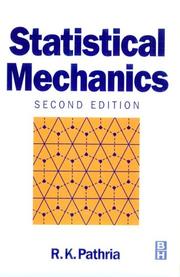
The definitive advanced reference for partition functions, quantum statistics, and phase transitions; reading it after Huang consolidates and extends the statistical framework to its full depth.
Entropy, Irreversibility & the Frontiers
ExpertDevelop a profound, modern understanding of entropy — its arrow of time, its informational meaning, and its role in irreversible processes — synthesizing everything into a unified worldview of how energy governs physical reality.
▸ Study plan for this stage
Pace: 8–10 weeks, ~25–30 pages/day, with 2–3 days per week for reflection and problem-solving. Begin with de Groot's non-equilibrium framework (weeks 1–5), then transition to Bridgman's philosophical synthesis (weeks 6–8), with final 1–2 weeks for integration and advanced applications.
- Entropy production and dissipation in non-equilibrium systems: how de Groot formalizes the rate of entropy generation and its connection to irreversible processes
- The arrow of time and irreversibility: understanding why entropy increase defines the direction of physical processes and how this emerges from microscopic dynamics
- Entropy as information and disorder: reconciling thermodynamic entropy with statistical mechanics and information theory, bridging classical and modern interpretations
- Phenomenological laws and transport coefficients: how de Groot derives constitutive relations (Onsager relations, coupling effects) that govern real-world irreversible phenomena
- Bridgman's operational and empirical philosophy: learning to ground thermodynamic concepts in measurable, reproducible operations rather than abstract ideals
- Unified worldview of energy governance: synthesizing entropy, work, heat, and information into a coherent picture of how energy constrains and drives all physical reality
- Non-equilibrium steady states and dissipative structures: recognizing how systems far from equilibrium can maintain order through continuous energy dissipation
- Limits of classical thermodynamics and modern frontiers: identifying where classical theory breaks down and how modern statistical mechanics, quantum effects, and information theory extend our understanding
- How does de Groot define entropy production rate, and what is its physical significance in irreversible processes?
- Explain the connection between the second law of thermodynamics and the arrow of time. Why does entropy increase define the direction of spontaneous processes?
- What are Onsager reciprocal relations, and how do they constrain the coupling between different transport processes in non-equilibrium systems?
- How does Bridgman's operational approach to thermodynamics differ from more abstract formulations, and what advantages does it offer?
- Reconcile the thermodynamic definition of entropy (macroscopic, statistical) with its informational interpretation. What does entropy tell us about disorder and missing information?
- Describe a non-equilibrium steady state and explain how dissipative structures can maintain local order while global entropy increases.
- What are the fundamental limitations of classical thermodynamics, and how do modern theories (statistical mechanics, quantum mechanics, information theory) overcome them?
- Work through de Groot's derivation of the entropy production tensor and calculate entropy generation rates for 2–3 concrete examples (e.g., heat conduction in a rod, viscous flow, diffusion in a mixture).
- Derive the Onsager reciprocal relations for a coupled transport system (e.g., thermoelectric effects) and verify that the phenomenological matrix is symmetric.
- Construct a detailed energy balance and entropy balance for a non-equilibrium steady-state process (e.g., a heated fluid in a gravity field) and show how entropy production relates to dissipation.
- Read and critically annotate Bridgman's key chapters on operational definitions; write a 2–3 page reflection on how his philosophy challenges or clarifies your understanding of entropy.
- Solve 5–8 problems from de Groot involving entropy production in multi-component systems, chemical reactions, or coupled phenomena; compare your results with published solutions.
- Create a concept map linking entropy, irreversibility, information, energy dissipation, and the arrow of time; use it to explain the unified worldview to someone unfamiliar with thermodynamics.
Next up: This stage establishes entropy and irreversibility as the fundamental principles governing energy flow and physical change, positioning you to explore how these principles apply to specific domains—whether biological systems, cosmology, quantum mechanics, or information technology—where the interplay of energy, entropy, and information becomes concrete and transformative.

Extends thermodynamics beyond equilibrium into irreversible processes and transport phenomena, revealing the full scope of the second law in systems that evolve in time.
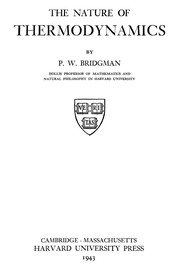
A Nobel laureate's deep philosophical and operational examination of what thermodynamic concepts truly mean, providing the reflective capstone that transforms technical knowledge into genuine understanding.
Discussion
Keep reading
Paths that share books, cover the same subject, or open a related topic.