The Best Books on Occupational Health and Safety
This curriculum builds from core safety concepts and regulatory literacy up through professional-grade risk assessment, hazard control, and safety management systems. Each stage assumes mastery of the previous one, so a beginner can progress steadily toward the knowledge base expected of a certified OHS professional (e.g., ASP, CSP, or NEBOSH).
Foundations: Safety Thinking & OSHA Basics
BeginnerUnderstand the language of occupational health and safety, the purpose of OSHA regulations, workers' rights and employer duties, and the basic logic of hazard recognition.
▸ Study plan for this stage
Pace: 4–5 weeks, ~25–30 pages/day
- Occupational health and safety as a discipline: definition, scope, and historical evolution
- OSHA's regulatory framework: the OSH Act, standards, and enforcement mechanisms
- Workers' rights under OSHA: right to know, right to refuse unsafe work, and right to participate in safety decisions
- Employer duties and responsibilities: hazard assessment, controls, training, and recordkeeping
- Hazard recognition fundamentals: identifying physical, chemical, biological, and ergonomic hazards in workplaces
- The hierarchy of controls: elimination, substitution, engineering controls, administrative controls, and PPE
- Workplace inspection procedures and how to read OSHA citations and penalties
- The role of occupational health professionals and safety culture in preventing workplace injuries and illnesses
- What are the key differences between occupational health and occupational safety, and why does OSHA address both?
- What are the main provisions of the Occupational Safety and Health Act of 1970, and what rights and duties does it establish?
- How do you systematically recognize and classify hazards in a workplace using LaDou's framework?
- What is the hierarchy of controls, and why is it the preferred approach to hazard mitigation rather than relying solely on personal protective equipment?
- What are workers' rights under OSHA, and what protections exist against retaliation?
- What are the typical steps in an OSHA inspection, and what do citations and penalties indicate about employer compliance?
- Conduct a hazard walk-through of a familiar workplace or building (office, retail, warehouse, school, etc.) and document at least 10 hazards using LaDou's hazard categories; classify each by type and severity
- Create a one-page summary of the OSH Act's key provisions, including Section 5(a)(1) (the General Duty Clause) and explain how it applies to a hypothetical workplace scenario
- Review a real OSHA citation (available on OSHA.gov) and identify the hazard, the standard violated, the proposed penalty, and what corrective actions the employer should take
- Map out the hierarchy of controls for three different workplace hazards (e.g., chemical exposure, noise, ergonomic strain), proposing specific controls at each level
- Interview an occupational health or safety professional (or watch a recorded interview) about how they approach hazard recognition and control in their workplace; summarize key insights
- Write a brief workplace safety policy (1–2 pages) for a small business that reflects workers' rights, employer duties, and the basic principles of hazard control learned from LaDou
Next up: This foundation in OSHA language, regulatory logic, and hazard recognition principles equips you to dive into specific hazard categories and industry-specific standards in the next stage, where you'll apply these concepts to real-world scenarios and learn detailed control strategies.

A classic entry-level text that defines core OHS concepts—hazard, exposure, risk, and control—in plain language, giving beginners the vocabulary they need for everything that follows.
Risk Assessment & Safety Management Systems
IntermediateConduct structured risk assessments, apply safety management system frameworks (ANSI/ASSP Z10, ISO 45001), and understand how organizations build a proactive safety culture.
▸ Study plan for this stage
Pace: 4–5 weeks, ~25–30 pages/day, with 2–3 days per week dedicated to exercises and case study work
- Risk assessment fundamentals: definition, scope, and the systematic process of identifying hazards and evaluating their likelihood and severity
- Hazard identification techniques: job safety analysis (JSA), hazard and operability studies (HAZOP), failure mode and effects analysis (FMEA), and checklists
- Risk evaluation and prioritization: using risk matrices, severity/probability scoring, and risk tolerance thresholds to rank hazards
- Control hierarchy and risk mitigation: elimination, substitution, engineering controls, administrative controls, and personal protective equipment (PPE)
- Integration of risk assessment into safety management systems: linking assessment findings to policy, procedures, and continuous improvement
- Regulatory and standards context: how risk assessment aligns with ANSI/ASSP Z10 and ISO 45001 requirements
- Documentation, communication, and stakeholder engagement: recording assessments, sharing findings with workers, and building buy-in for safety controls
- Continuous monitoring and reassessment: reviewing control effectiveness and updating assessments when processes, equipment, or hazards change
- What are the main steps in a structured risk assessment process, and how does each step contribute to identifying and controlling workplace hazards?
- Compare and contrast at least three hazard identification techniques (e.g., JSA, HAZOP, FMEA) and explain when you would use each in different workplace contexts.
- How do you use a risk matrix or severity/probability scoring to prioritize hazards, and what role does risk tolerance play in deciding which controls to implement first?
- Describe the control hierarchy and explain why elimination and substitution are preferred over PPE, using specific workplace examples.
- How does risk assessment integrate into a broader safety management system, and what are the key connections to ANSI/ASSP Z10 or ISO 45001 frameworks?
- What are the critical elements of communicating risk assessment findings to workers and management, and how do you ensure buy-in for recommended controls?
- Conduct a job safety analysis (JSA) for a real or hypothetical job role in your workplace or a familiar industry; document each task, hazards, and recommended controls.
- Create a risk matrix for a specific process or department, identifying 8–12 hazards, scoring them by severity and probability, and ranking them for control priority.
- Apply the control hierarchy to three hazards from your JSA or risk matrix: for each, propose elimination, substitution, engineering, administrative, and PPE options, and justify your preferred control.
- Review a sample risk assessment report (from your organization or a public case study) and map its findings to ANSI/ASSP Z10 or ISO 45001 requirements.
- Develop a one-page communication summary of a risk assessment for two audiences: (a) frontline workers and (b) senior management, highlighting key hazards and recommended actions.
- Design a simple reassessment schedule and checklist for monitoring the effectiveness of controls implemented from a risk assessment over a 6–12 month period.
Next up: Mastering risk assessment and control selection establishes the foundation for implementing comprehensive safety management systems and building a proactive safety culture where hazards are systematically identified and managed before incidents occur.

Provides a systematic, step-by-step approach to qualitative and quantitative risk assessment methods (HAZOP, FMEA, fault-tree analysis) that safety professionals use daily.
Advanced: Occupational Health, Epidemiology & Regulatory Mastery
ExpertIntegrate occupational medicine, epidemiological thinking, and deep regulatory knowledge to evaluate health outcomes, design exposure monitoring programs, and lead enterprise-level safety strategy.
▸ Study plan for this stage
Pace: 12–14 weeks, ~40–50 pages/day (mix of dense technical content and case studies; allow extra time for epidemiological methods and regulatory frameworks)
- Occupational epidemiology: cohort and case-control study design applied to workplace health outcomes, exposure-response relationships, and attributable risk calculations
- Exposure assessment and monitoring: quantitative methods for measuring chemical, physical, and biological hazards; sampling strategies and analytical techniques from Patty's
- Occupational disease recognition and causation: clinical assessment, latency periods, and differential diagnosis for work-related conditions across organ systems
- Regulatory frameworks and standards: OSHA regulations, ACGIH TLVs, NIOSH RELs, and international standards; how to interpret and apply them in enterprise risk management
- Health surveillance programs: design and implementation of medical monitoring, biological monitoring, and health outcome tracking systems
- Risk characterization and management: integrating exposure data with epidemiological evidence to quantify risk and prioritize interventions at organizational scale
- Environmental and occupational health integration: understanding how workplace exposures interact with community and environmental factors to affect worker health
- How would you design a cohort study to investigate whether workers in a specific industry have elevated rates of a suspected occupational disease, and what exposure-response relationship would you expect to find?
- What are the key differences between OSHA PELs, ACGIH TLVs, and NIOSH RELs, and how would you use each in developing an exposure monitoring and control strategy for your organization?
- Describe the components of a comprehensive health surveillance program for a workforce with potential exposure to a known occupational hazard; what metrics would you track and why?
- How would you conduct a quantitative exposure assessment for a chemical hazard in a manufacturing facility, including sampling design, analytical methods, and interpretation of results against regulatory standards?
- Given epidemiological evidence linking an occupational exposure to health outcomes, how would you calculate attributable risk and use it to justify control measures to senior leadership?
- What are the clinical features, diagnostic criteria, and occupational history elements you would assess when evaluating a worker for a suspected work-related disease?
- Conduct a literature review and critical appraisal of 2–3 published occupational epidemiology studies; summarize study design, exposure assessment methods, findings, and limitations relevant to a real workplace scenario
- Design a complete health surveillance program for a specific industry or hazard: define objectives, select health outcomes and exposure metrics, specify monitoring frequency, and outline data management and interpretation protocols
- Develop a quantitative exposure assessment plan for a chemical or physical hazard in a real or realistic facility: specify sampling locations, methods, analytical approaches, and decision rules for comparing results to regulatory standards
- Create a regulatory compliance matrix for your organization: map applicable OSHA standards, ACGIH TLVs, and NIOSH guidance to specific job roles and hazards; identify gaps and recommend corrective actions
- Analyze a real occupational health dataset (or case study): calculate exposure-response relationships, estimate attributable risk, and present findings with recommendations to a hypothetical executive audience
- Conduct a clinical case assessment: given a worker's history, symptoms, and exposure profile, develop a differential diagnosis for occupational disease, justify your leading hypothesis, and recommend diagnostic and management steps
Next up: This stage equips you with the epidemiological rigor, exposure science depth, and regulatory mastery needed to transition to enterprise leadership roles—designing and defending evidence-based occupational health strategies, conducting complex investigations, and advising senior management on risk prioritization and compliance in complex, multi-hazard environments.
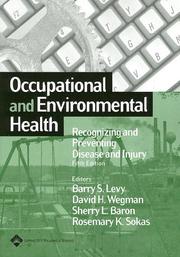
A graduate-level text used in public health programs that connects workplace exposures to disease outcomes, equipping the reader to collaborate with occupational physicians and industrial hygienists.

The definitive professional reference for chemical and physical agent evaluation; reading this after building a solid foundation allows the advanced learner to use it as a true working tool rather than an overwhelming encyclopedia.
Discussion
Keep reading
Paths that share books, cover the same subject, or open a related topic.