Best Books to Explore Musical Theater (in Order)
This curriculum takes a beginner from a broad, joyful introduction to Broadway's history, through the landmark shows that shaped the art form, and finally into the craft of songwriting and musical construction. Each stage builds the vocabulary and context needed for the next, so by the end the reader can appreciate a musical on multiple levels — as history, as storytelling, and as a technical achievement.
Foundations: The Story of Broadway
BeginnerGain a confident, chronological understanding of how Broadway evolved from vaudeville and operetta to the modern musical, and absorb the essential vocabulary of the art form.
▸ Study plan for this stage
Pace: 4–5 weeks, ~25–30 pages/day. Week 1–2: "Broadway, the American Musical" (approximately 250 pages); Week 3–4: "The Season" (approximately 350 pages); Week 5: Review and synthesis exercises.
- The evolution of Broadway from vaudeville and operetta through the Golden Age (1920s–1950s) to contemporary musical theater, as traced through Kantor's historical narrative
- The role of key composers, lyricists, and producers (Rodgers & Hammerstein, Cole Porter, Irving Berlin, etc.) in establishing the modern musical form
- The structure and conventions of the Broadway musical: book, music, lyrics, choreography, and how they integrate to tell a story
- The economics and production realities of Broadway as a commercial enterprise, including the role of producers, investors, and the Broadway season cycle
- How 'The Season' reveals the behind-the-scenes creative and business pressures that shape what gets produced and how shows succeed or fail
- The vocabulary of musical theater: terms like 'book musical,' 'golden age,' 'revival,' 'out-of-town tryout,' 'opening night,' and genre distinctions
- The relationship between popular culture, social change, and Broadway content across different eras
- How individual shows exemplify broader trends and innovations in the form (e.g., integration of dance, psychological realism, concept musicals)
- How did vaudeville and operetta influence the development of the Broadway musical, and what key innovations transformed these earlier forms into the modern musical?
- Who were the major creative figures in establishing the Golden Age of Broadway, and what specific contributions did composers like Rodgers and Hammerstein make to the form?
- What are the essential structural components of a Broadway musical, and how do book, music, and lyrics work together to create a complete theatrical experience?
- According to 'The Season,' what are the primary economic and creative pressures that producers and creators face when bringing a show to Broadway, and how do these pressures shape the final product?
- What does Goldman's 'The Season' reveal about the role of chance, timing, and critical reception in determining whether a Broadway show succeeds or fails?
- How has Broadway content and style evolved in response to broader social and cultural changes, as illustrated by specific shows discussed in Kantor's history?
- Create a timeline of Broadway eras (vaudeville/operetta → Golden Age → modern era) with 3–4 representative shows from each period, noting the key innovations each introduced.
- Select one show from Kantor's 'Broadway, the American Musical' and write a 1-page analysis of how its structure (book, music, lyrics) reflects the innovations of its era.
- Read the full account of one production in Goldman's 'The Season' and map out the major decision points, conflicts, and turning moments that shaped its path to opening night.
- Compile a glossary of 15–20 essential Broadway and musical theater terms (e.g., 'book musical,' 'golden age,' 'out-of-town tryout,' 'integration,' 'concept musical') with definitions and examples from the two books.
- Watch a filmed version of a classic Golden Age show (e.g., 'Oklahoma!' or 'The Sound of Music') and identify the structural and stylistic elements Kantor describes in his history.
- Write a comparative 2-page essay on how Kantor's historical overview and Goldman's insider account of 'The Season' offer complementary perspectives on what makes Broadway work as an art form and business.
Next up: This stage provides the historical context, vocabulary, and understanding of Broadway's economic and creative ecosystem necessary to engage deeply with specific shows, creators, and contemporary issues in the next stage.

The companion book to the acclaimed PBS documentary series, this is the single most accessible and comprehensive visual history of Broadway from its origins to the modern era — the perfect starting point for any beginner.
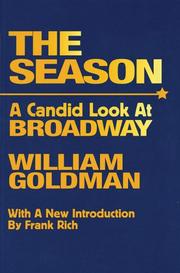
Goldman's witty, insider analysis of a single Broadway season (1967–68) immediately grounds the reader in how the industry actually works — the economics, the critics, the flops, and the hits — giving essential real-world context before going deeper.
Landmark Shows: The Musicals That Changed Everything
BeginnerUnderstand the specific landmark productions — Oklahoma!, West Side Story, A Chorus Line, and beyond — that defined Broadway's golden age and beyond, and why each was a turning point.
▸ Study plan for this stage
Pace: 4–5 weeks, ~40–50 pages/day (approximately 250–300 pages total)
- How Oklahoma! (1943) revolutionized musical theater by integrating story, song, and dance into a unified whole, establishing the template for modern musicals
- The role of creative partnerships and collaboration (composer, lyricist, director, choreographer) in producing landmark shows, as illustrated through Chapin's insider perspective
- How West Side Story (1957) expanded the artistic possibilities of Broadway by tackling serious social themes and employing innovative music and choreography
- The evolution of musical theater from spectacle-driven entertainment to character-driven storytelling across the golden age and beyond
- A Chorus Line's (1975) significance in democratizing the Broadway narrative by centering the experiences of ensemble dancers and redefining what musical theater could address
- The business and production realities behind landmark shows—how creative vision intersects with commercial viability and institutional support
- The concept of 'turning points' in Broadway history: what makes certain shows transformative versus merely successful
- What specific innovations did Oklahoma! introduce to musical theater, and why is it considered the birth of the modern musical?
- How did the creative team behind the landmark shows Chapin discusses approach the integration of music, dance, and narrative differently than their predecessors?
- What social or artistic barriers did West Side Story break through, and what made it a turning point rather than just another successful show?
- How does A Chorus Line's focus on the lives of ensemble dancers represent a shift in what Broadway considered worthy subject matter?
- Based on Chapin's account, what role did institutional support, mentorship, and creative risk-taking play in producing these landmark productions?
- How do the landmark shows Chapin examines reflect broader cultural and social changes in American society during their respective eras?
- Create a timeline of the landmark shows discussed in 'Everything Was Possible,' noting the key innovation each introduced and the cultural context of its premiere
- Write a comparative analysis of two landmark shows (e.g., Oklahoma! vs. West Side Story) focusing on how their creative teams approached storytelling, music, and social relevance differently
- Research and document one creative partnership mentioned in Chapin's book (e.g., Rodgers & Hammerstein, Bernstein & Sondheim) and analyze how their collaboration produced transformative work
- Watch filmed versions or recordings of at least two landmark shows discussed and identify the specific theatrical techniques (choreography, staging, musical motifs) that Chapin highlights as revolutionary
- Conduct an interview-style reflection: imagine interviewing one of the creators Chapin discusses about what they believed made their show a 'turning point'—write their hypothetical responses based on Chapin's insights
- Create a 'turning point criteria' checklist based on Chapin's analysis, then apply it to a more recent Broadway show to evaluate whether it qualifies as a landmark production
Next up: This stage grounds you in the specific landmark productions and their creators, providing the historical foundation and analytical framework needed to explore either the technical craft elements of musical theater (composition, choreography, design) or the evolution of particular genres and themes on Broadway in subsequent stages.
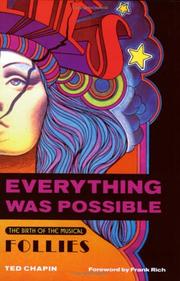
A vivid, day-by-day memoir of the creation of Follies (1971), one of Broadway's most ambitious and complex musicals — the first deep dive into how a single landmark show is actually built from the inside.
The Craft: Writing Songs for the Stage
IntermediateUnderstand the principles of musical theater songwriting — how lyrics, melody, and dramatic function work together — and begin to analyze any song or score with a trained ear.
▸ Study plan for this stage
Pace: 8–10 weeks, ~40–50 pages/day. Start with Sondheim's essays (Weeks 1–3), move through his memoir (Weeks 4–6), then tackle Cohen & Allen's practical guide (Weeks 7–10) with overlap for synthesis.
- Lyric specificity and compression: how Sondheim uses precise, economical language to reveal character and advance plot simultaneously
- The marriage of music and meaning: how melody, rhythm, and harmonic choices reinforce emotional and narrative intent
- Dramatic function of songs: distinguishing between exposition, character revelation, relationship development, and plot turning points
- Rhyme schemes and meter as tools: understanding how formal constraints serve storytelling rather than hinder it
- The concept of 'the hat' (craft mastery): recognizing that technical excellence in songwriting is invisible to the audience but essential to impact
- Song structure and form: verse-chorus, AABA, through-composed, and how form choices affect dramatic pacing
- Practical songwriting techniques: orchestration, prosody, subtext, and the relationship between music and lyrics in Cohen & Allen's framework
- What does Sondheim mean by 'finishing the hat,' and how does this concept apply to the invisible craft of songwriting?
- How do Sondheim's lyrics balance specificity with universality, and what techniques does he use to compress meaning into few words?
- Analyze a song from one of Sondheim's shows: what is its dramatic function, and how do the music and lyrics work together to achieve it?
- What are the key differences between writing a song for exposition versus a song for character revelation, and how would you approach each differently?
- How does Cohen & Allen's practical methodology complement or differ from Sondheim's philosophy about the craft?
- Choose a song from a musical theater score and identify its structural form (verse-chorus, AABA, etc.)—how does that form serve the dramatic moment?
- Close-read one Sondheim essay from 'Finishing the Hat' and annotate it for craft principles; then listen to a corresponding song he references and map his theory onto the actual music and lyrics.
- Write a character-establishing song (8–16 bars) for an original character, focusing on Sondheim's principle of specificity—use concrete details rather than generic emotions.
- Analyze three songs from different Sondheim musicals (e.g., 'Finishing the Hat' from Sunday in the Park with George, 'Not While I'm Around' from Sweeney Todd, 'Send in the Clowns' from A Little Night Music) and chart how each uses rhyme, meter, and melody to serve its dramatic moment.
- Read a passage from 'Look, I Made a Hat' about a specific song's creation, then listen to the song and write a one-page reflection on how Sondheim's process shaped the final product.
- Using Cohen & Allen's songwriting framework, outline a song for a dramatic scene you create (setup, conflict, resolution)—then draft the lyrics and a simple melodic contour.
- Rewrite a song lyric from an existing musical theater song, applying Sondheim's principle of compression: remove 20% of the words while preserving or deepening meaning.
Next up: This stage equips you with both the philosophical foundation (Sondheim's essays and memoir) and practical methodology (Cohen & Allen) to analyze and create songs with intentionality, preparing you to study specific shows, composers, and historical contexts in depth, or to begin your own songwriting projects grounded in craft.

Sondheim's annotated collection of his own lyrics is the definitive master class in musical theater lyric writing; it belongs here because the reader now has enough historical and show-specific context to fully appreciate his analysis.

The essential companion volume to Finishing the Hat, covering Sondheim's later work; read second so the reader can trace his evolving craft and philosophy across a complete career.

A practical, craft-focused textbook on how books, music, and lyrics are structured together; it synthesizes everything learned in earlier stages into actionable principles for deep analytical reading of any score.
Advanced Synthesis: The Directors, Producers, and the Future
ExpertSynthesize history, landmark shows, and craft into a complete picture by studying the visionaries who shaped Broadway's direction — and understand where the art form is heading.
▸ Study plan for this stage
Pace: 8–10 weeks, ~25–30 pages/day. Read "Contradictions" first (weeks 1–5, ~150 pages), then "The Happiest Corpse I've Ever Seen" (weeks 6–10, ~200 pages). Allocate 1–2 weeks for synthesis and reflection exercises.
- Harold Prince's directorial philosophy: the integration of concept, design, and narrative as a unified artistic vision
- The role of the producer-director as both visionary and pragmatist in shaping Broadway's commercial and artistic landscape
- How landmark shows (Cabaret, Sweeney Todd, Phantom of the Opera) emerged from specific creative contradictions and risk-taking
- Ethan Mordden's analysis of contemporary Broadway trends: the tension between legacy revivals, new musicals, and experimental work
- The business and artistic infrastructure that enables or constrains innovation on Broadway
- The evolution of audience expectations and how directors/producers respond to or challenge them
- The relationship between a director's personal vision and the collaborative demands of musical theater production
- What does Harold Prince mean by 'contradictions' in his directorial approach, and how did this philosophy shape shows like Cabaret and Sweeney Todd?
- How does Prince balance the roles of director and producer, and what tensions arise between artistic vision and commercial viability?
- According to Mordden, what are the defining characteristics of Broadway in the contemporary era, and how do they differ from earlier periods?
- What does Mordden identify as the primary challenges facing new musical creation on Broadway today?
- How do the visionary approaches described in both books—Prince's concept-driven direction and Mordden's analysis of current trends—suggest different futures for the art form?
- What role do revivals, adaptations, and legacy shows play in the current Broadway ecosystem, according to Mordden?
- Create a detailed case study of one Prince-directed show (Cabaret, Sweeney Todd, or Phantom of the Opera): identify the core contradiction he was exploring, the design choices that embodied it, and how it influenced subsequent productions.
- Annotate key passages from 'Contradictions' that reveal Prince's creative decision-making process; write a 2–3 page reflection on how his philosophy differs from more conventional directorial approaches.
- Analyze Mordden's discussion of a specific contemporary Broadway show or trend; write a brief essay (3–4 pages) on whether it supports or challenges Prince's vision of what musical theater can be.
- Conduct a comparative timeline: map Prince's major productions against Mordden's periodization of Broadway eras; identify where innovation occurred and what enabled or blocked it.
- Interview or research a contemporary Broadway director, producer, or dramaturg about their approach to new work; compare their answers to the philosophies articulated by Prince and Mordden.
- Design a hypothetical new musical or revival concept that synthesizes Prince's directorial principles with Mordden's analysis of current Broadway conditions; write a 2–3 page pitch that addresses both artistic vision and market viability.
Next up: This stage equips you to understand Broadway not as a collection of isolated hits but as an evolving ecosystem shaped by visionary leaders navigating contradictions between art and commerce—preparing you to evaluate, critique, and potentially contribute to the future direction of musical theater.
The memoir of the most influential director-producer in Broadway history, whose collaborations with Sondheim defined the concept musical; reading it last ties together the history, the shows, and the craft into one coherent creative vision.
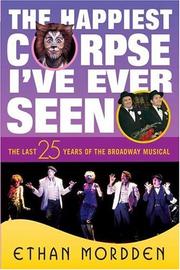
Mordden's sharp, opinionated survey of the late 20th-century Broadway musical is the ideal capstone — it demands the full historical and craft vocabulary built across the curriculum and rewards the reader with a sophisticated critical perspective on where Broadway has been and where it is going.
Discussion
Keep reading
Paths that share books, cover the same subject, or open a related topic.