Best Books to Master Market Research (in Order)
This curriculum builds from rigorous research design and data-collection craft (surveys and interviews) through the analytical power of segmentation, and culminates in translating customer insight into strategic decisions. Because the learner starts at an intermediate level, the path skips introductory marketing theory and dives straight into method, progressively layering quantitative discipline on top of qualitative depth before zooming out to decision-making and strategy.
Research Design & The Listening Mindset
IntermediateEstablish a rigorous mental model for why and how market research works, understand the difference between qualitative and quantitative approaches, and avoid the most common design mistakes before touching a single survey or interview guide.
▸ Study plan for this stage
Pace: 4–5 weeks, ~40–50 pages/day. Start with "The Market Research Toolbox" (Weeks 1–3, ~15–20 pages/day to absorb frameworks), then "Asking the Right Questions" (Weeks 3–5, ~20–30 pages/day for critical thinking application).
- The research design hierarchy: exploratory, descriptive, and causal research—when to use each and why most projects fail by choosing the wrong type
- Qualitative vs. quantitative trade-offs: depth and insight versus breadth and statistical power, and how to combine them strategically
- The listening mindset: suspending assumptions, asking open-ended questions, and designing research to discover rather than confirm
- Common design mistakes: confirmation bias, leading questions, sampling errors, and how to recognize them before data collection
- Question formulation as the foundation: how the quality of your research questions determines the quality of your insights
- The toolbox concept: understanding which research method (interviews, focus groups, surveys, observation) fits which business question
- Critical thinking frameworks: identifying unstated assumptions, evaluating evidence quality, and distinguishing correlation from causation in research findings
- What is the difference between exploratory, descriptive, and causal research, and when would you choose each for a real business problem?
- Why does McQuarrie argue that most market research projects fail at the design stage rather than the execution stage?
- How would you design a research project to *discover* customer needs versus one designed to *validate* an existing hypothesis—and what are the pitfalls of each?
- What are the five most common design mistakes in market research, and how would you catch them before launching a study?
- How do you formulate a research question that avoids leading the respondent or confirming your own bias?
- When should you use qualitative research, quantitative research, or a mixed-methods approach, and what are you trading off in each choice?
- Audit a real market research study (from a case study, article, or your organization): identify its research design type (exploratory/descriptive/causal), spot at least three design flaws or assumptions, and propose how you'd redesign it.
- Write three versions of a research question on the same business topic: one that is leading/biased, one that is neutral but too vague, and one that is well-formulated. Explain the differences using Browne's critical thinking framework.
- Design a small research project (2–3 pages) for a hypothetical business problem: specify the research type, justify your choice of qualitative vs. quantitative (or mixed), list your key assumptions, and outline your question set.
- Conduct a 'listening mindset' interview with a colleague or friend on a topic you care about: record yourself, then review the recording to count how many times you led the respondent, interrupted, or inserted your own interpretation. Reflect on what you'd change.
- Take a survey or questionnaire you encounter (online, in-store, or from your organization) and critique it using McQuarrie's toolbox framework: identify the research design intent, spot leading or ambiguous questions, and suggest rewording.
- Create a one-page 'design checklist' for yourself based on the most common mistakes covered in both books—use it to evaluate a research proposal or your own study plan before launch.
Next up: This stage equips you with the mental discipline to design sound research before execution; the next stage will teach you the specific mechanics of running qualitative and quantitative studies, knowing that your foundation in *why* and *how* to ask the right questions will prevent wasted effort and flawed data.

A concise, practitioner-oriented overview of every major research method — surveys, interviews, focus groups, observation — that gives intermediate learners a shared vocabulary and a decision framework for choosing the right tool. Read this first to see the whole map before drilling into individual techniques.

Trains critical thinking about how questions are framed and what assumptions they carry — an essential foundation before writing a single survey item or interview probe, so you learn to spot leading, ambiguous, or double-barreled questions from the start.
Surveys: Measurement & Quantitative Craft
IntermediateDesign surveys that measure what you actually intend to measure, sample correctly, avoid response bias, and analyze results with statistical confidence.
▸ Study plan for this stage
Pace: 6–8 weeks, ~40–50 pages/week (approximately 2–3 hours of focused reading per week)
- Validity and reliability in survey measurement: ensuring questions measure what you intend to measure
- Question design principles: wording, response options, and cognitive burden to minimize measurement error
- Sampling theory and practice: probability sampling, sample size determination, and representativeness
- Sources of survey error: coverage error, sampling error, nonresponse bias, and measurement error
- Response bias mechanisms: social desirability, acquiescence, and context effects in survey responses
- Data quality assessment: identifying and quantifying bias in survey results
- Statistical foundations for survey analysis: weighting, confidence intervals, and significance testing with survey data
- Practical survey implementation: mode effects, questionnaire design trade-offs, and pretesting
- What is the difference between validity and reliability in survey measurement, and why do both matter?
- How does question wording affect response quality, and what specific wording problems should you avoid?
- What are the four main sources of survey error, and which are controllable through design decisions?
- How do you determine an appropriate sample size, and what factors influence this decision?
- What is response bias, what causes it, and what design strategies can reduce it?
- How do you assess whether your survey results are statistically reliable and representative of the population?
- Critique 5–10 existing survey questions from published studies or organizations: identify validity threats, wording problems, and potential response biases
- Design a 15–20 question survey on a topic of interest, applying Fowler's principles for question wording, response scales, and logical flow; document your design rationale
- Calculate required sample sizes for 3–4 different research scenarios using power analysis and margin of error principles; justify your assumptions
- Conduct a cognitive pretest: interview 3–5 respondents while they complete your survey, documenting comprehension issues and response difficulty
- Analyze a real survey dataset (or use a provided one): compute weighted estimates, confidence intervals, and assess potential nonresponse bias
- Design a sampling plan for a specific population: define the frame, choose a sampling method, calculate coverage and sampling error, and justify your approach
Next up: This stage equips you with the technical foundation to build trustworthy surveys; the next stage will likely focus on applying these principles to specific research designs, advanced analytical techniques, or integrating surveys with other research methods to answer complex business questions.
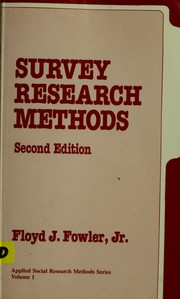
The canonical academic-yet-accessible treatment of sampling, measurement error, and interviewer effects. Fowler deepens and stress-tests the design principles from Czaja, pushing you toward publication-quality rigor.
Qualitative Depth: Interviews & Customer Discovery
IntermediateConduct interviews that surface genuine customer motivations, jobs-to-be-done, and unspoken needs — and synthesize those conversations into actionable insight rather than anecdote.
▸ Study plan for this stage
Pace: 8–10 weeks, ~25–30 pages/day. Allocate 2–3 weeks per book with overlap for practice between titles.
- The Mom Test principle: ask about customer behavior and context, not opinions or hypotheticals—avoid leading questions that make people tell you what you want to hear
- Jobs-to-be-done framework: understand what job the customer is trying to accomplish, not just what product they use
- Interview design and preparation: craft question guides, identify the right participants, and create psychological safety so people reveal genuine motivations
- Active listening and interpretation: recognize patterns, contradictions, and unspoken needs in what customers say and do
- Synthesis and storytelling: transform raw interview data into coherent insights and narratives that drive product decisions
- Continuous discovery as a habit: embed regular customer conversations into ongoing product work rather than treating research as a one-time project
- Emotional and social context: surface the deeper motivations—embarrassment, identity, relationships—that drive real behavior
- What is the Mom Test, and why does asking 'Do you think this is a good idea?' fail as a customer research question?
- How do you identify and interview the right people, and what makes a good interview participant versus a poor one?
- What is a job-to-be-done, and how does it differ from a feature or product category?
- What are the key techniques for active listening and recognizing patterns across multiple interviews?
- How do you turn raw interview notes into actionable insights without over-interpreting or cherry-picking anecdotes?
- What does continuous discovery look like in practice, and how do you sustain a regular cadence of customer conversations?
- Conduct 3–5 interviews using the Mom Test framework: prepare a question guide that avoids leading questions, record observations about context and behavior, and write up what you learned about the customer's actual situation (not their opinions).
- Map a job-to-be-done for a product or service you know: define the functional, emotional, and social dimensions of the job, and identify competing solutions customers currently use.
- Transcribe and annotate one interview: highlight moments of genuine insight, contradictions, and unspoken needs; practice distinguishing between what was said and what it reveals about motivation.
- Create an interview guide for a specific research question: include 5–7 open-ended questions, note follow-up probes, and identify the type of participant you need to recruit.
- Synthesize insights from 3 interviews into a one-page narrative: identify 2–3 core patterns, explain what job the customer is trying to do, and suggest one product or messaging implication.
- Design a continuous discovery rhythm for your team or project: define how often you'll talk to customers, who owns the conversations, and how you'll share findings with stakeholders.
Next up: This stage equips you with the discipline and techniques to listen deeply to customers; the next stage will teach you how to validate those insights through quantitative methods and scale your learning across larger populations.

Teaches how to ask questions that get honest answers instead of polite validation — a critical skill before any customer interview. Its concise, example-driven style makes the lessons immediately applicable.

Goes deeper than The Mom Test into professional interview technique: building rapport, probing effectively, handling silence, and synthesizing findings. Read second to layer craft on top of Fitzpatrick's mindset shift.

Bridges one-off interviews to a sustainable, ongoing discovery practice, introducing opportunity mapping and assumption testing — the natural next step once you can run a good interview and need a system for doing it repeatedly.
Segmentation & Making Sense of the Market
ExpertMove from individual customer data to market-level patterns: segment customers meaningfully, size opportunities, and understand competitive positioning through the lens of customer perception.
▸ Study plan for this stage
Pace: 6–7 weeks, ~40–50 pages/day (approximately 280–350 pages total across both books)
- Segmentation bases and variables: demographic, psychographic, behavioral, and geographic dimensions for dividing markets
- Segment evaluation criteria: measurability, accessibility, responsiveness, and actionability to identify viable targets
- Competitive positioning and perceptual mapping: how customers perceive your offering relative to competitors within segments
- Analytics-driven segmentation: using data and statistical methods to uncover hidden patterns and validate segment assumptions
- Segment sizing and opportunity assessment: quantifying market potential and growth prospects for prioritized segments
- Linking segmentation to strategy: translating segment insights into differentiated value propositions and competitive advantage
- Analytical capabilities as competitive advantage: building organizational competencies to sustain insight-driven decision-making
- What are the primary segmentation bases (demographic, psychographic, behavioral, geographic) and how do you choose which ones are most relevant for your market?
- How do you evaluate whether a segment is worth pursuing using the criteria of measurability, accessibility, responsiveness, and actionability?
- What is perceptual mapping and how can it reveal your competitive position and white space opportunities within a segment?
- How can analytics and data-driven methods validate or challenge intuitive segmentation assumptions, and what role does statistical analysis play?
- How do you size a market segment and estimate its growth potential to prioritize which segments to target?
- How should segmentation insights translate into differentiated marketing strategies, product positioning, and competitive moves?
- What organizational capabilities and analytics infrastructure are needed to sustain competitive advantage through segmentation over time?
- Map your own industry or a case study company using at least three segmentation bases; identify which segments emerge and justify your choices
- Create a perceptual map for a product category you know well, plotting competitors on two key dimensions; identify gaps and positioning opportunities
- Conduct a segment evaluation scorecard for 4–5 potential segments using measurability, accessibility, responsiveness, and actionability criteria; rank them
- Analyze a dataset (real or provided) to identify hidden customer clusters using behavioral or transactional data; compare your findings to conventional segment definitions
- Estimate the total addressable market (TAM) and serviceable addressable market (SAM) for two contrasting segments; build a simple sizing model
- Write a competitive positioning statement for a single segment that reflects how your offering differs from key competitors based on customer perceptions
- Design a simple analytics dashboard or reporting framework that would help a company continuously monitor and refine its segmentation strategy
Next up: This stage equips you with the frameworks and analytical tools to understand your market structure and competitive landscape at scale; the next stage will build on this foundation by showing how to translate segment insights into actionable marketing tactics, channel strategies, and customer acquisition approaches.

The most comprehensive practitioner text on segmentation strategy — demographic, psychographic, behavioral, and needs-based — with frameworks for evaluating and selecting target segments. Sets the analytical foundation for this stage.

Shows how leading organizations turn segmentation and customer data into a durable competitive advantage, connecting research outputs to organizational decision-making — a bridge into the final strategic stage.
Turning Insight into Decisions & Strategy
ExpertSynthesize everything — survey data, interview findings, and segmentation — into decisions that improve products, messaging, and strategy, and communicate research impact to stakeholders.
▸ Study plan for this stage
Pace: 8–10 weeks, ~25–30 pages/day. Start with "Thinking, Fast and Slow" (4–5 weeks, ~20 pages/day for depth), then "Inspired" (3–4 weeks, ~30 pages/day for application focus).
- System 1 vs. System 2 thinking: recognizing when intuition misleads and when deliberate analysis is needed in research interpretation
- Cognitive biases (anchoring, availability, confirmation bias) and how they distort research findings and stakeholder decision-making
- Heuristics and their role in simplifying complex market data—when they help and when they fail
- The product discovery framework: how to validate assumptions before building, using research to reduce risk
- Outcome-focused product strategy: translating research insights into measurable product goals and OKRs
- Stakeholder communication: presenting research findings in ways that overcome cognitive biases and drive action
- Prototyping and testing as continuous feedback loops informed by market research
- Building a culture of evidence-based decision-making that balances data with speed and intuition
- How can you identify when your team is relying on System 1 thinking to interpret market research, and what deliberate processes can you introduce to engage System 2?
- What cognitive biases are most likely to distort how your stakeholders interpret survey data or customer interview findings, and how would you design your research presentation to counteract them?
- How does Kahneman's concept of anchoring apply to how customers respond to pricing research or feature prioritization surveys?
- What is the product discovery process outlined in 'Inspired,' and how does it integrate insights from customer research, segmentation, and competitive analysis?
- How would you translate a set of customer interview findings into a specific product strategy or roadmap decision, and what evidence would you need to convince skeptical stakeholders?
- What is the difference between outcome-focused and output-focused product goals, and why does this distinction matter when communicating research impact?
- Cognitive bias audit: Take a recent market research project (survey, interviews, or segmentation analysis). Identify at least three cognitive biases that may have influenced how you or your team interpreted the findings. Write a brief memo explaining each bias and how you would reframe the analysis to mitigate it.
- Stakeholder communication redesign: Take a research presentation you've given or received. Rewrite it using Kahneman's insights—highlight where System 1 thinking might mislead, use anchoring strategically to frame findings, and structure the narrative to overcome confirmation bias in your audience.
- Product discovery case study: Select a product or feature you know well. Map out how customer research (interviews, surveys, segmentation) should have informed the discovery process using Cagan's framework. Identify what research was missing or misinterpreted.
- OKR translation exercise: Given a set of customer interview findings (e.g., 'users struggle with onboarding,' 'pricing is a barrier for SMBs'), write 2–3 outcome-focused OKRs that would address these insights. Define how you'd measure success and what research would validate progress.
- Prototype feedback loop: Design a simple prototype or mockup based on one market research insight. Conduct 3–5 user tests with it, document findings, and iterate. Reflect on how this cycle validates or challenges your original research interpretation.
- Bias-resistant research brief: Write a research brief for a new study (customer interviews, survey, or concept test) that explicitly anticipates and mitigates cognitive biases—both in how you'll collect data and how you'll present findings to stakeholders.
Next up: This stage equips you to make research-informed decisions and communicate their impact; the next stage will likely deepen your ability to measure, iterate, and scale those decisions through advanced analytics, experimentation, and long-term strategy evaluation.

Understanding how customers (and decision-makers) actually think is the master key to interpreting research correctly and avoiding the cognitive biases that distort both data collection and the conclusions drawn from it.

Demonstrates how customer research — discovery interviews, usability tests, market data — feeds directly into product strategy and roadmap decisions, making it the ideal capstone that shows research living inside a real organizational process.
Discussion
Keep reading
Paths that share books, cover the same subject, or open a related topic.