Managerial Accounting: The Best Books to Learn It, In Order
This curriculum builds managerial and cost accounting mastery from the ground up, starting with core financial vocabulary and intuition, then advancing through cost systems, budgeting, and variance analysis, and finally tackling strategic profit decisions and advanced management control. Each stage assumes the vocabulary and frameworks of the previous one, so reading in order is essential.
Foundations: Accounting Language & Managerial Mindset
BeginnerUnderstand the purpose of managerial accounting, distinguish it from financial accounting, and get comfortable with core cost vocabulary (fixed vs. variable, direct vs. indirect, product vs. period costs).
▸ Study plan for this stage
Pace: 4–5 weeks, ~25–30 pages/day. Start with "Accounting Made Simple" (Chapters 1–4, ~2 weeks), then move to "Managerial Accounting" by Garrison (Chapters 1–3, ~2–3 weeks). Allocate 2–3 days for review and concept consolidation at the end.
- The fundamental purpose of managerial accounting: providing internal decision-makers with relevant, timely information (vs. financial accounting's external reporting focus)
- The accounting equation (Assets = Liabilities + Equity) and how transactions flow through financial statements
- Fixed costs vs. variable costs: definitions, behavior patterns, and how they respond to changes in activity levels
- Direct costs vs. indirect costs: traceability to cost objects and allocation challenges
- Product costs vs. period costs: what gets capitalized on the balance sheet versus expensed immediately
- Cost classification systems and how different cost perspectives serve different managerial decisions
- The managerial mindset: using accounting data for planning, control, and decision-making rather than compliance
- What are the primary differences between managerial accounting and financial accounting in terms of purpose, audience, and reporting requirements?
- How do fixed costs and variable costs behave differently as production volume changes, and why does this distinction matter for managerial decisions?
- What is the difference between direct and indirect costs, and how do you determine whether a cost is traceable to a specific cost object?
- Explain the distinction between product costs and period costs. Which appear on the balance sheet, and which go directly to the income statement?
- How would you classify a specific cost (e.g., factory supervisor salary, packaging materials, advertising) as fixed/variable and direct/indirect, and why would a manager care?
- Why might the same cost be classified differently depending on the managerial question being asked?
- Create a cost classification matrix for a simple manufacturing business (e.g., a bakery or furniture maker): list 10–15 costs and classify each as fixed/variable and direct/indirect. Explain your reasoning for each.
- Work through 5–8 transaction scenarios from 'Accounting Made Simple' and trace how each affects the accounting equation and the three main financial statements.
- Take a real company's annual report (or a case study from Garrison): identify and classify at least 8–10 costs from their income statement and notes as product vs. period costs.
- Solve 4–6 cost behavior problems from Garrison's end-of-chapter exercises (Chapters 2–3): calculate total costs at different activity levels and explain how fixed and variable components change.
- Write a 1–2 page memo to a fictional business owner explaining why managerial accounting data (cost classifications, cost behavior) would help them make a specific decision (e.g., whether to accept a special order, discontinue a product line).
- Create a simple contribution margin analysis: given a product's selling price, variable cost per unit, and fixed costs, calculate the break-even point and explain what this tells a manager about risk and profitability.
Next up: This stage establishes the vocabulary and conceptual foundation needed to analyze costs and make decisions; the next stage will build on these classifications to explore cost allocation methods, costing systems (job-order and process costing), and how to use cost data for specific managerial decisions like pricing and make-or-buy analysis.

A concise, plain-English primer that builds the basic accounting vocabulary (debits, credits, financial statements) a beginner needs before tackling cost concepts. Reading this first prevents confusion when cost accounting texts assume general accounting fluency.

The most widely adopted introductory managerial accounting textbook worldwide. It introduces cost behavior, job-order costing, budgeting, and variance analysis in a logical, beginner-friendly sequence that anchors the entire curriculum.
Cost Systems: Job, Process & Activity-Based Costing
BeginnerMaster how costs are tracked and assigned through job-order, process, and activity-based costing systems, and understand why choosing the right cost system changes managerial decisions.
▸ Study plan for this stage
Pace: 8–10 weeks, ~40–50 pages/day (mix of dense technical chapters and case studies)
- Job-order costing: tracking direct materials, direct labor, and manufacturing overhead for discrete projects or batches, and how overhead allocation methods affect product profitability
- Process costing: accumulating costs by production stage and calculating equivalent units to assign costs to homogeneous products in continuous manufacturing
- Activity-based costing (ABC): identifying cost drivers and allocating indirect costs based on actual consumption of activities rather than volume-based assumptions
- Cost system design trade-offs: balancing accuracy, complexity, and implementation cost when choosing between job-order, process, and ABC systems
- Overhead allocation and variance analysis: understanding how different allocation methods distort product costs and influence make-or-buy and pricing decisions
- Cost behavior and cost flows: distinguishing fixed, variable, and mixed costs, and tracing their movement through work-in-process and finished goods accounts
- Real-world system selection: criteria for when to use each costing method based on production environment, product diversity, and strategic objectives
- How do job-order and process costing systems differ in their approach to accumulating and assigning costs, and what type of manufacturing environment is each suited for?
- What are equivalent units in process costing, and how do you calculate them under the weighted-average and FIFO methods?
- How does activity-based costing improve upon traditional volume-based overhead allocation, and what cost drivers might you use in a manufacturing setting?
- Why can choosing the wrong cost system lead to distorted product costs and poor managerial decisions (e.g., incorrect pricing or make-or-buy choices)?
- What are the key trade-offs between accuracy and implementation complexity when designing a cost system, and how do you decide which system to implement?
- How do you calculate and interpret overhead variances, and what do they reveal about operational efficiency and cost control?
- Work through a complete job-order costing example from Horngren: track materials, labor, and overhead for 2–3 jobs, calculate job costs, and prepare journal entries for work-in-process and finished goods
- Solve a multi-period process costing problem (using weighted-average or FIFO method) with beginning and ending inventory; calculate equivalent units and per-unit costs, then assign costs to completed units and ending WIP
- Design an ABC system for a realistic manufacturing scenario: identify 4–5 activities, select cost drivers, allocate overhead to products, and compare results to a traditional volume-based allocation
- Analyze a case study from Horngren or Cooper showing how a company's costing system led to poor decisions; propose an alternative system and justify why it would improve decision-making
- Calculate and interpret overhead variances (spending and efficiency) for a production period; explain what the variances suggest about cost control and operational performance
- Create a decision matrix comparing job-order, process, and ABC costing for a given manufacturing scenario; recommend the best system and explain the trade-offs
Next up: This stage equips you with the foundational systems for tracking and assigning costs, setting the stage for using cost data in decision-making contexts—such as pricing, profitability analysis, and strategic cost management—which are typically covered in the next stage.
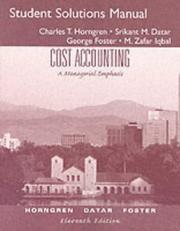
The canonical cost accounting textbook, used in top business schools for decades. It deepens every costing method introduced in Garrison and adds rigorous treatment of ABC, overhead allocation, and joint costs — essential before studying variance analysis.
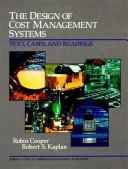
Written by one of the inventors of Activity-Based Costing, this book explains WHY traditional cost systems distort decisions and how ABC corrects them — providing the conceptual depth that textbooks summarize but rarely explain fully.
Budgeting & Planning: Building the Financial Blueprint
IntermediateConstruct master budgets (operating and financial), understand rolling forecasts, and connect the budget to organizational strategy and performance targets.
▸ Study plan for this stage
Pace: 4–5 weeks, ~40–50 pages/day. Week 1–2: "Budgeting Basics and Beyond" (foundational techniques and master budget construction); Week 3–4: "Beyond Budgeting" (modern alternatives and strategic alignment); Week 5: Integration and synthesis across both texts.
- Master budget structure: operating budget (sales, production, expense forecasts) and financial budget (cash flow, balance sheet projections)
- Budget preparation methods: top-down vs. bottom-up approaches, incremental vs. zero-based budgeting, and their trade-offs
- Rolling forecasts and continuous planning as alternatives to static annual budgets for organizational agility
- Variance analysis: comparing actual results to budget and interpreting performance deviations
- Connecting budgets to organizational strategy, KPIs, and performance targets for alignment and accountability
- Behavioral aspects of budgeting: motivation, gaming, and organizational culture in budget processes
- Flexible budgets and scenario planning for managing uncertainty and multiple strategic outcomes
- What are the components of a master budget, and how do the operating budget and financial budget interconnect?
- When should an organization use incremental budgeting versus zero-based budgeting, and what are the advantages and limitations of each?
- How do rolling forecasts differ from traditional annual budgets, and what organizational conditions favor each approach?
- How do you interpret a budget variance, and what questions should managers ask when actual results diverge significantly from budget?
- How can budgets be designed to support organizational strategy and performance targets rather than become disconnected from business goals?
- What behavioral risks exist in budgeting (e.g., sandbagging, gaming), and how can organizations mitigate them?
- Build a complete master budget for a fictional company: construct the sales forecast, production budget, expense budgets, and cash flow projection; identify interdependencies.
- Compare incremental vs. zero-based budgets for the same organization; analyze cost drivers and justify which approach fits the company's strategy.
- Create a 12-month rolling forecast model that updates monthly; document how it differs from a static annual budget in flexibility and decision-making.
- Perform variance analysis on a provided actual-vs.-budget dataset; calculate and interpret volume, spending, and efficiency variances; identify root causes.
- Design a flexible budget for a department; show how it adjusts for different activity levels and use it to evaluate performance more fairly than a static budget.
- Develop a balanced scorecard or KPI dashboard that links budget targets to organizational strategy; explain how budget metrics reinforce strategic priorities.
Next up: This stage equips you with both traditional and modern budgeting frameworks, positioning you to evaluate how budgets drive operational decisions and performance management—the foundation for the next stage on cost behavior, cost-volume-profit analysis, and decision-making under different cost structures.
A practical, step-by-step guide to building every component of the master budget — sales, production, cash, and capital budgets. It bridges textbook theory and real-world spreadsheet work, making it the ideal first dedicated budgeting read.
After learning how to build traditional budgets, this book challenges their limitations and introduces adaptive, rolling-forecast alternatives used by leading companies — giving the reader a critical, strategic perspective on planning.
Variance Analysis & Performance Measurement
IntermediatePerform and interpret price, efficiency, volume, and mix variances; link variances back to operational decisions; and use balanced scorecard and other frameworks to measure performance holistically.
▸ Study plan for this stage
Pace: 6–8 weeks, ~40–50 pages/day (alternating between Winston's quantitative chapters and Kaplan's strategic framework)
- Standard costing and variance decomposition: price, efficiency, volume, and mix variances as tools to isolate root causes of performance deviations
- Linking variances to operational decisions: interpreting why variances occurred and translating them into corrective actions or strategic insights
- Balanced scorecard framework: translating strategy into four perspectives (financial, customer, internal process, learning & growth) with linked metrics and targets
- Performance measurement beyond variances: using leading and lagging indicators, cause-and-effect relationships, and strategic objectives to drive accountability
- Integration of quantitative analysis and strategy: combining variance analysis with balanced scorecard thinking to align operational execution with organizational goals
- Mix and yield variances in multi-product environments: understanding how product/customer mix changes affect profitability and resource utilization
- Cascading scorecards and alignment: translating corporate strategy into departmental and individual performance metrics
- How do you decompose a total cost variance into price and efficiency components, and what operational decisions does each component inform?
- What is the difference between a volume variance and a mix variance, and when would you use each to diagnose performance in a multi-product business?
- How does the balanced scorecard framework move beyond financial metrics to create a holistic view of organizational performance?
- How would you design a balanced scorecard for a specific business unit, ensuring that metrics in each perspective are linked to strategic objectives?
- What are the limitations of variance analysis alone, and how does the balanced scorecard address those limitations?
- How do you cascade a corporate balanced scorecard down to departmental and individual levels to ensure strategic alignment?
- Using a realistic case from Winston's Practical Management Science, calculate standard price, efficiency, and volume variances for a manufacturing process; then write a one-page memo explaining what each variance reveals about operational performance and recommend corrective actions
- Build a multi-product variance analysis: compute mix and yield variances for a company producing 3+ products; interpret how changes in product mix affected profitability and identify which products should be prioritized
- Design a balanced scorecard for a real or hypothetical business unit (e.g., a manufacturing plant, sales division, or service center); define 3–4 strategic objectives, select 12–16 metrics across the four perspectives, and establish cause-and-effect linkages
- Conduct a variance deep-dive: take a company's quarterly results, calculate all relevant variances, and then map each variance to a balanced scorecard metric to show how operational variances connect to strategic performance
- Create a cascading scorecard exercise: start with a corporate-level balanced scorecard and translate it into departmental scorecards for operations, sales, and finance; ensure metrics are aligned and non-redundant
- Analyze a real balanced scorecard case study (e.g., from Kaplan's book or a published company example); critique the metric selection, assess whether the cause-and-effect logic is sound, and propose improvements
Next up: This stage equips you with both the quantitative tools (variances) and strategic frameworks (balanced scorecard) to diagnose performance gaps and align operations with strategy—preparing you to advance to more complex topics like activity-based costing, strategic cost management, or advanced performance management systems.
Introduces the quantitative and analytical thinking — including sensitivity analysis and what-if modeling — that underpins rigorous variance investigation and decision modeling, bridging accounting data with analytical action.

Written by the co-creator of both ABC and the Balanced Scorecard, this book shows how financial variances must be read alongside non-financial performance indicators — a critical perspective for anyone moving from number-crunching to management insight.
Advanced: Profit Decisions, Strategy & Management Control
ExpertApply CVP analysis, relevant-cost reasoning, transfer pricing, and strategic cost management to complex profit decisions; integrate all prior tools into a coherent management control system.
▸ Study plan for this stage
Pace: 8–10 weeks, ~40–50 pages/day, with 2–3 days per week dedicated to case studies and problem sets
- Management control systems as integrated frameworks: planning, budgeting, performance measurement, and feedback loops that align organizational strategy with execution
- Strategic cost management: using cost analysis to inform competitive positioning, value chain analysis, and cost driver identification across the organization
- Profit decision frameworks: integrating CVP analysis, relevant costs, and strategic considerations to evaluate make-or-buy, pricing, and product mix decisions
- Transfer pricing mechanisms: designing internal pricing systems that balance goal congruence, performance evaluation, and organizational efficiency
- Behavioral dimensions of control: how incentive structures, performance metrics, and accountability systems influence managerial decision-making and organizational culture
- Cost of quality and lifecycle costing: embedding quality and long-term profitability into strategic cost management decisions
- Linking strategy to operations: translating competitive strategy into specific cost management priorities and control system design choices
- How do the planning, budgeting, and performance measurement components of a management control system reinforce each other to execute organizational strategy?
- What is the relationship between value chain analysis and cost driver identification, and how does this inform strategic cost management decisions?
- How would you design a transfer pricing system for a multi-division company that balances internal goal congruence with accurate profit measurement?
- When evaluating a make-or-buy decision, what relevant costs should be included, and how does strategic positioning (e.g., outsourcing vs. vertical integration) affect the analysis?
- How do behavioral incentives embedded in a control system influence whether managers make decisions aligned with overall organizational strategy?
- What role does cost of quality analysis play in strategic pricing and product mix decisions, and how should it be integrated into the control system?
- Design a complete management control system for a hypothetical multi-division manufacturing company: specify planning cycles, budget formats, performance metrics, and feedback mechanisms that align divisional managers with corporate strategy
- Conduct a value chain analysis for a real or case-study company; identify cost drivers at each stage, assess where the company has competitive advantage, and recommend strategic cost management priorities
- Solve 4–6 transfer pricing problems with varying scenarios (cost-plus, market-based, negotiated) and evaluate trade-offs between goal congruence, performance evaluation accuracy, and organizational efficiency
- Work through 3–4 complex make-or-buy or product mix decisions that require integrating CVP analysis, relevant costs, strategic positioning, and qualitative factors; document assumptions and sensitivity analyses
- Analyze a real company's annual report or case study to identify how its cost structure, pricing strategy, and control system reflect its competitive strategy; critique alignment and suggest improvements
- Design a performance measurement dashboard for a division manager that balances financial metrics (profit, ROI) with strategic metrics (cost reduction, quality, customer satisfaction); justify metric selection and discuss behavioral implications
Next up: This stage synthesizes all prior managerial accounting tools into an integrated management control system, positioning you to apply these frameworks to real-world strategic challenges and to understand how organizations sustain competitive advantage through disciplined cost management and aligned incentive structures.
The definitive advanced text on how organizations use accounting information — budgets, transfer prices, incentive systems — to align managers with strategy. It synthesizes everything in the curriculum into a unified control framework.

Closes the curriculum by showing how cost information drives competitive strategy — value chain analysis, cost driver analysis, and strategic positioning — elevating the reader from accountant to strategic business partner.
Discussion
Keep reading
Paths that share books, cover the same subject, or open a related topic.