Isaac Asimov Reading Order: Where to Start
This curriculum guides you through Asimov's interconnected fictional universe in the order that best builds comprehension and appreciation — starting with his most accessible short fiction, moving into the Robot novels, then the Foundation saga, and finally the late "bridge" novels that weave everything together. Each stage deepens your familiarity with Asimov's ideas, style, and grand design before the next stage demands more of you.
First Contact: The Robot Short Stories
BeginnerUnderstand Asimov's foundational concept — the Three Laws of Robotics — and get comfortable with his clean, idea-driven prose through self-contained stories before tackling novels.
▸ Study plan for this stage
Pace: 6–8 weeks total. Week 1–3: Read "I, Robot" (~250 pages) at ~15–20 pages/day — slow down to annotate each story's central dilemma. Week 4–6: Read the 8 short stories in "The Rest of the Robots" (~2 stories per sitting, 2–3 sittings per week). Week 7–8: Read the 2 novels in "The Rest of the Robots" at
- The Three Laws of Robotics — their exact wording, hierarchical priority, and the philosophical intent behind designing ethics into machinery
- Robopsychology and the 'robot as mirror' device — how Asimov uses robots to reflect human fears, biases, and moral blind spots
- The Technological Optimism vs. Technophobia tension — Asimov's deliberate pushback against the 'Frankenstein complex' present in most sci-fi of his era
- Logical paradox as plot engine — how nearly every story in 'I, Robot' is structured as a puzzle where a Law conflict creates the central mystery
- Susan Calvin as authorial surrogate — her cold rationalism and what it reveals about Asimov's own view of science and emotion
- The evolution from short story to novel form — how 'The Rest of the Robots' shows Asimov stretching the same ideas into longer, more socially embedded narratives
- Positronic brains and the limits of rule-based systems — the idea that even perfect rules produce unforeseen edge cases (a precursor to modern AI ethics debates)
- The framing narrative device in 'I, Robot' — how the interview structure with Susan Calvin creates a retrospective, almost archaeological feel for the history of robotics
- State all Three Laws of Robotics from memory and explain why their order of priority matters — give one story from 'I, Robot' where violating that order would change the outcome entirely.
- In 'I, Robot,' how does the story 'Liar!' expose a fundamental flaw in the First Law, and what does Susan Calvin's emotional response reveal about her character?
- Choose any two stories from the 8 short stories in 'The Rest of the Robots' and explain how each one presents a different kind of Three Laws conflict — logical, emotional, or social.
- How does Asimov's framing device (Susan Calvin being interviewed near the end of her life) shape the reader's relationship to the robot stories in 'I, Robot'? What would be lost without it?
- What is the 'Frankenstein complex' as Asimov defines it through his fiction, and which specific robots in these two books most directly challenge or embody it?
- After reading the 2 novels in 'The Rest of the Robots,' describe one way the novel format allowed Asimov to explore a theme that the short story format could not fully accommodate.
- Three Laws Stress-Test Journal: After each story in 'I, Robot,' write 2–3 sentences identifying which Law is under pressure, how the robot resolves (or fails to resolve) the conflict, and whether you find the resolution satisfying — build this into a running log you can review at the end.
- Rewrite a Scene: Pick the ending of one story from 'I, Robot' (e.g., 'Runaround' or 'Liar!') and rewrite it assuming one of the Three Laws was worded slightly differently — what changes? This forces close reading of the Laws' exact language.
- Character Sketch — Susan Calvin: After finishing 'I, Robot,' write a one-page profile of Susan Calvin: her worldview, her relationship to robots vs. humans, and whether you find her sympathetic. Revisit and revise this sketch after reading 'The Rest of the Robots' to see if your view evolved.
- Story Comparison Matrix: Create a simple table with columns for Story Title, Book, Type of Laws Conflict, Robot's 'Mistake' or Surprise Behavior, and Human Reaction — fill it in for every short story across both books to spot patterns in Asimov's storytelling formula.
- Modern AI Ethics Bridge: After completing both books, find one real-world AI ethics debate from a current news source (e.g., autonomous vehicles, content moderation algorithms) and write a short paragraph connecting it to a specific story or robot from these books — practice applying Asimov's framework to the present.
- Prose Style Imitation: Write a 1–2 page original scene in Asimov's style — a technician and a robot, a single logical problem, clean dialogue-heavy prose — to internalize his stripped-down, idea-first approach before moving on to his longer works.
Next up: Mastering the Three Laws as a tight, self-contained ethical framework in these short stories and introductory novels gives you the conceptual vocabulary and trust in Asimov's prose style needed to follow those same ideas as they expand, complicate, and collide with galactic-scale society in his longer and more ambitious works.
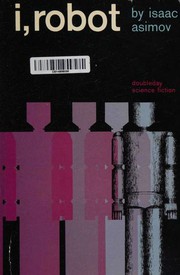
The essential starting point: nine linked short stories introduce the Three Laws of Robotics and the recurring characters of Susan Calvin and Powell & Donovan. Reading these first gives you the conceptual vocabulary every later Robot and Foundation book assumes.
![The Rest of the Robots [8 stories, 2 novels]](https://covers.openlibrary.org/b/id/15155264-M.jpg)
Collects additional early robot stories that round out the themes of I, Robot. Reading it second fills in gaps and reinforces the Three Laws before you move to novel-length Robot fiction.
The Robot Novels
BeginnerExperience Asimov's robots in long-form narrative, meet detective Elijah Baley and R. Daneel Olivaw, and understand the sociological tensions between Earth and the Spacer worlds that will later feed into Foundation.
▸ Study plan for this stage
Pace: 9–11 weeks total: ~3–4 weeks per novel, reading roughly 20–25 pages per day. "The Caves of Steel" (270 pp): weeks 1–3; "The Naked Sun" (187 pp): weeks 4–6; "The Robots of Dawn" (435 pp): weeks 7–11. Allow one buffer day per week for reflection and note-taking.
- The Three Laws of Robotics and their logical loopholes — pay close attention to how each novel's mystery hinges on a creative interpretation or apparent violation of the Laws
- The Caves of Steel as a sociological portrait of Earth: overcrowded, agoraphobic, City-bound humanity that fears both open spaces and robots
- The Naked Sun as a sociological portrait of the Spacer world Solaria: extreme isolation, aversion to physical human contact, and total dependence on robots — the mirror-opposite of Earth
- The Robots of Dawn and the planet Aurora: a middle-ground Spacer society that nonetheless reveals deeper political stakes — the future colonization of the Galaxy and who will lead it
- Elijah Baley's character arc across all three novels: from a xenophobic, agoraphobic Earthman to a visionary advocate for human expansion beyond Earth
- R. Daneel Olivaw as a philosophical foil: a humaniform robot whose near-perfect mimicry of humanity forces Baley (and the reader) to question what makes us distinctly human
- The detective-fiction structure as a vehicle for ideas: Asimov uses the murder mystery genre to dramatize ethical, sociological, and philosophical questions rather than just plot puzzles
- The seeds of the Galactic Empire and Foundation: the sociological tensions between Earth and the Spacers, and the question of who will populate the Galaxy, directly anticipate the civilizational themes of the Foundation series
- In 'The Caves of Steel,' how does the City function as both a physical setting and a symbol of Earth society's psychological state — and why does Baley initially distrust R. Daneel?
- How does Solaria in 'The Naked Sun' represent the logical extreme of robot dependence, and what does Asimov suggest is the danger of a society that has outsourced all labor and physical contact to machines?
- Across all three novels, how do the Three Laws of Robotics serve as the key to solving each murder? Identify the specific Law (or loophole) central to each book's mystery.
- How does Baley's attitude toward open spaces and the wider universe change from 'The Caves of Steel' to 'The Robots of Dawn,' and what events drive that transformation?
- What is the significance of R. Daneel Olivaw being a humaniform robot specifically? How does his appearance affect the way other characters — and the reader — relate to him compared to a conventional robot?
- By the end of 'The Robots of Dawn,' what is Asimov's implied answer to the question: should it be Spacers, Earthpeople, or robots who lead the future colonization of the Galaxy — and what evidence in the text supports your reading?
- **Three Laws Audit:** After finishing each novel, write a one-page breakdown of how the Three Laws were interpreted, bent, or apparently broken in that book's central crime. Compare all three entries side-by-side when you finish 'The Robots of Dawn' to see how Asimov's use of the Laws grows more sophisticated.
- **Society Sketch:** Draw or diagram the social structure of each world — Earth (Caves of Steel), Solaria (Naked Sun), and Aurora (Robots of Dawn) — noting population density, human-robot ratio, attitude toward physical contact, and attitude toward space travel. Use this visual to articulate what Asimov is saying about the relationship between environment and culture.
- **Character Arc Timeline:** Create a timeline of Elijah Baley's key emotional and philosophical turning points across all three novels (e.g., his first time outside in 'Caves of Steel,' his experience on Solaria's open plains, his final speech in 'Robots of Dawn'). Annotate each point with a direct quote from the text.
- **Daneel vs. Human Debate:** Write a short (300–400 word) argument either defending or refuting the claim: 'R. Daneel Olivaw is, for all practical purposes, a person.' Use specific scenes from the novels as evidence, then write a brief counter-argument to stress-test your position.
- **Genre Reflection:** Asimov grafts science fiction onto the classic detective novel. After each book, jot down which elements feel like traditional detective fiction (e.g., the locked-room mystery, the unreliable witness) and which elements could only work as science fiction. Discuss: does the genre blend strengthen or weaken the philosophical arguments?
- **Bridge Journal Entry:** After completing 'The Robots of Dawn,' write a 200-word journal entry predicting how the sociological tensions you've observed — Earth vs. Spacers, human vs. robot, isolation vs. expansion — might play out on a Galactic scale. Save this entry to revisit when you begin the Foundation series.
Next up: The Robot Novels establish the deep civilizational anxieties — human stagnation, robot dependency, and the question of who inherits the Galaxy — that Asimov scales up to an empire-wide canvas in the Foundation series, making the transition feel like a natural zoom-out from street-level sociology to Galactic history.

The first Baley/Daneel mystery novel — a perfect gateway to novel-length Asimov. It introduces the Earth-vs-Spacer conflict and the partnership that anchors the entire Robot series.

The direct sequel deepens the Spacer world-building and Daneel's character; reading it immediately after The Caves of Steel keeps the mystery momentum and expands the universe you'll need for Foundation.
The third Baley novel explicitly begins bridging the Robot series toward Foundation, introducing Giskard and the concept of psychic robotics — crucial setup for the unified universe.
Foundation: The Original Trilogy
IntermediateGrasp the sweep of Asimov's magnum opus — psychohistory, the fall of the Galactic Empire, and the two Foundations — which forms the backbone of his entire fictional universe.
▸ Study plan for this stage
Pace: 6–8 weeks total (~25–30 pages/day): spend roughly 2 weeks on "Foundation," 2 weeks on "Foundation and Empire," and 2–3 weeks on "Second Foundation," leaving a final week for review, re-reading key passages, and completing exercises.
- Psychohistory: Hari Seldon's mathematical science of predicting the broad behavior of large populations, and its foundational assumption that individuals are unpredictable but masses are not
- The Seldon Plan: the deliberate, centuries-long blueprint to shorten the interregnum between Galactic Empires from 30,000 years to 1,000 years, and how each 'Seldon Crisis' represents a branching point the Plan anticipates
- The First Foundation vs. the Second Foundation: the Encyclopedia Foundation at Terminus (mastery of physical science and technology) versus the hidden Second Foundation at 'Star's End' (mastery of the mind and psychohistory itself), and their complementary but secret roles
- The Encyclopaedia Gambit: Seldon's deliberate misdirection — the Encyclopedia is a cover story to concentrate scientists on Terminus, not the true purpose of the Foundation
- Power transitions and political evolution: how the Foundation cycles through theocracy, mercantile dominance, and direct political control as successive responses to Seldon Crises, illustrating Asimov's view of historical determinism
- The Mule: the unforeseen mutant whose ability to alter human emotions represents the single greatest threat to the Seldon Plan, embodying the limits of statistical prediction when a true historical anomaly appears
- Mentalics and mental science: the Second Foundation's psychic disciplines — the ability to sense and adjust human minds — as a counterweight to both physical force and the Mule's powers
- Determinism vs. free will: the trilogy's central philosophical tension — whether individuals genuinely shape history or are merely foam on a wave whose direction is already mathematically fixed
- How does Hari Seldon use the Encyclopaedia project as a strategic deception, and what does this reveal about the relationship between stated goals and true intentions in the Seldon Plan?
- Trace the sequence of at least three Seldon Crises in 'Foundation': what form does each crisis take, what solution emerges, and how does each solution reflect the power structure of its era?
- In 'Foundation and Empire,' why does the Mule represent an existential threat that the Plan cannot absorb, and how does his method of conquest differ fundamentally from every antagonist in 'Foundation'?
- What is the significance of the Second Foundation's location being kept secret even from the First Foundation, and how does 'Second Foundation' use that secrecy as its central dramatic engine?
- By the end of 'Second Foundation,' in what sense has the Seldon Plan been 'restored' — and what has been sacrificed or permanently altered to achieve that restoration?
- How does Asimov use the episodic, multi-generational structure across all three books to argue a point about the irrelevance of individual heroism to large-scale historical forces?
- Crisis mapping: After finishing 'Foundation,' draw a timeline charting each Seldon Crisis — label the political/military threat, the solution that emerged, and the dominant power structure (theocracy, trade, etc.) that solution produced. Annotate where Seldon's hologram appearances occur and what they confirm or withhold.
- Character mortality audit: Because the trilogy spans centuries and kills off or replaces its cast between episodes, keep a running cast log as you read. For each major character note their era, their role in the Plan, and whether they act as an agent of historical forces or attempt to defy them — then write a one-paragraph conclusion about what the pattern suggests.
- The Mule essay: After completing 'Foundation and Empire,' write a 400–600 word analytical response to this prompt: 'The Mule is not just a military conqueror — he is a philosophical argument. What argument does he make, and how does Asimov answer it in Second Foundation?'
- Debate the Plan: Stage a written (or spoken) devil's advocate exercise — argue FOR the proposition that the Seldon Plan is fundamentally unethical (it treats human beings as statistical objects and manipulates them without consent), then argue AGAINST it. Use specific scenes from all three books as evidence.
- Structural comparison: Asimov modeled the trilogy loosely on Edward Gibbon's 'The Decline and Fall of the Roman Empire.' Without reading Gibbon, identify at least five specific parallels between the fall of the Galactic Empire and what you know of Rome's decline (e.g., overextension, barbarian analogues, bureaucratic decay). Note which scenes in the books most explicitly evoke these parallels.
- Predict the gap: Before moving to the next stage, write a one-page speculative note predicting what unresolved questions the trilogy leaves open — particularly around the Second Foundation's continued role, the nature of Seldon's foresight, and the fate of mentalics. Seal it and compare it to what you discover in later reading.
Next up: Completing the original trilogy establishes the full arc and rules of Asimov's universe — the Plan, its vulnerabilities, and the two Foundations — giving the reader the essential baseline against which the later prequel ("Prelude to Foundation") and sequel ("Foundation's Edge," "Foundation and Earth") novels deliberately expand, complicate, and ultimately challenge everything the trilogy appeared

The cornerstone of the saga: introduces Hari Seldon, psychohistory, and the First Foundation. Its episodic structure (originally separate stories) makes it very accessible as an entry point to the series.
Raises the stakes with the Mule — a mutant who threatens to derail the Seldon Plan — and introduces the mystery of the Second Foundation. Read directly after Foundation while the political context is fresh.

Completes the original trilogy by revealing the nature and location of the Second Foundation. The payoff depends entirely on having read the first two books in order.
Foundation Extended: The Later Novels
IntermediateFollow Asimov's return to Foundation decades later, experience richer characterization and new mysteries, and begin to see how the Robot and Foundation timelines are part of one designed history.
▸ Study plan for this stage
Pace: 4–5 weeks total: spend roughly 2–2.5 weeks on Foundation's Edge (~30 pages/day across ~400 pages), then 2–2.5 weeks on Foundation and Earth (~30 pages/day across ~500 pages). Read each book in one sustained arc before moving to the next to preserve narrative momentum and the slow-burn mystery struct
- Gaia and Galaxia — the concept of a planet-wide, and ultimately galaxy-wide, group consciousness as a third alternative to the First and Second Foundations
- The Second Foundation's secret survival and continued manipulation of the Seldon Plan, now revealed as an active, hidden force rather than a distant legend
- Trevize's role as a 'decision-maker' — why his intuitive judgment was specifically chosen to determine humanity's future, and what that says about free will vs. determinism in the series
- The merging of the Robot and Foundation timelines — the revelation that R. Daneel Olivaw has been quietly guiding human history for 20,000 years, connecting Asimov's Robot novels to the Foundation universe
- Earth as a lost, radioactive origin point — the mythological and literal search for humanity's home world and what its concealment implies about who controls historical memory
- Richer, more psychologically complex characterization compared to the original trilogy — Trevize, Pelorat, and Bliss as fully realized individuals rather than archetypal figures
- The Seldon Plan's limitations — both novels interrogate whether psychohistory alone is sufficient, introducing biological and psychological forces (Gaia, Daneel) that operate outside its equations
- Authorial intent and retcon — understanding how Asimov consciously retrofitted decades-old works into a unified 'future history,' and the narrative seams that result
- By the end of Foundation's Edge, what three options does Trevize identify for humanity's future, and what choice does he make — and why is it significant that Asimov gives this decision to an intuitive rather than a calculating mind?
- Who is R. Daneel Olivaw, what has he been doing for 20,000 years, and how does his existence in Foundation and Earth reframe the events of the original Foundation trilogy?
- What is Gaia, and how does the Gaia/Galaxia concept challenge the core premise of psychohistory as established by Hari Seldon?
- Why is Earth radioactive and hidden from galactic memory, and what does the suppression of this knowledge reveal about the nature of power and historical control in Asimov's universe?
- How do Foundation's Edge and Foundation and Earth represent a stylistic and structural departure from the original Foundation trilogy, and what does this shift suggest about Asimov's evolving priorities as a writer?
- At the close of Foundation and Earth, Trevize admits he is still not certain his choice was correct. What unresolved fear does he harbor, and how does this open ending set up the larger unified history?
- Timeline mapping: Create a hand-drawn or digital timeline that places R. Daneel Olivaw's activities across both the Robot era (~20,000 years prior) and the Foundation era, noting every moment in Foundation's Edge and Foundation and Earth where his hidden influence can be inferred or confirmed.
- Debate the decision: Write a 400–600 word structured argument either defending or opposing Trevize's choice of Galaxia over the two Foundations. Use specific evidence from Foundation's Edge (the three-way debate) to support your position.
- Character comparison chart: Build a side-by-side comparison of Trevize/Pelorat/Bliss against characters from the original trilogy (e.g., Salvor Hardin, The Mule, Bayta). Note differences in depth, motivation, and narrative function to articulate how Asimov's characterization evolved.
- World-visit log for Foundation and Earth: As you read each planetary stop (Comporellon, Aurora, Solaria, Melpomenia, Alpha, Earth/Moon), keep a one-paragraph journal entry per location noting: what is found, what it reveals about the Robot past, and how it advances the central mystery.
- Psychohistory stress-test: List at least five events or forces introduced in these two novels that fall outside what psychohistory could have predicted or controlled. Then write a short paragraph assessing whether the Seldon Plan is still the 'hero' of the Foundation saga after reading these books.
- Retcon reflection: Choose one scene or revelation from Foundation and Earth that directly reinterprets something from the original trilogy. Write a brief close-reading (300–400 words) explaining what the original passage meant on its own, and how its meaning changes in light of the new information.
Next up: By establishing R. Daneel Olivaw as the secret architect of the Foundation universe and leaving Trevize's ultimate fear unresolved, these two novels make it essential to read the Robot and Empire novels — the stage that fills in the 20,000-year backstory of Daneel's work and the true origins of the galaxy Trevize is trying to save.
Asimov's Hugo-winning return to Foundation after 30 years; it deepens the mystery of who is really guiding history and introduces Gaia — a concept that will tie everything together. Best read after the original trilogy is fully absorbed.

The direct sequel to Foundation's Edge and the novel where Asimov explicitly connects the Robot universe to Foundation. Reading it here, after the Robot novels and the original trilogy, makes the revelations land with full force.
The Grand Unification: Prelude & Robots and Empire
ExpertRead the 'bridge' novels that Asimov wrote to formally unify his Robot and Foundation universes into one continuous future history, and appreciate the full architectural design of his life's work.
▸ Study plan for this stage
Pace: 6–8 weeks total: Weeks 1–3 for Robots and Empire (~500 pages, ~25 pages/day with reflection pauses); Weeks 4–6 for Prelude to Foundation (~400 pages, ~25 pages/day); Weeks 7–8 reserved for comparative re-reading of key chapters, note synthesis, and completing exercises. Set aside one longer session
- The Zeroth Law of Robotics: Giskard's and Daneel's expansion of the Three Laws to prioritize humanity as a whole over individual humans — the philosophical and ethical rupture this represents
- Terraforming as destiny: the deliberate seeding of Earth's radioactivity and the migration to the Spacer/Settler worlds as the hidden robotic hand shaping humanity's future in Robots and Empire
- The Robot–Foundation bridge: how Daneel Olivaw's multi-millennium plan in Robots and Empire is the secret scaffolding upon which the Foundation series is built
- Solaria's transformation: the extreme individualism of the Solarians as a foil to the communal, expansionist Settler ethos — and what each implies about humanity's long-term survival
- Psychohistory's origins in Prelude to Foundation: Hari Seldon's mathematical intuition as raw, unproven potential, and the political forces that immediately weaponize it
- Trantor as a living character: the planet-city's bureaucratic complexity, its factions (Imperial court, Mycogen, Dahl, Wye), and how each encodes a different theory of social organization
- The mentor-protégé dynamic: Hummin/Chetter Hummin's role as guide and hidden agent in Prelude to Foundation, and how it echoes Daneel's unseen guidance across millennia
- Architectural unity of the future history: recognizing how Asimov retroactively constructed a single coherent timeline from independently written series, and the narrative seams and elegances this produces
- By the end of Robots and Empire, how does R. Giskard Reventlov justify the Zeroth Law to himself, and what does his final act cost him — and why is that sacrifice thematically essential to the Robot–Foundation bridge?
- How does the deliberate radioactive degradation of Earth's surface in Robots and Empire function as both a plot mechanism and a metaphor for the price of long-term planning?
- In Prelude to Foundation, what specific social and political pressures on Trantor does Hari Seldon encounter across the sectors of Mycogen, Dahl, and Wye, and how does each encounter refine (or complicate) his nascent theory of psychohistory?
- How does Asimov use the character of Dors Venabili in Prelude to Foundation to continue the thematic legacy of robotic protectors established in Robots and Empire, even without making her identity explicit to Seldon?
- What is the relationship between the Spacer philosophy of long individual life and low population versus the Settler philosophy of short lives and high expansion — and which does Robots and Empire ultimately endorse, and how?
- Taken together, how do Robots and Empire and Prelude to Foundation reframe the entire Foundation series retroactively — what details from the classic Foundation trilogy now carry new meaning in light of these bridge novels?
- Timeline architecture map: Draw a single annotated timeline from the era of Robots and Empire (~1,000 years post-Caves of Steel) through to the Galactic Empire of Prelude to Foundation. Mark key events, the lifespan of Daneel Olivaw, and the moment psychohistory enters the picture. Identify the 'seams' where Asimov stitched the two universes together.
- Zeroth Law ethics debate: Write a 500-word internal monologue from Giskard's perspective at the moment he chooses to act on the Zeroth Law for the first time. Then write a 250-word rebuttal from the perspective of a strict Three Laws purist. Which argument do you find more compelling, and why?
- Sector sociology journal: As you read Prelude to Foundation, keep a running log for each Trantorian sector Seldon visits (Streeling, Mycogen, Dahl, Wye, the Imperial Sector). For each, note: dominant social structure, attitude toward the Empire, and what psychohistorical 'variable' it represents. At the end, synthesize: what is Trantor as a whole saying about the limits of centralized civilization
- Retroactive re-reading exercise: Select any two chapters from the classic Foundation trilogy (not in this stage's reading list, but from memory or notes) and write a one-page analysis of how their meaning shifts when read through the lens of Daneel's Zeroth Law plan revealed in Robots and Empire.
- Character lineage essay: Trace the thematic lineage from R. Daneel Olivaw (Robots and Empire) to Dors Venabili (Prelude to Foundation). Write a 600-word essay arguing whether Dors represents an evolution, a repetition, or a deliberate echo of Daneel's role — focusing on what each reveals about Asimov's view of the relationship between humanity and its robotic guardians.
- Architectural critique: Write a one-page 'editor's memo' to Asimov identifying one narrative seam in the unification between Robots and Empire and Prelude to Foundation that feels strained or retroactively forced, and propose how you might have bridged it differently while staying true to his themes.
Next up: Mastering the Zeroth Law's philosophical stakes and Seldon's nascent psychohistory in these bridge novels equips the reader to engage the later Foundation novels (Foundation's Edge, Foundation and Earth) with full awareness of the hidden robotic architecture operating beneath the surface of galactic history.

Set thousands of years after the Baley novels, this book closes the Robot era and directly sets up the conditions for the Galactic Empire and Foundation. It is the keystone bridge between the two series and rewards readers who know both.
A prequel following the young Hari Seldon as he first develops psychohistory; best saved for last so you can appreciate every historical echo and callback to both the Robot novels and the Foundation trilogy you've already read.
Discussion
Keep reading
Paths that share books, cover the same subject, or open a related topic.